
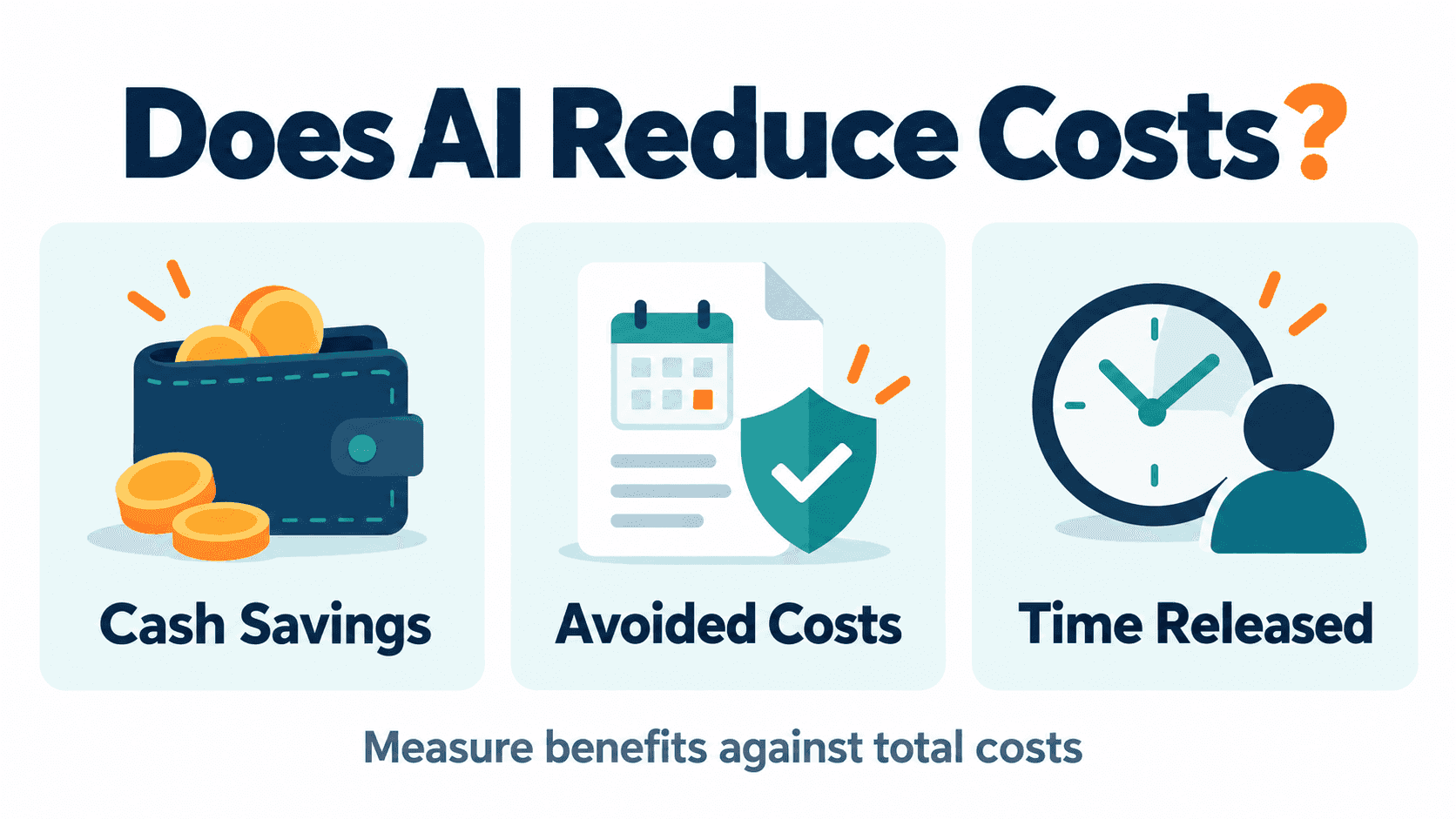
AI reduces operating costs when it lowers actual expenditure or avoids a justified future expense by more than it adds in implementation and running costs. Releasing employee time can also create value, but it is not automatically a cash saving. A credible business case separates these outcomes and tests them against a measured baseline.
Why can an AI cost-reduction case disappoint?
A business case becomes weak when the team chooses a tool before identifying the cost it intends to change.
A workflow may become faster while the financial benefit remains limited. Employees might spend less time drafting but more time reviewing, or the saved effort may be too small to offset implementation and support costs.
Start with a specific question: which expense, workload, or capacity constraint should change, and what evidence would demonstrate that change?
For Saudi enterprises working in Arabic and English, measure the actual language mix. Include representative documents and conversations in both languages where relevant, rather than assuming they require equal effort or produce equal results.
Where should you look for reducible operating costs?
Several activities provide useful starting points for investigation.
Repeated data entry: Employees may transfer the same information between forms, spreadsheets, email, and business systems. Measure the transfer effort and resulting corrections. A direct integration or simpler process may address the problem without AI.
Search and retrieval: Staff may spend time locating policies, product information, contract terms, or previous answers. Measure how long it takes to obtain verified, usable information, including help from colleagues.
Rework: Incorrect quantities, unsuitable matches, incomplete responses, and duplicated handling can consume additional effort. Record frequency, handling time, and consequences rather than assuming all errors have equal cost.
Exception handling: Missing information and unusual requests may require investigation or specialist decisions. Measure their effort separately from routine cases. Case counts alone can conceal how much work exceptions create.
These are candidate areas to assess, not a ranking of where every organization spends most.
What is the difference between savings and released capacity?
Separate three types of value before calculating a return.
| Type of value | What it means | Evidence needed |
|---|---|---|
| Actual cash savings | An existing expense decreases | Lower overtime, outsourcing, or other attributable expenditure |
| Avoided future costs | A justified future expense is no longer required | A documented demand and spending plan, with evidence that capacity now meets the need |
| Released capacity | Fewer employee hours are required for equivalent work | Measured effort before and after, including review and correction |
Multiplying released hours by a loaded hourly cost can estimate the value of capacity. It does not establish that payroll or total expenditure decreased.
Document how the organization uses that capacity. Reducing a backlog, serving more customers, or improving quality may be worthwhile even when the benefit is not a cash saving.
How do you establish the baseline?
Choose one workflow with a named owner and a clear definition of an acceptable completed output.
Record workload, complexity, human effort, errors, rework, and existing expenditure. Include preparation, checking, correction, escalation, and follow-up across everyone involved.
Measure both routine and exceptional cases. Include unfinished work so that the baseline does not overlook difficult cases still waiting in a queue.
Keep elapsed completion time separate from human effort. A shorter customer wait can be valuable without representing the same reduction in labour hours.
How do you calculate net benefit without double-counting?
Define the comparison period first. Then compare the existing process with the proposed process at an equivalent workload and quality level.
For a cash-focused assessment:
Net cash benefit over the period = attributable cash savings + supported avoided expenditure − additional cash costs
Additional costs may include implementation, integration, usage, licences, support, training, governance, and transition costs where relevant.
For an operational assessment, calculate:
Human hours released = total human effort before − total human effort after
If the “after” effort already includes review and correction, do not subtract them again. Likewise, do not count the same released hours as both capacity value and avoided staffing expenditure.
Track internal implementation effort even when it does not create a new invoice. Show it separately from cash flows if that distinction matters to the decision.
Use scenarios to expose uncertainty. Vary workload, adoption, review effort, exception handling, and operating costs. Explain which assumptions would make the project worthwhile and which would undermine it.
What costs are easily overlooked?
Initial costs can include source preparation, configuration, integration, testing, training, and staff participation.
Recurring costs can include model usage, hosting, storage, licences, monitoring, source maintenance, technical support, and human handling.
Changes to scope or permissions can create further work. Preparing a draft, writing to a live record, and sending a commercial commitment require different controls. Their costs should be estimated from the actual design.
Identify items already included in a supplier’s fee. Avoid counting support, integration, or control work twice under different headings.
What can a pilot establish about cost reduction?
A pilot tests the assumptions behind the business case.
It can measure handling effort, review time, output quality, exception performance, adoption, and resource consumption. These results can improve the estimate of future operating costs and benefits.
A short pilot may not establish full payback. It may also miss seasonal demand, infrequent failures, or longer-term maintenance requirements. State these limitations when presenting the result.
Agree on acceptance criteria before testing, including quality and control requirements as well as financial or operational targets.
The outcome may be to expand, adjust and retest, or stop. A technically successful system can still fail to justify its cost.
When might AI be a poor fit?
Low volume warrants scrutiny, but it is not an automatic rejection. A rare task may still consume substantial specialist effort or carry significant value.
Frequent exceptions also require investigation. An agent may assist with preparation even when the final decision remains human. Measure whether that assistance reduces total effort.
Changing policies and catalogues create maintenance requirements. Estimate who will update sources, test changes, and resolve failures.
Where sources conflict or lack ownership, improving data may be the appropriate first project. Also compare AI with rules, integration, process redesign, or continued manual handling.
If the proposal includes staffing changes, make those assumptions explicit. Released hours alone are insufficient evidence for a workforce decision.
How do you start with one measurable workflow?
Choose a task with identifiable effort, available data, and an accountable owner.
For sales quotations, SmartQuote provides a starting point for discussing RFQ interpretation and quotation drafts. Measure the complete effort through review and release.
For internal knowledge retrieval, OpsRAG can support a discussion about finding information with source references. Include verification time and answer quality.
For repetitive customer enquiries, WhatsApp CX can be evaluated within an agreed scope. Track resolution quality, escalation effort, and operating costs.
Define permissions, review responsibilities, data access, and retention before live use. Confirm deliverables, licences, ownership rights, and transition arrangements contractually.
If you have a workflow whose costs need investigation, talk to LeenAI about its baseline and constraints to define a pilot that tests whether measurable benefits justify the additional cost.
Frequently Asked Questions
How do I know if my workflow is a good candidate for cost reduction with AI?
Look for repetitive, high-volume work that involves reading documents or messages and deciding by clear rules, such as RFQs, repeated customer questions or invoice matching. If you already measure time and errors today, proving the saving will be much easier.
Does human review not cancel out the saving?
Not if it is designed well. Staff review a ready draft instead of starting from scratch and focus only on exceptions. As accuracy holds steady, the scope of review can be reduced gradually against agreed criteria.
What costs should I budget for beyond the AI model itself?
Budget for system integration and data preparation, hosting and monitoring, staff time for review and testing, training, and ongoing maintenance and rule updates. The model itself is often a small part of the total cost.


