Why does Arabic OCR break where English OCR works?
Arabic script presents challenges that most free OCR tools handle poorly: cursive letterforms that change shape depending on position, optional diacritics, and the common mixing of Arabic and Latin text in the same document. A scanned contract may contain Arabic clauses, English annexes, and numeric tables in both directions. Free tools often return garbled text, lose table structure, or merge columns, forcing staff to retype and re-check manually.
The real cost is not the OCR engine itself but the human cleanup that follows. When a procurement team receives a scanned supplier contract or a form filled by hand, the goal is rarely "get the text." It is to extract the contract number, the effective date, the payment terms, and the line items into a structured format that can be validated and entered into the ERP. Raw text does not get you there; structured extraction does.
This distinction matters for Saudi enterprises processing high volumes of Arabic documents: purchase orders, invoices, government forms, HR files, and contracts. If your team is copying fields from PDFs into a system today, that workflow is already costing time and introducing errors. That is the kind of workflow LeenAI starts with, because it already has a measurable baseline.
How is an AI extraction agent different from a free OCR tool?
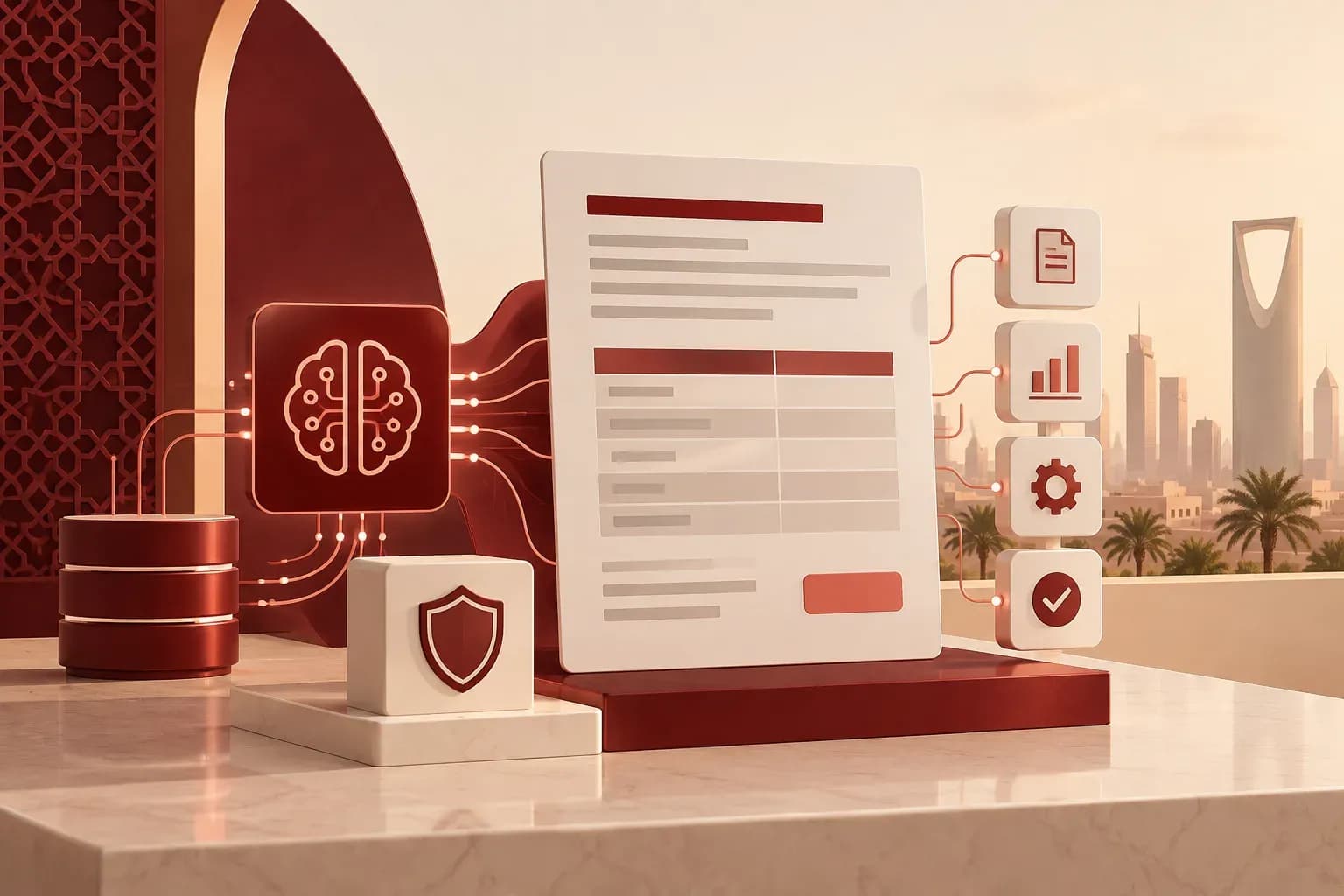
A free OCR tool is a converter: image in, text out. An AI extraction agent is a pipeline with a defined schema, confidence scoring, and a review path. You tell it which fields matter — supplier name, contract value, expiry date, VAT number — and it returns those fields with a confidence level for each one. Fields above the threshold proceed automatically; fields below it are flagged for a human to confirm.
This is the difference between automation and governed automation. The agent does not silently guess. It knows what it does not know, and it hands those cases to a person with the source snippet highlighted. That review step is not a weakness; it is what makes the system safe to connect to your ERP. Without it, a single misread digit in a contract value becomes a downstream error that takes longer to find than manual entry would have taken.
LeenAI's AI Document Processing and Company Knowledge Search (OpsRAG) is built around this pattern: extract structured fields, cite the source, flag low confidence, and require human approval before any write to a business system. The system starts read-only, with data minimization and auditability in place before broader permissions are considered. That sequencing is deliberate — it lets your team verify accuracy on real documents before anything is connected.
What does a governed extraction workflow look like end to end?
A typical governed workflow has five stages. First, ingestion: documents arrive by email, scanner, or upload, and are logged with a timestamp and source. Second, classification: the agent identifies the document type — invoice, contract, form, CV — so the correct extraction schema is applied. Third, extraction: fields are pulled in Arabic and English, with the source location retained for each value.
Fourth, validation: the agent checks internal consistency (does the line-item total match the stated total?) and confidence thresholds. Fifth, routing: high-confidence documents proceed to the ERP or records system; low-confidence ones go to a review queue where a named person approves, corrects, or rejects. Every action is logged. The audit trail shows who approved what, when, and on which source document.
This is what makes the output usable in a regulated or audited environment. If a finance team later questions a posted invoice, the trail shows the extracted fields, the confidence score, and the reviewer's approval. Free OCR tools leave no such trail. For enterprises preparing for PDPL obligations, that documented review path is not optional — it is how you demonstrate that personal data in documents was handled with minimization and control.
Where should humans stay in the loop?
Humans should stay in the loop wherever an error would be expensive to reverse or hard to detect. Contract values, payment terms, personal identifiers, and anything that triggers a financial posting belong behind an approval step. The agent's job is to make that review fast — pre-filling fields, highlighting the source, and surfacing only the uncertain items — not to remove the reviewer entirely.
A practical rule: automate the extraction, govern the commitment. The agent can read a thousand documents and prepare structured records; a person still signs off on the ones that create obligations. This is consistent with how LeenAI frames all of its agents: they handle repetitive operational work while people retain decision control. The same principle applies whether the agent is reading RFQs in SmartQuote, LeenAI's AI Quotation System, or screening CVs.
Reviewers also need a way to improve the system over time. When a reviewer corrects a field, that correction should be captured so the extraction rules and confidence thresholds can be tuned. Without that feedback loop, the same errors repeat. With it, the review queue shrinks as the system learns your document patterns — Arabic handwriting, specific supplier formats, recurring form layouts.
How do you connect extracted data to ERP without creating risk?
Connection to ERP is where most document-automation projects fail, because teams try to write directly to production too early. The safer path is staged. Start with read-only extraction and export to a staging table or spreadsheet, and compare against what your team would have entered manually. Measure field-level accuracy on a real sample before any write access is granted.
Once accuracy is demonstrated, introduce a controlled write path with human approval as the gate. When staff later need to search the documents you have extracted, OpsRAG, LeenAI's knowledge-search agent, answers with citations from the approved set. The agent prepares the record; the reviewer approves; the system posts. Role-based access control determines who can approve what, and retention rules define how long extracted data and source documents are kept. These are documented before code is written, not after.
LeenAI scopes the deployment environment, data handling, review paths, and permission boundaries before any execution decision is made. For a document-processing pilot, that means agreeing on the document types, the target fields, the confidence thresholds, and the acceptance criteria up front. The pilot produces an acceptance pack with KPIs, UAT notes, and operating guidance — the proof a serious buyer should see before scaling. If you want to see how a scoped pilot is structured, see how we scope pilots or talk to us about your document workflow. Within 24 hours we reply with scope, timeline, and SAR cost.
What should you demand before trusting Arabic extraction at scale?
Demand a measured baseline. Before the pilot, count how many documents your team processes per week and how long each takes. After the pilot, compare extraction accuracy, review time per document, and the percentage of documents that pass without correction. These are the numbers that justify scaling — not a demo on five clean samples.
Demand transparency on failure modes. Ask what happens when a document is rotated, handwritten, or bilingual in an unusual layout. A credible vendor will show you the review queue and explain how low-confidence cases are handled, not just the happy path. Ask whether the system cites the source location for each extracted field, so a reviewer can verify in seconds rather than re-reading the whole document.
Demand data governance in writing. Where does the data reside? Who can access it? How long is it retained? Is personal data minimized or masked before processing? LeenAI advises business users to avoid entering sensitive personal or confidential data into AI prompts, and applies the same discipline to document pipelines: read-only first, minimization by default, audit logs on. The customer owns the system and all artifacts. If you are evaluating Arabic OCR for contracts, forms, or PDFs, start with one document type and one workflow — then let the evidence decide whether to expand. Start here to define that first workflow.
Frequently Asked Questions
How can I extract text from images in Arabic?
For occasional use, OCR tools can convert an image or PDF into text, but Arabic results often lose letter connections, numbers and table structure. For business documents, an AI extraction system reads Arabic and English together, keeps the layout, and returns the specific fields you need.
What is the difference between free OCR tools and AI data extraction?
Free OCR turns an image into raw text that someone still has to read, clean and retype. AI data extraction understands the document type, pulls structured fields such as names, dates, amounts and line items, scores its confidence, and sends low-confidence fields to a person for review.
Can extracted data go straight into our ERP?
Yes, once accuracy has been proven on a real sample of your documents. Start read-only, measure field-level accuracy, then add a controlled write path to your ERP or other systems with human approval as the gate.