
What is agentic AI, and how is it different from a chatbot?
Agentic AI refers to software agents that can take a goal, plan a sequence of steps, use tools and data sources, and produce a work product — a draft quote, a shortlist, a customer reply — under defined guardrails. Unlike a chatbot that answers questions in a single turn, an agent operates over a workflow: it reads inputs, retrieves context, applies rules, and prepares an output for a human to approve. The distinction matters for UAE and GCC enterprises because the value is not in conversation but in completing a decision cycle with an audit trail.
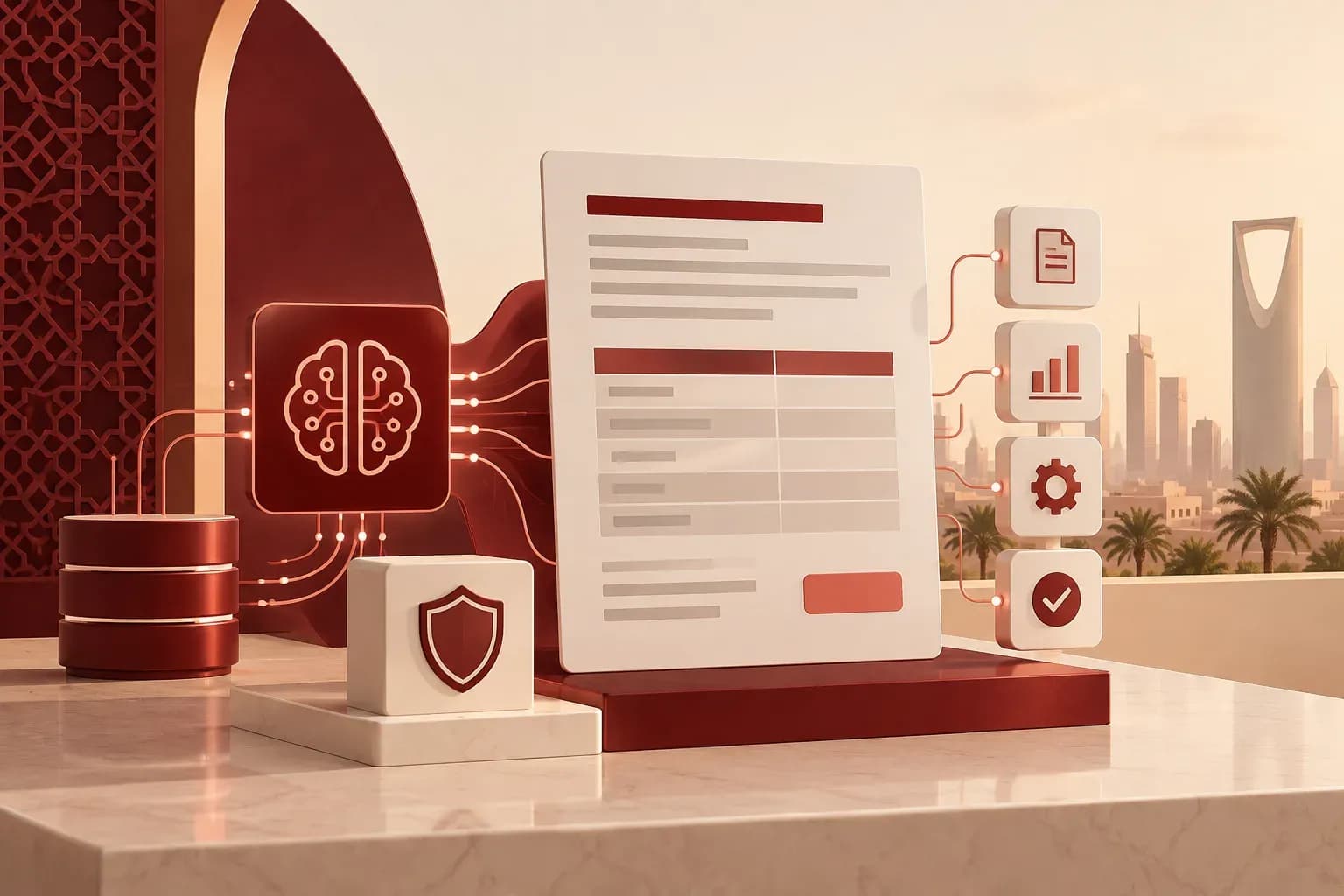
A useful way to frame it for your board: an AI agent is a digital teammate with a narrow job description, a defined set of tools, and a supervisor. It does not have unlimited autonomy. It has bounded authority. In practice, that means read-only access to source systems first, explicit approval gates before any action that changes a record or sends an external message, and logs that show what the agent read, what it inferred, and who approved the result.
This is why the implementation question is not "which model do we buy?" but "which decision do we want to make faster, more consistently, or with fewer errors?" The technology is increasingly accessible; the operating discipline is what separates a governed system from an expensive experiment.
How is agentic AI implemented in a UAE enterprise?
Implementation follows a sequence that is deliberately narrow at the start. The first step is to name one decision — not a department, not a platform. Examples include: turning an incoming RFQ into a priced quote draft, screening a batch of CVs against a job description, or answering a customer's WhatsApp question from an approved knowledge base. The decision must have a current owner, a current cost in time or risk, and a measurable baseline.
The second step is to define the data and knowledge the agent needs, and to grant read-only access to the minimum set. This is where data minimization becomes practical: if the agent does not need a field to produce the draft, it does not get the field. Role-based access control, retention rules, and audit logging are documented before any code is written. In the UAE, this aligns with federal data-protection requirements and with your own information-security policies.
The third step is to build the agent in a sandbox — a contained environment where it can run against real or realistic data, produce outputs, and log every step. Sandbox results are reviewed by the business owner, not just by IT. The fourth step is user acceptance testing (UAT) with defined acceptance criteria: does the agent produce the draft within the agreed quality threshold, does it escalate correctly, and does the human reviewer have everything needed to approve or reject?
The fifth step is handover: documentation, runbooks, access reviews, and a clear statement of what the system does and does not do. The sixth step is scale-up, which only happens after UAT is signed off. LeenAI presents 6-8 weeks to first system as an operating-model timeline, not a promise of full transformation. The output is a working decision system your team owns, with a practical path to the next phase.
What does a 6-8 week implementation actually deliver?
A first system in this timeframe typically delivers one workflow-specific agent, a governed data-access layer, an approval interface for human reviewers, and a set of logs and reports that show how the agent performed against the baseline. It also delivers the artifacts that matter for scale: the decision definition, the acceptance criteria, the escalation rules, and the handover documentation. This is the difference between a pilot that ends in a slide deck and one that ends in an owned system.
It is important to be precise about what is not delivered in 6-8 weeks. It is not a company-wide rollout, not a replacement of your ERP or CRM, and not an autonomous agent that acts without human review. Those are later phases, and they should be justified by the results of the first system. The first system is designed to answer a specific question: can this decision be improved with a governed agent, and does the improvement justify the next phase?
For enterprises evaluating agentic AI across the GCC, this staged approach reduces risk. You are not betting the operating model on a single large program. You are buying evidence: a working system, a measured baseline comparison, and a clear go/no-go gate for scale-up. LeenAI's AI Pilot Project is structured around exactly this logic, with UAT required before scale-up.
How do you govern agents without slowing the business down?
Governance is often framed as a brake. In practice, it is the accelerator for adoption, because it gives business owners the confidence to let agents touch real workflows. The core controls are straightforward: read-only-first access, human-in-the-loop approval for any external action, role-based access control, audit logs, retention rules, and a documented escalation path. These are not afterthoughts; they are scoped from day one.
A second governance principle is separation of duties. The person who defines the acceptance criteria should not be the only person who signs off on UAT. The agent's outputs should be reviewable by the business owner and auditable by risk or compliance. Where personal data is involved — CVs, customer messages, employee records — the agent should process the minimum necessary and retain outputs only as long as the policy allows.
A third principle is transparency to the end user. If an agent is responding to a customer on WhatsApp, it should identify itself as AI and offer a path to a human. If it is drafting a quote, the human who approves it should see the reasoning and the source data. This is not just good practice; it is how you build trust with customers and regulators in the UAE and across the GCC. LeenAI's approach to governed pilots is built on these controls.
What are the most common implementation mistakes in the GCC?
The most common mistake is starting with the tool instead of the decision. Teams spend months evaluating platforms, then discover that no one has defined what "better" means for the workflow they want to improve. The second mistake is granting broad data access "to be safe," which increases risk and makes security review harder. The third is skipping UAT or defining acceptance criteria after the build, which turns the pilot into an open-ended science project.
A fourth mistake is treating the pilot as an IT project rather than an operating-model change. The business owner must be involved from scoping through handover, because they are the ones who will approve the agent's outputs in production. A fifth mistake is failing to plan for scale-up from the beginning: if the first system cannot be extended to a second workflow without a rebuild, the economics weaken quickly.
Finally, many organizations underestimate the change management required. Reviewers need to understand what the agent does, where it is reliable, and when to override it. Training is not a one-hour session; it is part of the handover. LeenAI frames its work around operating decisions rather than disconnected AI demos, which is why the first conversation is about the decision, not the model.
How LeenAI supports UAE and GCC enterprises
LeenAI builds enterprise decision systems with bilingual delivery, clear governance, and measurable execution. When a decision is clear, LeenAI turns it into a scoped implementation plan. That plan includes scope, KPIs, timeline, access requirements, and an estimated SAR range — delivered within 24 hours of a clear brief. The customer owns the system and all artifacts.
For workflows close to revenue or risk, LeenAI's agents are designed to act with guardrails. SmartQuote, LeenAI's AI Quotation System, reads RFQs and produces a quote draft for human approval. OpsRAG, LeenAI's AI Document Processing and Company Knowledge Search, answers employee questions with citations from approved documents. WhatsApp CX, LeenAI's AI Customer Service for WhatsApp Business, answers from an approved knowledge base and escalates to a human with context. Each is a governed agent, not an autonomous actor.
If you are evaluating agentic AI for a UAE or GCC enterprise, the fastest way to move is to bring one workflow. Talk to us with the decision you want to improve, and we will reply within 24 hours with a scoped plan. You can also see how we scope pilots or start with a diagnostic. Arabic or English, whichever you prefer.
Frequently Asked Questions
How is agentic AI implemented in an enterprise?
Start by choosing one named decision with a clear owner and baseline. Give the agent read-only access to the approved data, set up the knowledge and data layer, run the agent in a sandbox with full logs, test it with real users, then hand over with training and a plan for controlled expansion.
How is AI being used by businesses in the UAE?
UAE businesses are applying AI to customer service in Arabic and English, document processing, knowledge search for employees, sales and quotation workflows, and operations reporting. The strongest results come from focused use cases with governance and human approval built in.
Do we need to replace our ERP or CRM to use agentic AI?
No. Agentic AI usually connects to your existing ERP, CRM, email and messaging systems, starting with read-only access. Write actions are added later, behind human approval, once the agent has proven accurate on your own data.