
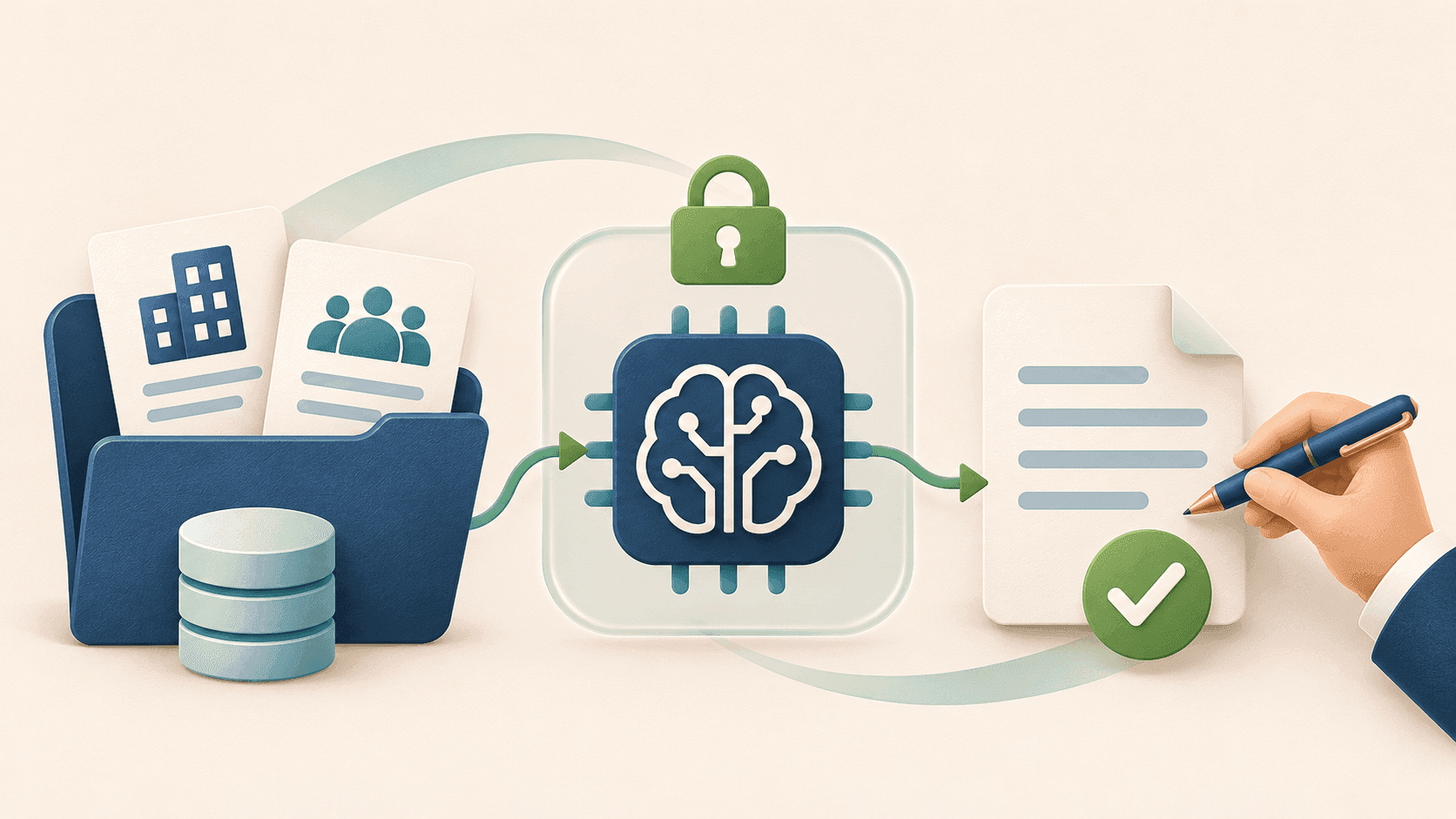
How Agentic AI Solutions Work Inside an Enterprise: Sources, Tools, Steps, and Permission Boundaries What is an agentic AI solution? An agentic AI solution connects a model to information sources and tools so it can select steps within a defined task. It may interpret a request, retrieve relevant information, prepare a document, or invoke an approved action.
Its scope can be narrow. A quotation assistant might prepare a draft without permission to send it. A knowledge assistant might retrieve policy information without changing the underlying documents.
For enterprise buyers, three questions establish the operating boundaries: what can the system access, what can it do, and who can approve or stop it?
Those answers should describe enforceable controls and responsibilities, alongside the intended behaviour. How does it differ from a chatbot or conventional automation? A chatbot is a conversational interface. Depending on the connected system, it may answer questions, retrieve information, or invoke tools.
Conventional automation follows programmed rules and paths. It can include branching, validation, retries, and exception handling.
An agent uses a model to select steps or tools within permitted boundaries. That can help with variable language and document formats, while introducing uncertainty that needs testing and control. Aspect Chatbot interface Conventional automation AI agent Main role Interact through conversation Execute programmed steps Select steps or tools for a task Input handling Depends on the connected system Uses supported rules and formats Can interpret varied language and documents Actions Possible when tools are connected Follow programmed paths Depend on available tools and permissions Review Based on consequence Based on process risk Based on output and action risk
A practical solution may combine all three. A chat interface receives the request, a model extracts requirements, programmed checks validate calculations, and an employee approves the commercial decision.
A wrong answer can be consequential even when the system takes no external action. Risk depends on the information, intended use, and permissions. How does the system connect to sources? Sources may include approved documents, product catalogues, pricing tables, CRM records, and ticketing systems. Connections can use APIs, controlled exports, connectors, or authorised document repositories.
For each source, establish its owner, update process, access rules, and treatment of obsolete versions. The system should not quietly treat an outdated policy as current.
Check both the system’s service permissions and the requesting user’s access. Broad backend access must not allow an assistant to reveal content that the user is not authorised to see.
Read-only access limits modification of source systems. It does not prevent disclosure through answers, previews, exports, logs, or external processing.
Where answers include citations, test whether the cited material supports the answer and is appropriate for that user. A citation provides a verification route; it does not guarantee correctness. How do tools turn a proposal into an action? Tools expose specific capabilities: looking up a record, preparing a document, creating a task, or sending a message.
Each capability needs defined limits. Permission to draft a quotation should not automatically include permission to send it, change pricing, or commit to delivery dates.
Before execution, the surrounding application should check identity, parameters, destination, business limits, and any required approval. These checks need enforcement outside the model’s instructions.
For example, an approved messaging tool could restrict recipients, channels, and message types. A record-update tool could restrict which fields and accounts it can change.
Documents and incoming messages should be treated as task data. Instructions embedded within them must not grant additional permissions or override operating rules. What happens during a workflow? A quotation workflow illustrates the sequence:
- Intake: Receive the customer request and identify missing or unsupported information.
- Retrieval: Obtain relevant catalogue entries and approved pricing information.
- Preparation: Extract requirements and propose matching items.
- Validation: Check required fields, calculations, and business rules.
- Review: Present the draft and relevant evidence to an authorised reviewer.
- Execution or handover: Carry out only the action permitted by the agreed workflow. SmartQuote from LeenAI relates to preparing quotation drafts from incoming RFQs for human review. The proposed implementation should specify which matching, pricing, review, and sending capabilities are included.
Other workflows need different boundaries. When evaluating WhatsApp CX, define approved response topics, customer commitments, and escalation arrangements. For OpsRAG, assess answer quality, source support, freshness, and access isolation.
The reviewer should receive the information needed to check the result. This can include source references, assumptions, exceptions, and validation results; it should not be described as access to the model’s complete internal reasoning. What makes an approval enforceable? Define approval by action and consequence. An internal summary, customer message, and financial commitment may require different rules.
The reviewer should see the proposed content, intended action, recipient, and relevant evidence. Approval should apply to that version and have a defined validity period.
Material changes—such as a different price, recipient, or commitment—should trigger renewed review. Silence should not become approval.
Also specify what happens when approval is rejected, expires, or cannot be obtained. Where autonomous execution is permitted, document its limits, monitoring, and suspension mechanism.
Permission categories are operating choices. A system does not need to progress automatically from reading to writing. What happens when a tool fails? A timeout does not establish that an action failed. The receiving system may have completed it before confirmation was lost.
Retrying without checking can duplicate a message, task, or transaction. Use request identifiers, status tracking, duplicate prevention, or controlled reconciliation where appropriate.
Distinguish attempted actions from confirmed outcomes. Define retry limits, waiting periods, and the point at which uncertain execution requires human intervention.
Shutdown behaviour also needs testing. Stopping new requests may leave queued work or actions already running in connected systems. Operators need to know what stops, what continues, and how pending work is resolved. How should performance and control be tested? Start with representative, authorised examples and reviewed reference outcomes. Add constructed cases for rare failures and adversarial inputs.
Run security and failure tests within an agreed scope in an isolated environment. Include restricted-document requests, misleading instructions inside files, invalid tool parameters, revoked permissions, expired approvals, duplicate requests, and shutdown.
Measure performance in workflow terms: Measure What it helps establish Output quality Whether results meet the agreed standard Critical errors Whether consequential mistakes remain Review and correction time How much human effort is required Escalation quality Whether the right cases reach a person with useful context Latency Whether results arrive within the operational requirement Cost per accepted result Whether usable outputs justify their operating cost Permission enforcement Whether access and action boundaries hold
Do not rely solely on confidence scores to route errors. The system may be confidently wrong.
Record test dates, versions, methods, findings, and remediation owners. A successful test supports the assessed configuration and scope; it does not establish permanent reliability. What evidence should support deployment? Define audit events that allow an authorised reviewer to reconstruct a case: request identifiers, source references, configuration versions, tool calls, approvals, overrides, and confirmed outcomes.
Protect records against unauthorised access and alteration, minimise sensitive content, and define retention and logging-failure behaviour.
The release decision should combine performance results, tested controls, known limitations, operating instructions, and named owners. Outcomes may include limited deployment, remediation and retesting, further evidence gathering, or stopping.
Agree handover and exit terms separately, including documentation, access, export, deletion, deliverable rights, and third-party dependencies.
To assess one workflow, explore LeenAI’s pilot scoping or contact LeenAI. Bring the systems involved, expected inputs, permitted actions, review responsibilities, and the outcome you want to measure.


