Why Saudi decision makers need a governed approach to AI
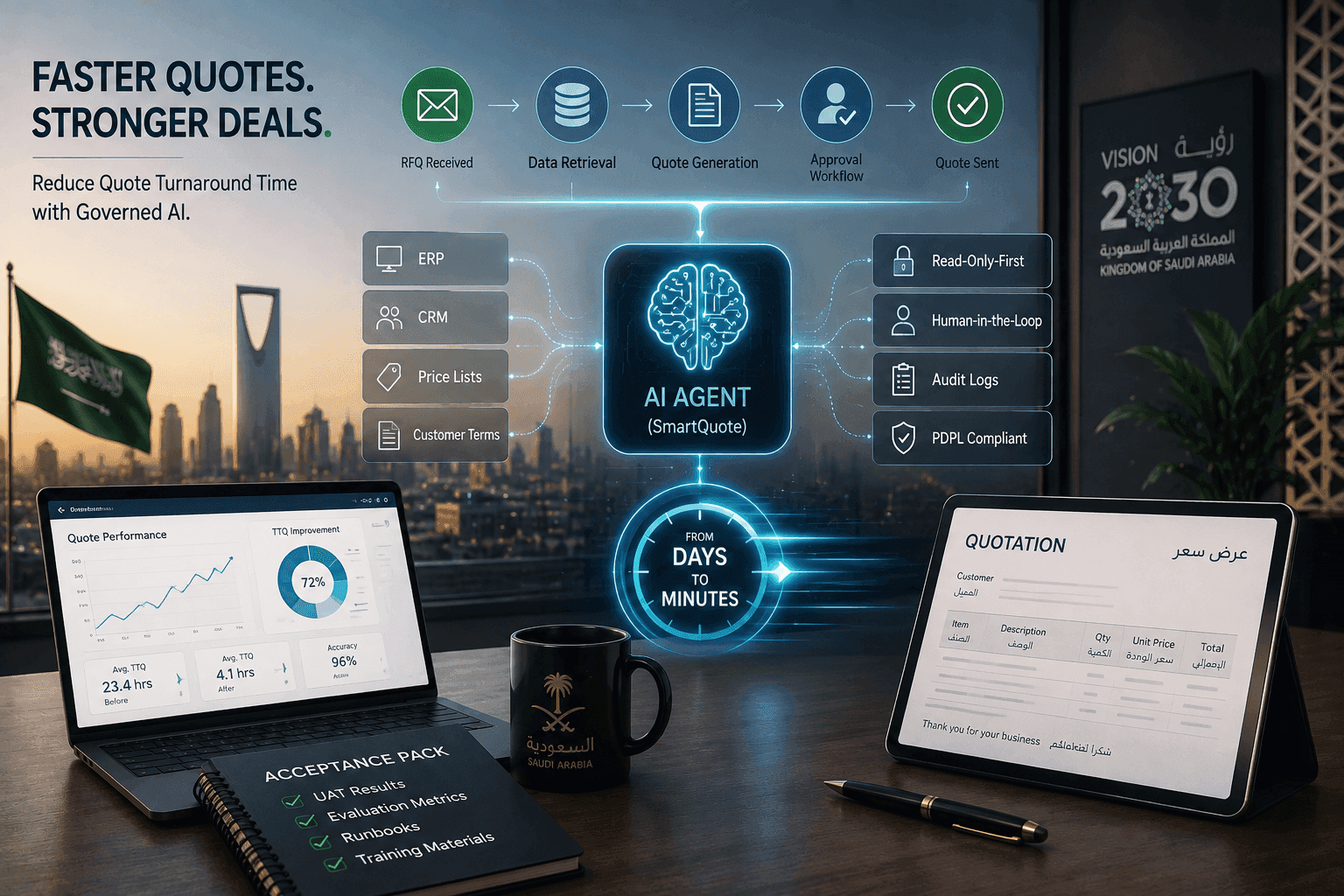
Saudi Arabia’s Vision 2030 sets an ambitious agenda for economic diversification, and AI is central to that transformation. But for a CIO, COO, or procurement leader, the question isn’t whether to adopt AI—it’s how to adopt it responsibly. A governed AI approach means deploying AI agents that act within clear boundaries: read-only-first access to data, human-in-the-loop for critical decisions, and complete audit trails. This is not about slowing down innovation; it’s about making it safe and sustainable.
Without governance, AI projects often stall—not because the technology fails, but because stakeholders don’t trust it. Data privacy concerns, regulatory uncertainty, and fear of unintended consequences can halt a pilot before it proves its value. A governed approach addresses these concerns head-on, aligning with Saudi Arabia’s Personal Data Protection Law (PDPL) and the National Data Governance framework.
What does 'governed AI' actually mean for your organization?
Governed AI is not a product; it’s a set of principles and practices that ensure AI systems are transparent, accountable, and aligned with business objectives. For Saudi enterprises, this means three things: first, AI agents should be read-only-first—they can access and analyze data but cannot modify or delete it without explicit human approval. Second, human-in-the-loop (HITL) is non-negotiable for high-stakes decisions, such as approving a large procurement order or responding to a customer complaint. Third, every action must be logged for audit, so you can trace exactly what the AI did and why.
These principles are not just theoretical. For example, consider an AI agent that automates RFQ-to-quote processes. Without governance, it might send a quote with an incorrect discount, damaging a client relationship. With read-only access and HITL, the agent prepares the quote but a human reviews and approves it before it goes out. This ensures accuracy and accountability.
How does PDPL compliance shape AI adoption in Saudi Arabia?
The Saudi Personal Data Protection Law (PDPL) imposes strict requirements on how personal data is collected, processed, and stored. For AI systems, this means you must ensure data minimization (only collect what you need), purpose limitation (use data only for stated purposes), and data residency (keep data within Saudi Arabia). A governed AI approach builds these requirements into the design, not as an afterthought.
For example, an AI agent that handles customer service on WhatsApp must be PDPL-aware: it should only access the data necessary to resolve the query, and it must log every access. This is not just about compliance; it’s about building customer trust. In a market where data privacy is increasingly valued, a PDPL-compliant AI is a competitive advantage.
What does a 6-week pilot deliver for Saudi enterprises?
A common concern among decision makers is that AI projects take too long and cost too much. That’s why LeenAI’s approach is built around fixed-scope pilots that deliver results in 6-8 weeks. These pilots are not proof-of-concepts that end in a slide deck; they are working AI agents that hit agreed KPIs. For example, a procurement team might target a 30% reduction in quote turnaround time (TTQ), or a customer service team might aim for a 20% improvement in first-contact resolution (FCR).
Each pilot comes with an Acceptance Pack, which includes user acceptance testing (UAT), evaluation metrics, runbooks, and training. This ensures that your team knows exactly how to use the agent and how to measure its success. The goal is to move from pilot to production with confidence, not to create a science project.
How to evaluate AI agents: moving beyond the hype
When evaluating AI vendors, focus on evidence, not promises. Ask for case studies, but more importantly, ask for a pilot that you can run in your own environment. Look for vendors that offer transparent evaluation criteria—such as accuracy, latency, and user satisfaction—and that are willing to define success metrics upfront. Avoid vendors that cannot explain how their AI handles data privacy or how it integrates with your existing systems.
A useful framework is to evaluate AI agents on three dimensions: capability (can it do the job?), governance (does it comply with your policies and regulations?), and ROI (does it deliver measurable value?). For example, LeenAI’s SmartQuote is designed to automate RFQ-to-quote workflows, but it also includes guardrails that prevent unauthorized changes and logs every action for audit. This is the kind of evidence you should look for.
Why Arabic-first AI is a strategic advantage for Saudi Arabia
Most AI models are trained primarily on English data, which can lead to poor performance on Arabic text, especially in dialectal or domain-specific contexts. For Saudi enterprises, this is a critical gap. A governed AI that is bilingual—Arabic and English—from day one can handle customer queries, documents, and workflows in the language your team actually uses. This is not just a nice-to-have; it’s a strategic advantage in a market where Arabic is the language of business.
For example, LeenAI’s OpsRAG is built with Arabic RAG (retrieval-augmented generation) capabilities, allowing it to pull accurate answers from Arabic documents and respond in Arabic. This ensures that your AI agents are not just technically capable but culturally and linguistically relevant.
How to start your governed AI journey today
Starting a governed AI journey does not require a massive transformation. Begin with a small, high-impact use case that can demonstrate value quickly. Define clear KPIs, such as TTQ, FCR, or average handling time (AHT), and agree on acceptance criteria with your vendor. Ensure that your team is trained on the new system and that you have a clear plan for scaling.
At LeenAI, we believe in proof before claims. That’s why every pilot includes an Acceptance Pack and is designed to deliver measurable results in weeks, not years. If you are ready to see how a governed AI agent can work for your organization, talk to us or see how we scope pilots. You can also explore our specific solutions like LeenAI's SmartQuote or WhatsApp CX to see how they fit your needs.