What is an AI Proof of Concept?
An AI proof of concept (PoC) is a strategic initiative undertaken by enterprises to validate the feasibility and potential impact of AI solutions before full-scale implementation. In the context of Saudi enterprises, this involves aligning the PoC with Vision 2030 goals, ensuring compliance with local regulations like the PDPL, and addressing specific business challenges. A well-executed PoC allows decision-makers to assess the practical benefits of AI, such as improved efficiency and customer experience, without committing to significant resources upfront.
Why is Governance Critical in AI PoCs?
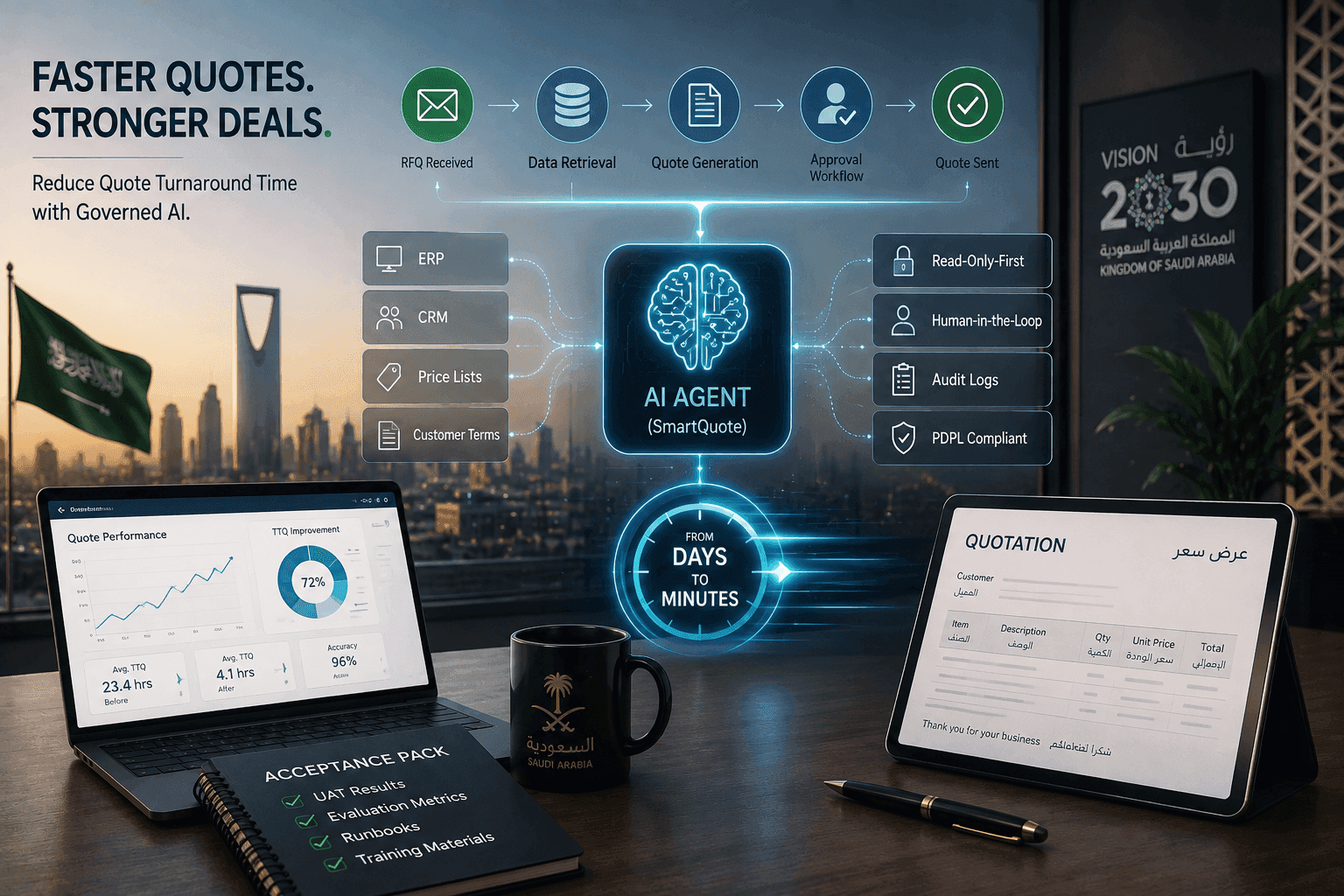
Governance is a cornerstone of any successful AI PoC, especially in Saudi Arabia where data protection laws are stringent. Incorporating governance from the outset ensures that AI systems are not only effective but also compliant with the PDPL. This involves setting up audit trails and ensuring data residency and minimization. By adopting a 'read-only-first' approach and keeping humans in the loop, enterprises can maintain control over AI decisions, thus mitigating risks associated with autonomous operations.
How to Align AI PoCs with Business Objectives?
Aligning an AI PoC with business objectives is vital for demonstrating its value. Enterprises should start by clearly defining the specific problems they aim to solve and the metrics they will use to measure success. This could involve improving time-to-quote (TTQ) or first-call resolution (FCR) rates in customer service. Selecting the right AI agents, such as SmartQuote or WhatsApp CX, that can address these objectives is crucial. Establishing clear KPIs and involving stakeholders early in the process ensures that the PoC has a direct impact on strategic goals.
What Does a 6-Week AI Pilot Deliver?
A typical 6-week AI pilot delivers a comprehensive evaluation of the AI solution's effectiveness and alignment with enterprise goals. During this period, the focus is on testing the AI agent in a controlled environment, gathering data on performance metrics, and making necessary adjustments. The inclusion of an Acceptance Pack, comprising UAT, evals, runbooks, and training, facilitates a smooth transition from pilot to full-scale deployment. This structured approach ensures that decision-makers have the evidence needed to justify further investment.
How to Ensure PDPL Compliance in AI PoCs?
Ensuring PDPL compliance is non-negotiable for AI PoCs in Saudi Arabia. This involves designing AI systems with built-in audit logs, data residency, and minimization practices. Enterprises should prioritize a 'read-only-first' approach to data handling, ensuring that sensitive information is not altered by AI agents. Keeping humans in the loop further strengthens compliance efforts, providing an additional layer of oversight and accountability.
Conclusion: The Strategic Advantage of AI PoCs
Successfully implementing an AI PoC provides enterprises with a strategic advantage, offering a proof-before-claims approach that minimizes risk and maximizes potential ROI. By focusing on governance, alignment with business objectives, and compliance, enterprises can confidently explore AI solutions that are not only innovative but also safe and effective.