What Are Governed AI Agents and Why Do Saudi Enterprises Need Them?
Governed AI agents are not just chatbots or standalone models. They are AI systems that act—processing documents, answering customers, generating quotes—but within a strict governance framework. For Saudi enterprises, this means three non-negotiables: read-only-first access, human-in-the-loop approvals, and full audit trails. These guardrails ensure that AI can take meaningful action without compromising compliance or control.
Saudi Arabia's Vision 2030 pushes for digital transformation, but decision-makers face a tension: how to adopt AI quickly while meeting PDPL requirements and internal risk policies. Governed AI agents resolve this by being compliant by design. They operate on your data, in your environment, with permissions that start read-only and escalate only with human approval. This approach lets you test AI's value without exposing your organization to unnecessary risk.
How Do Governed AI Agents Differ from Traditional Automation?
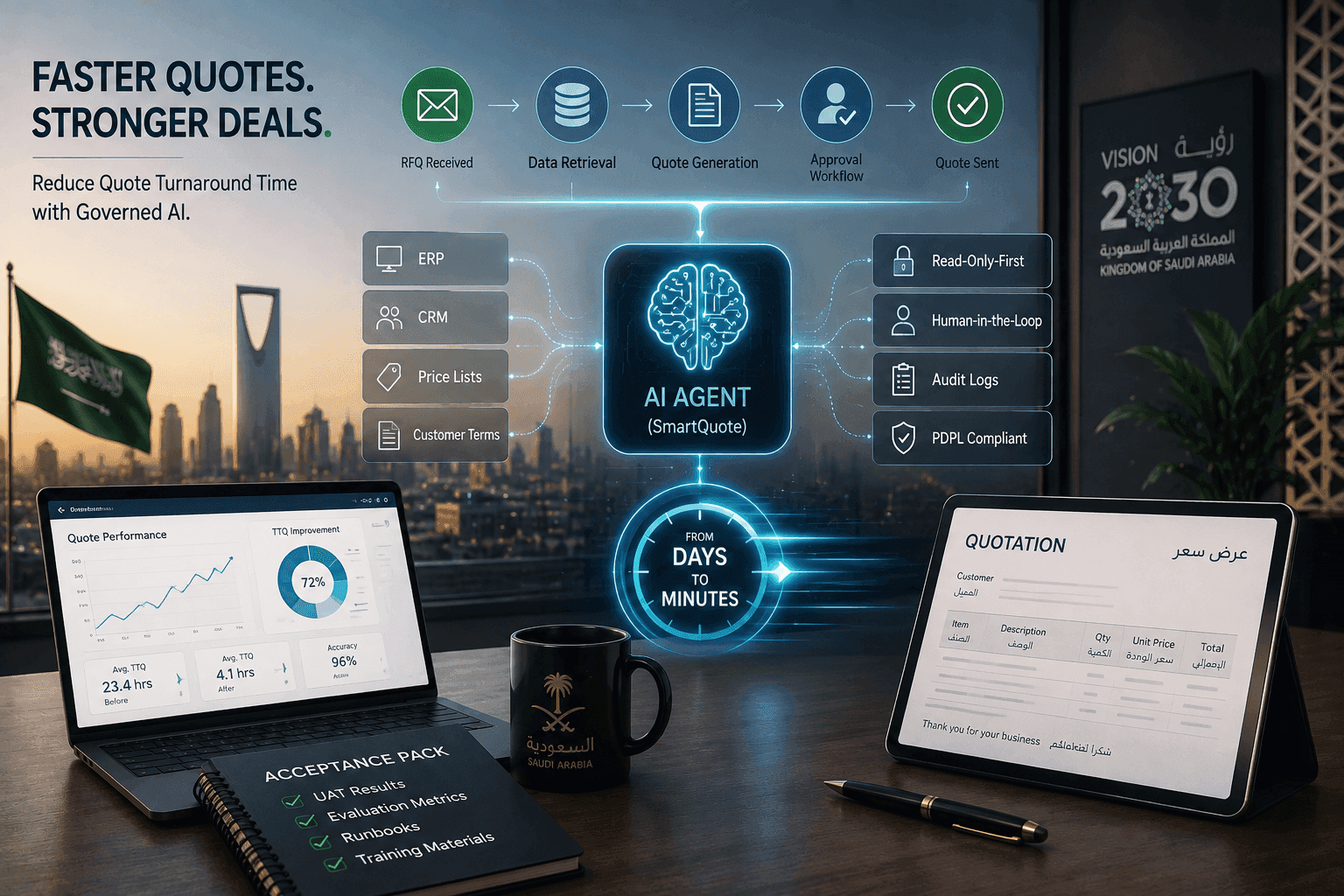
Traditional automation follows fixed rules—if this, then that. AI agents, however, can handle ambiguity, learn from feedback, and make decisions based on context. But with that power comes risk. A governed AI agent is designed to act within boundaries. For example, an agent that automates RFQ-to-quote can read incoming requests, extract key details, and draft a quote—but it cannot send it without a human reviewing it first. This human-in-the-loop model is essential for high-stakes processes.
Another key difference is auditability. Every action an agent takes is logged: what it read, what it decided, and why. This is not just for compliance—it's for continuous improvement. You can see where the agent excels and where it needs more training. This transparency builds trust with stakeholders, from procurement teams to board members.
What Does a Governed AI Agent Pilot Look Like in 6–8 Weeks?
A typical pilot with LeenAI starts with a fixed scope and clear KPIs. For example, a procurement leader might want to reduce quote turnaround time (TTQ) by 30%. The pilot focuses on one process—say, RFQ-to-quote for a specific product line. In weeks one and two, we map the workflow, identify data sources, and configure the agent with read-only access. By week three, the agent is processing live requests in a sandbox, with human oversight.
Weeks four to six are about evaluation and refinement. We measure performance against your KPIs, using your data. The agent's accuracy, speed, and error rates are tracked. You see exactly what it would have done, but nothing is finalized without approval. By week eight, you have a clear go/no-go decision based on evidence, not promises. This is what we call the Acceptance Pack: UAT, evaluation results, runbooks, and training for your team.
How Does LeenAI Ensure PDPL Compliance in AI Agents?
PDPL compliance is built into the architecture of LeenAI's agents. First, data residency: your data stays in Saudi Arabia, on your infrastructure or a local cloud. Second, data minimization: the agent only accesses the data it needs for the task, and nothing more. Third, read-only-first: the agent starts with read permissions, and any write action requires human approval. This is not an afterthought—it's the default.
Audit logs are comprehensive. Every query, every decision, every approval is recorded. This gives you a complete trail for compliance audits and internal reviews. For Arabic content, LeenAI's agents are bilingual from day one, with Arabic RAG capabilities that understand context and nuance. This is a significant edge in a market where Arabic data is often underserved.
What Are the Key KPIs to Measure for Governed AI Agents?
KPIs should align with your business goals. For procurement, that's quote turnaround time (TTQ), accuracy of quotes, and cost per quote. For customer service, it's first contact resolution (FCR), average handling time (AHT), and customer satisfaction (CSAT). For operations, it's document processing time and error rates. The key is to measure before and after, using the same metrics, to see the true impact.
But don't just look at efficiency. Look at quality and risk. How many errors did the agent make? How many required human intervention? What was the cost of those interventions? A governed AI agent should reduce risk, not add to it. By tracking these metrics, you can make data-driven decisions about scaling the agent to other processes.
How to Choose the Right Governed AI Agent for Your Enterprise?
Start with a high-impact, low-risk process. The goal is to demonstrate value quickly while building trust. Look for a vendor that offers a fixed-scope pilot with clear KPIs and an acceptance pack. Avoid vendors that promise everything but deliver little. Ask about their governance framework: read-only-first, human-in-the-loop, audit logs. These are not optional—they're essential.
LeenAI offers four governed AI agents tailored to Saudi enterprises: SmartQuote for RFQ-to-quote automation, WhatsApp CX for customer service, OpsRAG for knowledge operations, and MAE for management assistance. Each is designed with the same governance principles. If you're ready to see how a governed AI agent can work for you, talk to us or see how we scope pilots.
What Are the Next Steps for Saudi Decision-Makers?
The time to act is now. Vision 2030 demands digital transformation, but it must be done responsibly. Governed AI agents offer a path to AI that acts, with guardrails. Start small, measure rigorously, and scale with confidence. The technology is ready; the question is whether you're ready to lead.
At LeenAI, we believe in proof before claims. That's why every pilot includes an Acceptance Pack with UAT, evals, runbooks, and training. You'll know exactly what you're getting, and you'll have the evidence to decide. Explore LeenAI's OpsRAG for knowledge operations, or SmartQuote for procurement. The future of enterprise AI in Saudi Arabia is governed, and it's here.