
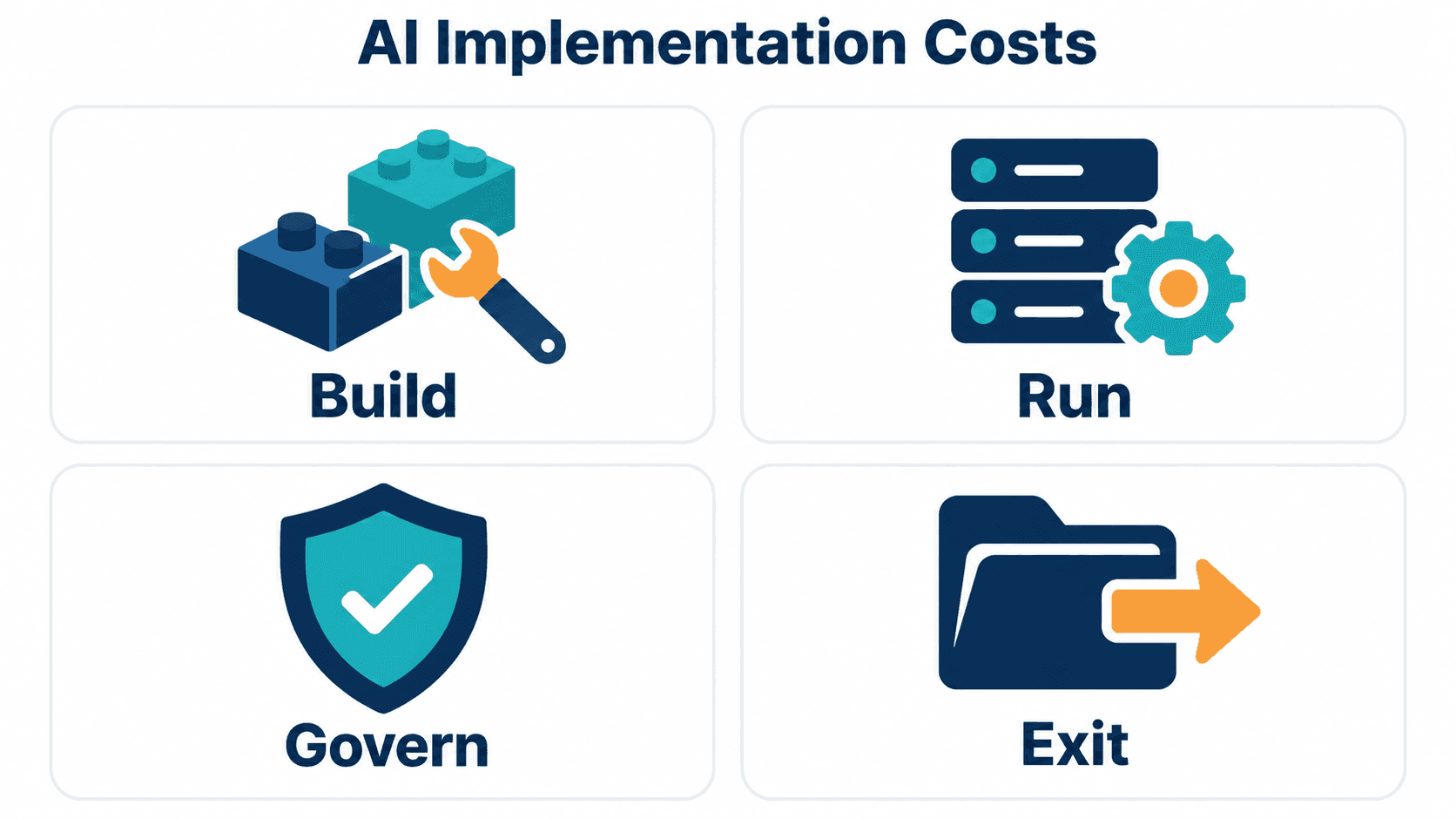
AI implementation cost includes building the system, operating it, maintaining its controls, and eventually transferring or retiring it. Each category depends on scope, data readiness, integrations, usage, and team responsibilities. A useful comparison brings these costs together over a defined period, with clear assumptions, exclusions, and contractual terms.
Why is there no single price for implementing AI?
Two projects described as an “internal knowledge assistant” can require different work. One may use a small collection of approved documents. Another may need conflicting sources reconciled and permissions connected across several systems.
Preparing a draft for employee review also differs from executing an action in a live system. Each requires access, testing, and operating controls appropriate to its consequences.
Start by defining the task, users, sources, acceptable outputs, and permissions. This provides a basis for estimating costs and comparing proposals that cover similar requirements.
What belongs in the build cost?
Build cost covers the work required to prepare, test, and hand over the agreed workflow. The proposal should specify whether it delivers a limited pilot or a system ready for live operation.
Potential components include:
- Scoping: documenting the workflow, responsibilities, boundaries, and acceptance criteria.
- Data preparation: reviewing sources, removing duplication where necessary, correcting problems, and identifying excluded information.
- Development and configuration: setting up retrieval, extraction, drafting, and associated rules.
- Integration: connecting sources and systems, managing access, and handling failures.
- Testing and handover: evaluating results, user acceptance testing, documentation, and agreed training.
Ask what each component includes and what your team must provide. A supplier might configure an integration while the customer remains responsible for correcting source data.
Also establish which pilot components can carry into production and which require further work.
What determines running costs after launch?
Running costs depend on usage, resources, and the services required to keep the workflow operating.
They may include model calls, document processing, hosting, storage, search, monitoring, third-party licences, and support. Employee time spent reviewing outputs, resolving exceptions, and maintaining sources also matters.
Tie estimates to measurable cost drivers:
| Cost driver | What to specify |
|---|---|
| Case volume | Expected monthly workload and peak periods |
| Input size | Document pages, conversation length, and context size |
| Processing steps | Retrieval, tool calls, and retries |
| Storage | Data, indexes, logs, and backups |
| Support | Coverage hours, response targets, and service scope |
| Human review | Cases requiring intervention and handling effort |
Agree on usage alerts, budget limits, and authorization for exceeding planned consumption. Clarify whether external services are paid directly or included in the supplier’s invoice.
How should you budget for maintenance and updates?
Assign responsibility for maintaining sources, rules, integrations, and evaluation results.
A policy change may require reviewing affected answers. A model or data-source update may require tests to establish its impact. The scope and frequency of testing should reflect the change and its risks.
Ask what recurring support includes and what becomes a separately priced change request. Fixing a fault differs from adding a source or expanding the task.
Both internal operation and a managed service can be suitable. Compare service levels, required expertise, cost, documentation, and the ability to transfer operations later.
Where do governance and data protection fit?
Budget time and resources to define what data the system uses, who can access it, which actions are permitted, and what evidence is retained for review.
Work may include access design, data minimization, field masking where appropriate, audit logging, retention configuration, security testing, and human-review arrangements. Relevant legal, privacy, and security stakeholders should determine the requirements applicable to the workflow.
Human approval does not eliminate technical controls. The system still needs to verify the approver’s identity and authority, the approved version, and the limits of the permitted action.
Read-only access restricts changes to source systems, but sensitive information can still appear in answers or logs.
Prevent double-counting by identifying controls already included in development or hosting and those priced separately.
What should exit or supplier-transition costs include?
An exit plan supports continuity or orderly shutdown, even when a supplier change is not currently expected.
Clarify:
- Export of customer data, agreed outputs, and configurations, including available formats.
- Handover of documentation, business rules, and relevant test cases.
- Transfer or reconfiguration of integrations and accounts.
- Revocation of supplier access and rotation of credentials where necessary.
- Treatment of backups and retained data under applicable requirements.
- Transition assistance, its duration, and potential fees.
- Licences or components that cannot transfer and the replacements needed.
Distinguish customer-data ownership, output-use rights, custom code, the supplier’s pre-existing intellectual property, and third-party licences. Define these rights and transition arrangements in the contract.
How do you build a cost model you can update?
Use one row per cost item, with its timing, driver, and owner recorded clearly.
| Item | Category | Cost pattern | Estimate basis | What to clarify |
|---|---|---|---|---|
| Source preparation | Build | Initial | File volume and preparation effort | Expected quality and correction responsibility |
| Integration setup | Build | Initial, then maintenance | Systems and access scope | Testing and external dependencies |
| Case processing | Run | Variable | Volume and resource consumption | Peaks and retries |
| Support and updates | Run | Recurring or on request | Service level and effort | Included and excluded work |
| Control design | Govern | Initial and recurring | Data, permissions, and reviews | Controls already included elsewhere |
| Internal staff time | Across categories | Initial and recurring | Hours by role | Preparation, review, and training |
| Transition or retirement | Exit | When required | Export, migration, and assistance | Formats, timing, and fees |
Add a low and high SAR estimate, the estimate source, assumptions, and responsibility for payment and delivery. State currency, tax treatment, and exclusions according to the proposal.
Use documented quantities, effort estimates, and unit costs where available. Avoid adjustment factors that lack a clear basis.
How do you compare supplier proposals consistently?
Set a comparison period and usage scope, then total the applicable costs:
Estimated total cost = initial costs + operating and maintenance costs over the period + internal costs + relevant transition costs
Do not add transition costs again if they are already included. Where a supplier change is uncertain, show separate continuation and transition scenarios.
Compare deliverables, acceptance criteria, and service levels alongside price. A lower-priced proposal may meet the requirement or exclude necessary work; the detail establishes which.
Request low, expected, and high usage scenarios, showing how each affects expenditure. Keep one-time costs separate from recurring charges.
Where should you start without overbuilding?
Choose a defined workflow with an owner, available data, and an output that can be tested. A quotation-drafting workflow such as SmartQuote, or company knowledge retrieval through OpsRAG, can provide a starting point for discussion.
Define the pilot’s cost and deliverables, then estimate operating costs if it succeeds. Assess expected benefits separately, distinguishing released time, avoided costs, and actual financial savings.
If you are preparing an AI implementation budget, talk to LeenAI about the workflow, sources, and systems involved to discuss a scope that makes build, run, govern, and transition costs explicit.