Why Vision 2030 Demands a New Approach to AI Adoption
Saudi Arabia's Vision 2030 is not just a national ambition; it is a blueprint for economic diversification and digital leadership. For enterprises, this means moving beyond pilot projects and isolated use cases. The goal is to embed intelligent systems that improve decision-making, operational efficiency, and customer experience at scale. Yet many organizations hesitate, fearing compliance risks, data privacy issues, and the complexity of integrating AI into existing workflows.
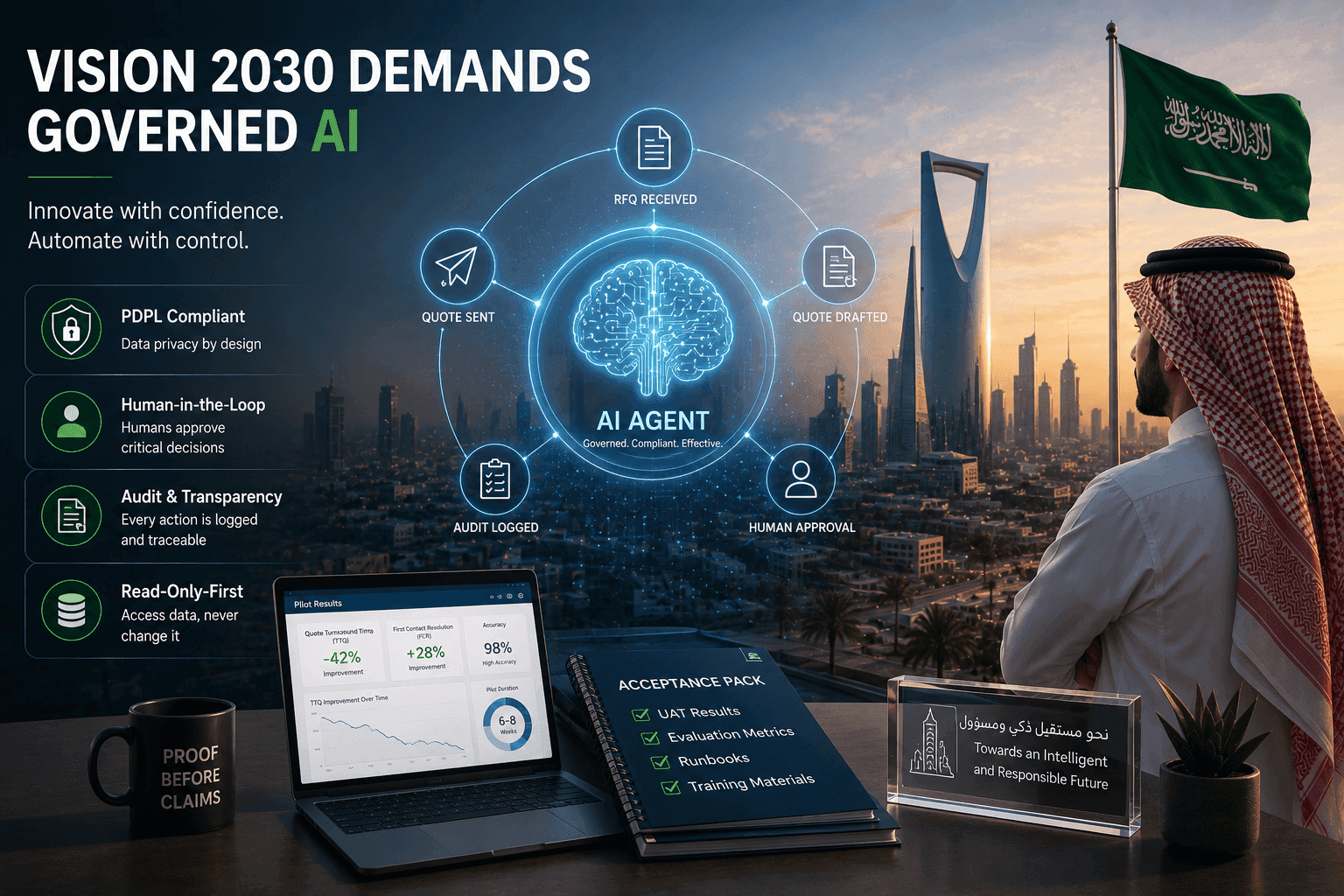
The answer is not to avoid AI but to adopt it with governance. Governed AI agents—systems that operate within clear guardrails—allow Saudi enterprises to benefit from automation while maintaining control. These agents are designed to be read-only-first, meaning they access data without altering it, and they always include a human-in-the-loop for critical decisions. This approach aligns perfectly with Vision 2030's emphasis on innovation and responsible technology use.
By focusing on governed AI, companies can address the concerns that typically stall adoption: data privacy under PDPL, auditability, and the fear of losing human oversight. The result is a path forward that is both ambitious and safe.
What Does 'Governed AI' Mean for Saudi Decision-Makers?
For CIOs, COOs, and procurement leaders, 'governed AI' means having systems that are transparent, accountable, and aligned with Saudi regulations. It is not about restricting AI's potential but about ensuring it operates within boundaries that protect the organization and its customers. Key elements include read-only-first access, human-in-the-loop approvals, and comprehensive audit logs. These features are not optional; they are essential for building trust among stakeholders and regulators.
Consider a procurement scenario: an AI agent that assists with RFQ-to-quote processes. Without governance, the agent might autonomously make decisions that could lead to compliance issues or pricing errors. With governance, the agent suggests quotes, but a human must approve final numbers. This ensures accuracy and accountability, which are critical in a regulated environment.
Moreover, governed AI is inherently PDPL-aware. It respects data minimization, ensuring that only necessary data is accessed, and it supports data residency, keeping Saudi data within national borders. For decision-makers, this reduces legal risk and demonstrates a commitment to ethical AI use.
How Can Saudi Enterprises Adopt AI in 6–8 Weeks?
The traditional approach to AI adoption often involves lengthy discovery phases, extensive custom development, and months of testing. This timeline is not suitable for organizations that need to show results quickly and align with Vision 2030's momentum. A better model is the fixed-scope pilot: a focused project with clear KPIs, delivered in 6–8 weeks. This approach allows enterprises to see tangible value before committing to larger investments.
For example, a distributor might pilot an AI agent for automating quote responses. The pilot would define specific metrics, such as time-to-quote (TTQ) and first-contact resolution (FCR), and measure improvements over a short period. The output is not a slide deck but a working system with measurable outcomes. This 'proof before claims' philosophy is central to LeenAI's approach.
The Acceptance Pack is a key component of this model. It includes user acceptance testing (UAT), evaluation criteria, runbooks, and training materials. This ensures that the pilot is not just a technical exercise but a business solution that teams can adopt and scale. By the end of 6–8 weeks, the organization has a clear picture of the AI's impact and a roadmap for expansion.
What Does a Governed AI Pilot Deliver?
A governed AI pilot is designed to deliver three things: measurable KPIs, a clear governance framework, and a reusable blueprint for scaling. For instance, in customer service, a WhatsApp CX agent might be deployed to handle common inquiries in both Arabic and English. The pilot would track metrics like average handling time (AHT) and customer satisfaction, while also documenting how the agent adheres to PDPL requirements.
Crucially, the pilot is not a black box. It comes with audit logs that record every action the agent takes, ensuring transparency. Human-in-the-loop checkpoints are built into the workflow, so that complex or sensitive requests are escalated to human agents. This dual approach—automation and oversight—builds confidence among both employees and customers.
Another deliverable is the runbook, a detailed guide that explains how to operate, monitor, and maintain the AI agent. This is essential for operational continuity and for training new team members. With these artifacts, the pilot becomes a foundation for broader AI adoption, not just a one-off experiment.
How Does Arabic RAG Enhance AI Agents for Saudi Enterprises?
One of the unique challenges for AI in Saudi Arabia is the need for high-quality Arabic language processing. Many global AI models are primarily English-centric, which can lead to poor performance in Arabic contexts. LeenAI's OpsRAG addresses this by using retrieval-augmented generation (RAG) that is optimized for Arabic. This means the AI can accurately retrieve and generate information in Modern Standard Arabic, which is critical for industries like procurement, legal, and customer service.
Arabic RAG also supports bilingual operations, allowing agents to switch seamlessly between Arabic and English. This is particularly valuable in a country where business is conducted in both languages. For example, a procurement agent might receive a quote request in Arabic and respond in English, or vice versa, without losing context or accuracy.
Moreover, Arabic RAG is designed with PDPL compliance in mind. It ensures that data retrieval is limited to what is necessary and that all interactions are logged. This combination of linguistic capability and governance makes AI agents truly effective for Saudi enterprises.
What Are the First Steps for a Vision 2030 AI Journey?
Starting an AI journey aligned with Vision 2030 does not require a massive overhaul. The first step is to identify a high-impact process that can benefit from automation, such as quote generation, customer support, or document processing. Next, define clear KPIs that align with business goals, such as reducing TTQ by 30% or improving FCR by 20%. These metrics will guide the pilot and provide a basis for evaluation.
Once the scope is defined, engage a partner like LeenAI that specializes in governed AI agents. The partner should offer a fixed-scope pilot with an Acceptance Pack, ensuring that the project is delivered on time and with clear outcomes. During the pilot, focus on learning and iterating, not on perfection. The goal is to demonstrate value quickly and build internal momentum.
Finally, plan for scaling. The pilot's success should lead to broader adoption across other processes. This might involve deploying additional agents, integrating with existing systems, or expanding to new departments. By taking a phased approach, Saudi enterprises can achieve sustainable AI transformation that supports Vision 2030's objectives.
How Can LeenAI Help You Navigate This Journey?
LeenAI specializes in governed AI agents for Saudi enterprises. Our solutions, such as SmartQuote for RFQ-to-quote automation, WhatsApp CX for customer experience, OpsRAG for knowledge operations, and MAE for decision support, are built with governance at their core. They are PDPL-aware, read-only-first, and human-in-the-loop, ensuring compliance and trust.
We offer an Acceptance Pack with every pilot, including UAT, evals, runbooks, and training. This ensures that you not only get a working AI agent but also the tools to manage and scale it. Our approach is 'proof before claims'—we deliver measurable results in weeks, not years.
If you are ready to align your enterprise with Vision 2030 through governed AI, talk to us about a fixed-scope pilot. We will help you define KPIs, design the governance framework, and deploy an AI agent that delivers real value. See how we scope pilots on our pricing page.