Why "Secure Enterprise AI" Is More Than a Compliance Box
Saudi enterprises are moving from AI pilots to production, but the bar is higher than elsewhere. With Vision 2030 driving digital transformation, decision-makers—CIOs, COOs, procurement and CX leaders—are under pressure to show AI that acts, not just demos. Yet "secure" can't mean locking everything down so tightly that the AI becomes useless. It means governed AI: systems that operate within clear boundaries, respect data protection laws, and earn trust through transparency.
LeenAI builds AI agents for Saudi enterprises that are governed by design: read-only-first, human-in-the-loop, and PDPL-aware. But before you adopt any AI agent, you need a practical way to evaluate it. This checklist gives you seven concrete points to assess readiness, from data governance to acceptance criteria.
What Does PDPL Compliance Mean for AI Agents?
The Saudi Personal Data Protection Law (PDPL) is a cornerstone of secure AI. For AI agents, PDPL compliance isn't just about encryption or consent—it's about data minimization, purpose limitation, and residency. Your AI should only access data it needs for the task, use it only for that purpose, and store it within Saudi Arabia.
Ask your vendor: Where is data processed? What happens to data after training? Can you export audit logs? A secure AI agent should support role-based access, anonymization where possible, and clear data retention policies. If a vendor can't articulate this, that's a red flag.
Is Your AI Read-Only First? The Governance Imperative
A secure AI agent should not have write access to your core systems by default. Read-only-first means the AI can retrieve and analyze data, but any action—like updating a quote or sending a message—requires explicit human approval. This reduces risk of unintended changes and ensures accountability.
For example, LeenAI's SmartQuote agent reads your RFQs and historical pricing to generate quotes, but it doesn't auto-submit them. A human reviews and approves. Similarly, OpsRAG retrieves answers from your documents but doesn't modify them. This approach aligns with PDPL and builds trust with stakeholders.
How Do You Keep Humans in the Loop Without Slowing Down?
Human-in-the-loop (HITL) is often seen as a bottleneck, but it doesn't have to be. The key is designing decision points that are high-value and low-frequency. For instance, an AI can handle 80% of routine queries, but exceptions—like a price override or a sensitive customer complaint—escalate to a human.
Define escalation rules upfront. What triggers human review? What's the approval workflow? In LeenAI's WhatsApp CX agent, for example, the agent handles common Arabic and English inquiries, but if a customer asks for a refund or a custom offer, it routes to a human with full context. This maintains control without sacrificing efficiency.
What Should You Audit? Logs That Matter
Audit logs are non-negotiable for secure AI. They should record every action the AI takes: what data it accessed, what it output, and when. But logs are only useful if they're readable and actionable. Ensure your AI vendor provides logs that your compliance team can query—not just raw JSON dumps.
Look for logs that show the reasoning behind decisions. For example, if an AI agent recommends a supplier, the log should show which criteria it used. This transparency is crucial for audits and for building trust with regulators and customers.
How Do You Measure Security and ROI in a Pilot?
A pilot is your chance to prove both security and value. Define KPIs before you start—like time-to-quote (TTQ), first-contact resolution (FCR), or average handling time (AHT). But also define security metrics: number of unauthorized access attempts, false positives, or human override rates.
LeenAI's Acceptance Pack includes UAT, evals, runbooks, and training, so you know exactly what success looks like. A fixed-scope pilot of 6–8 weeks is enough to see if the AI meets your standards. If it doesn't, you walk away—no long-term commitment.
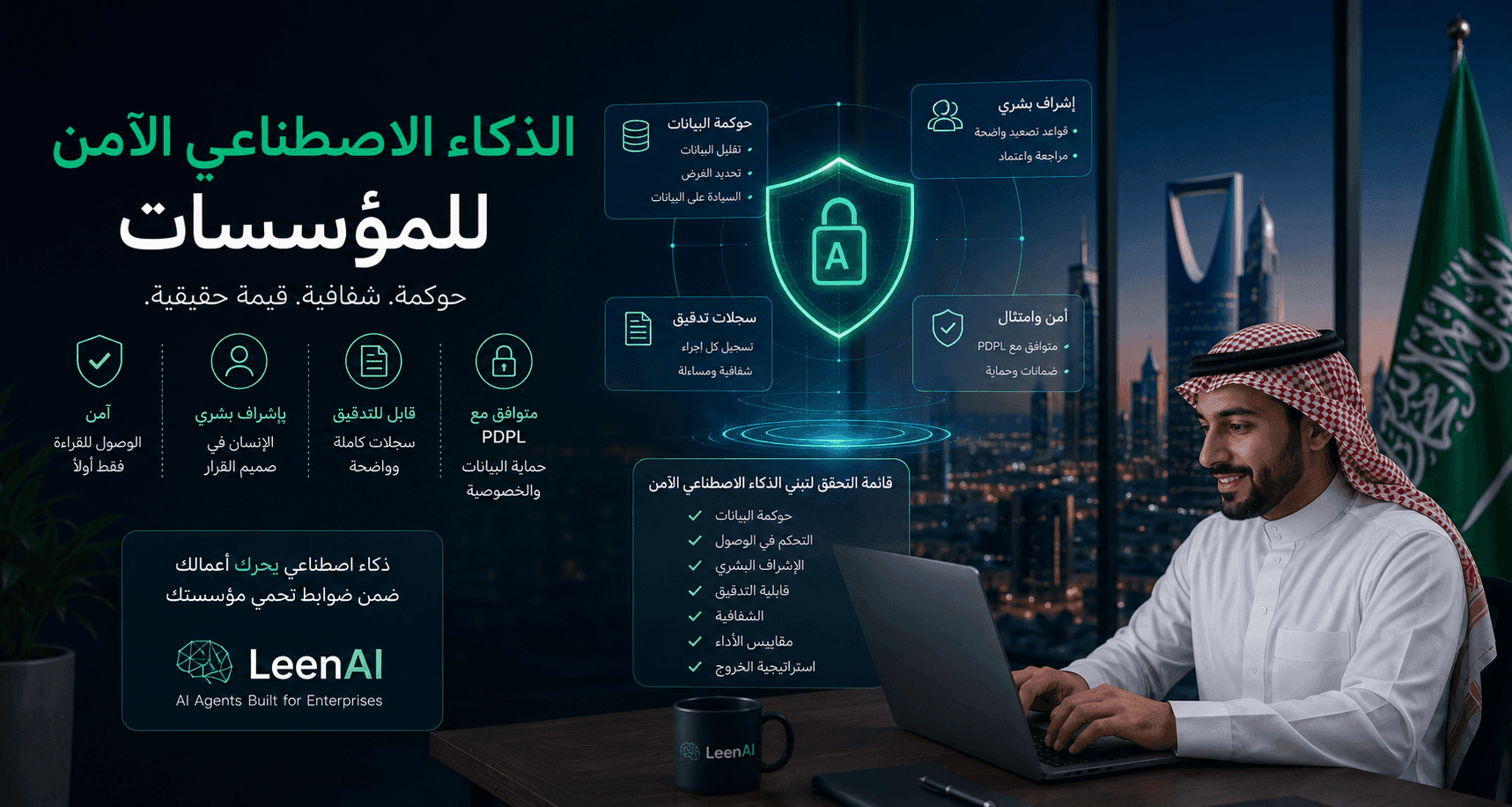
Your 7-Point Secure AI Adoption Checklist
Here's a summary to guide your evaluation:
- Data governance: Does the AI respect PDPL—data minimization, residency, and purpose limitation?
- Access control: Is it read-only-first, with role-based permissions?
- Human oversight: Are there clear escalation paths for exceptions?
- Auditability: Can you see every action and the reasoning behind it?
- Transparency: Does the AI explain its outputs in plain language?
- Performance metrics: Are KPIs defined and measurable from day one?
- Exit strategy: Can you terminate the pilot easily if it fails?
Use this checklist when talking to vendors. It will save you from costly mistakes and ensure you adopt AI that's both secure and effective.
Secure AI Is a Journey, Not a Destination
Adopting secure enterprise AI in Saudi Arabia is not a one-time project—it's an ongoing practice. As regulations evolve and your business changes, your AI governance must adapt. Start with a pilot that tests both security and value, and build from there.
If you're evaluating AI agents, see how we scope pilots or talk to us. We focus on governed AI that delivers proof before claims—because that's what Saudi enterprises deserve.