Why a Governance-First Approach Is Non-Negotiable in Saudi Arabia
Saudi Arabia's Vision 2030 has created a fertile ground for AI adoption, but with great opportunity comes great responsibility. The Saudi Data & AI Authority (SDAIA) and the Personal Data Protection Law (PDPL) set clear expectations: AI must be transparent, accountable, and respectful of data privacy. For CIOs and COOs, this means an enterprise AI strategy cannot be a free-for-all experiment. It must be built on governance from day one.
A governance-first approach means defining who can access what data, how AI decisions are made, and how they are audited. It means starting with read-only-first AI agents that observe and recommend, not act autonomously. This is not a limitation; it's a strategic advantage. It builds trust with stakeholders, regulators, and customers, and it reduces the risk of costly mistakes.
How Do You Align AI Strategy with Business Objectives?
The most common mistake in AI strategy is starting with technology and looking for a problem to solve. Instead, start with your business objectives. What are the critical pain points in your operations? For a distributor, it might be slow RFQ-to-quote cycles. For a customer service leader, it might be long response times and low first-contact resolution. For a COO, it might be fragmented knowledge across documents.
Once you've identified the pain points, define clear KPIs. For procurement, that could be time-to-quote (TTQ). For CX, it could be first-contact resolution (FCR) and average handling time (AHT). These metrics become the acceptance criteria for your AI pilots. This is what we call proof before claims: you don't just talk about value; you measure it.
What Does a 6-Week Pilot Deliver?
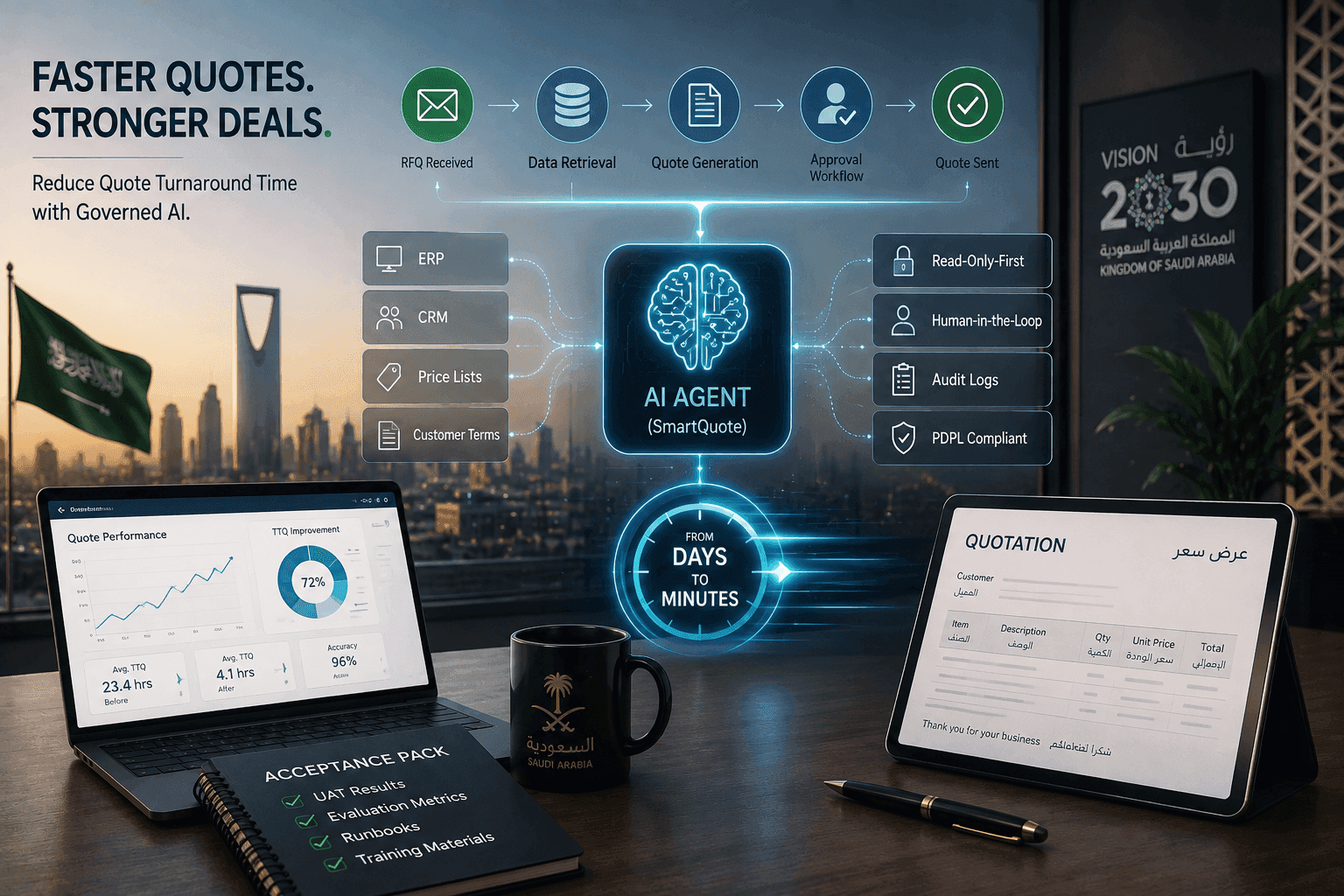
A well-scoped pilot should deliver more than a slide deck. It should deliver a working AI agent that is integrated into your workflow, with measurable results. In six weeks, you can deploy an AI agent that automates a specific, high-value task. For example, LeenAI's SmartQuote can automate the RFQ-to-quote process, reducing turnaround time and errors. Or OpsRAG can make your internal knowledge instantly accessible to your team, in both Arabic and English.
The key is to define the scope tightly. Don't try to solve everything at once. Pick one process, set the KPIs, and run a UAT (User Acceptance Testing) with your team. The pilot should also include training and runbooks, so your team knows how to use the agent and how to intervene when needed. This is part of the Acceptance Pack that ensures the pilot is not just a demo but a real deployment.
How to Ensure PDPL Compliance in Your AI Strategy?
PDPL compliance is not an afterthought; it must be baked into your AI strategy. This means data minimization: only collect and process the data you need. It means data residency: keep data within Saudi Arabia. It means read-only-first: AI agents should not modify data unless explicitly allowed and supervised. And it means audit logs: every action taken by an AI agent must be logged and traceable.
For Arabic RAG systems, this is particularly important. Arabic language processing involves sensitive data, and you need to ensure that your AI agents are trained and operate within PDPL guidelines. LeenAI's OpsRAG is designed with these principles in mind, ensuring that your knowledge base is leveraged without compromising compliance.
Building a Roadmap: From Pilot to Scale
After a successful pilot, the next step is to scale. But scaling should be deliberate. Use the learnings from the pilot to refine your approach. Expand to adjacent processes, but always with the same governance framework. Ensure that your AI agents are integrated with your existing systems, and that your team is trained to work alongside them.
A phased roadmap might look like this: first, automate a single process (e.g., quote generation). Second, expand to related processes (e.g., order processing). Third, integrate AI agents into your customer-facing channels (e.g., WhatsApp CX). Throughout, maintain human-in-the-loop oversight and continuously evaluate performance against KPIs.
The Role of Bilingual AI in Saudi Enterprises
Arabic is the language of business in Saudi Arabia, and your AI strategy must account for it. A bilingual AI agent that can understand and respond in both Arabic and English is a competitive advantage. It improves customer experience, reduces friction, and ensures that your AI is accessible to all stakeholders.
But bilingual AI is not just about translation; it's about understanding context and cultural nuances. This is where LeenAI's expertise in Arabic RAG comes in. Our agents are built to handle the complexities of Arabic, from dialect variations to right-to-left text. This ensures that your AI strategy is truly localized.
Measuring Success: KPIs and Acceptance Criteria
You can't manage what you don't measure. For each AI pilot, define success metrics upfront. These could be TTQ, FCR, AHT, or cost per transaction. Track these metrics before and after deployment. Use the data to make informed decisions about scaling.
An Acceptance Pack, like the one LeenAI provides, includes UAT, evals, runbooks, and training. This ensures that your team is confident and that the AI agent meets your standards. It's not just about deploying technology; it's about embedding it into your organization's DNA.
Conclusion: Start Small, Governed, and Scale with Confidence
Enterprise AI strategy in Saudi Arabia is not about chasing the latest trend. It's about building a foundation of governance, compliance, and measurable value. Start with a small, well-defined pilot. Use the results to build trust and momentum. Then scale with confidence, knowing that your AI agents are acting within guardrails.
At LeenAI, we help Saudi enterprises do exactly this. Our AI agents—SmartQuote, WhatsApp CX, OpsRAG, and MAE—are designed with governance and PDPL compliance at their core. We offer an Acceptance Pack on every pilot, so you know exactly what you're getting. If you're ready to move from strategy to action, talk to us or see how we scope pilots.