
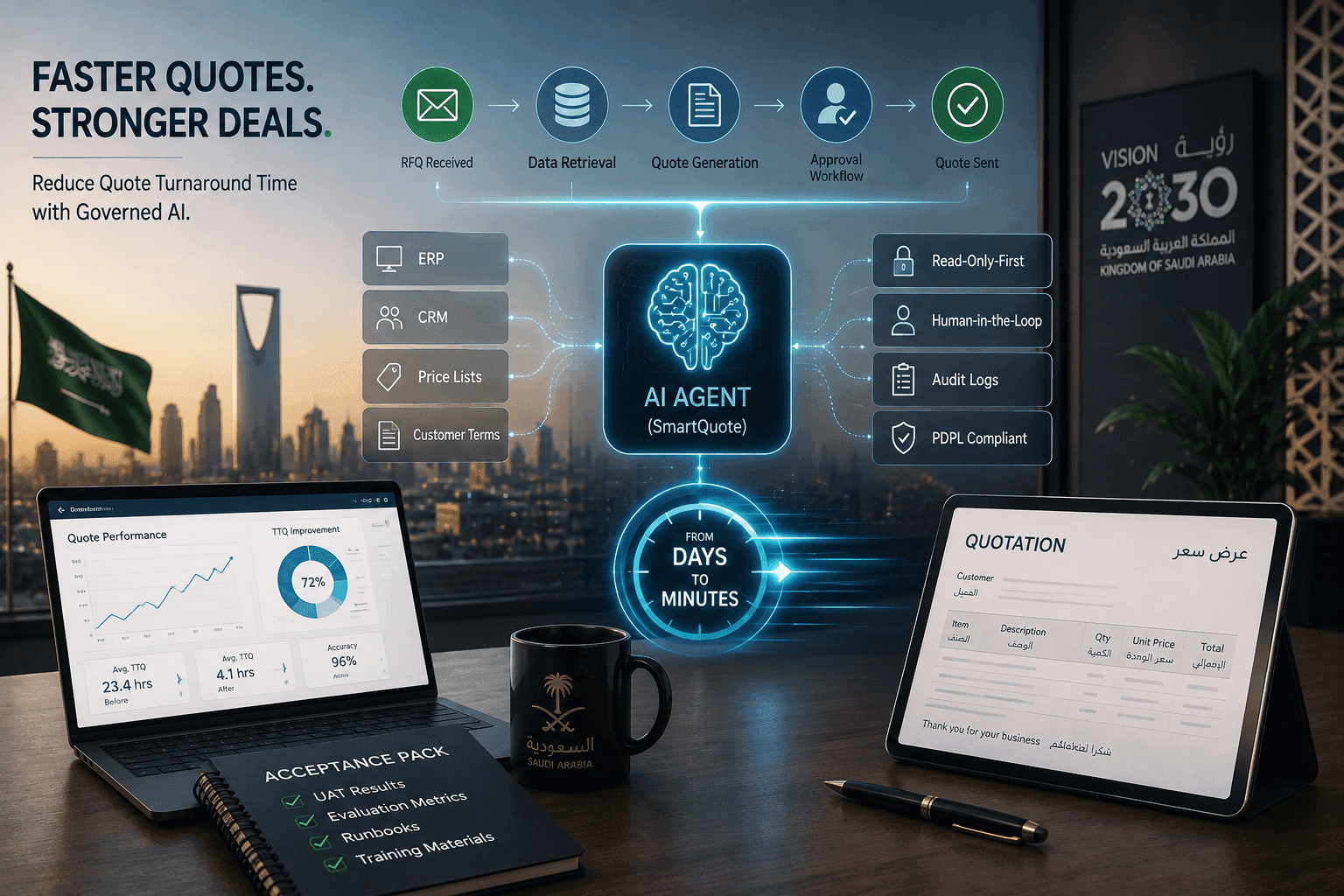
What is an AI agent chatbot for Saudi government tenders — and what is it not?
The phrase is misleading in a useful way. Most people hear "chatbot" and picture a widget on a website answering visitor questions. An AI agent for tenders works in the opposite direction: it sits inside your bid team, reads the tender, and does the first heavy pass of the work.
Concretely, an agent reads the tender document and its annexes, extracts mandatory requirements, evaluation criteria, submission deadlines, and required forms, then matches each requirement against your approved evidence — past submissions, certificates, project references, CVs, and product documentation. It drafts responses with citations back to those sources, flags what it cannot substantiate, and hands the package to a human bid manager. Chatbots answer; agents do work.
The distinction matters for governance. A public chatbot is a brand surface; a tender agent touches commercially sensitive material and legally binding submissions. That is why the design must be read-only-first, with a human approving every output before it leaves the building.
Why do Saudi tender teams need agents rather than more people?
The pain is not a shortage of effort. It is the shape of the work: long documents in Arabic and English, tight submission windows, repeated questions that already have answers somewhere in the company, and a review process that depends on whoever is available that week. Adding headcount does not fix a workflow where the same compliance clause is re-read from scratch on every bid.
LeenAI's view is that a suitable starting workflow is one that already costs the business time or money today. Tender response is a textbook case: every missed mandatory requirement is a disqualification, and every hour spent re-typing known answers is an hour not spent on pricing and technical differentiation.
There is also a knowledge-retention problem. When experienced bid managers leave, their sense of "what the evaluator is really asking" leaves with them. An agent that works from an approved, curated evidence base turns that tacit knowledge into something the team can inspect and reuse.
How does an agent read an Arabic and English tender without inventing requirements?
This is the technical heart of the question, and it is where most pilots fail. Tender documents are messy: scanned annexes, mixed-language tables, cross-references, and clauses that amend earlier clauses. An agent that summarises confidently without grounding is worse than no agent at all.
The governed pattern is retrieval with citations and explicit refusal. The system indexes the tender and your evidence base separately, retrieves the specific passage behind every extracted requirement, and shows the source page. Where retrieval confidence is weak, the agent does not guess — it marks the item as unresolved and routes it to a human. LeenAI addresses hallucinations through citations, golden-set evaluation, retrieval score thresholds, and explicit refusal when sources are weak.
Arabic deserves its own attention. Modern Standard Arabic tender language uses formal constructions and legal phrasing that generic models handle unevenly. A serious build tests the agent against a golden set of real historical tenders in both languages and measures extraction accuracy before anyone trusts it with live bids. This is the same discipline behind LeenAI's OpsRAG, which answers from approved documents with citations rather than from model memory.
What does a governed tender agent actually do end to end?
A realistic scope covers four stages, each with a defined owner.
- Intake and extraction. The agent reads the tender, produces a structured requirements register, and lists every mandatory item with its source clause and deadline.
- Compliance gap check. Each requirement is matched to approved evidence. Items with no evidence are flagged as gaps, not quietly filled with plausible-sounding text.
- Draft assembly. Technical and administrative responses are drafted from approved material, with citations, leaving pricing and commercial judgement to your team.
- Human review and handover. A bid manager reviews, edits, and signs. The final package, the requirements register, and the audit trail are handed over as artifacts your organisation owns.
Notice that the agent never submits. Submission is a write action into an external system, and LeenAI identifies a security gate and change-control path for any write action or system expansion. That gate is not bureaucracy; it is the reason a compliance officer can say yes.
How do PDPL and data residency shape the design?
Tender material often contains personal data: CVs of proposed staff, contact details, sometimes commercial information about third parties. Under the Saudi Personal Data Protection Law, that data needs a lawful basis, minimisation, and a documented retention position.
The practical controls are unglamorous and effective. Collect only the documents the workflow needs. Apply role-based access so a sales lead and a bid manager see different slices. Keep audit logs of who queried what and when. Document retention rules before code is written, not after. Where the architecture permits, keep processing and storage in-region and be explicit with your vendor about which model providers see which data.
LeenAI prepares sources, systems, and operating boundaries before building the workflow, and uses a provider-agnostic architecture so switching LLM providers is a configuration change rather than a rebuild. For a Saudi enterprise, that is a resilience argument as much as a technical one: regulation and vendor landscapes move, and your tender system should not have to be rebuilt when they do.
What should a pilot deliver before you commit to a rollout?
Do not buy a platform. Buy one workflow, measured. A credible pilot picks a single tender category, runs the agent against a set of historical tenders with known good outcomes, and compares extraction and drafting quality against the baseline of how the team works today.
Acceptance should be written down before the build starts: which requirement types must be extracted correctly, what citation coverage looks like, how unresolved items are handled, and who signs off. LeenAI identifies an acceptance pack with KPIs, UAT notes, and operating guidance as proof a serious buyer should see, and aims to deliver a working system with handover logic rather than a vague AI showcase or a long experimentation loop.
The commercial logic is straightforward: if the agent reliably catches mandatory requirements and removes re-typing, the case is made on disqualification risk alone. If it does not, you have learned that cheaply. Either way, you own the system and all artifacts. If you want to see how a scope like this is shaped, see how we scope pilots or talk to us with one tender workflow — within 24 hours we reply with scope, timeline, and SAR cost.
The decision in front of you
Saudi government tenders reward preparation discipline more than clever wording. An agent does not make your company more qualified; it makes your qualified company faster, more consistent, and more auditable in how it responds. That is the honest promise, and it is enough.
Start from the decision: which tender category, which evidence base, which human signs off, and what would have to be true for you to expand the scope. LeenAI is a Saudi company building decision systems that teams can operate, in Arabic or English, whichever you prefer. Start here when you are ready to name the workflow.
Frequently Asked Questions
Can an AI agent write a full government tender response on its own?
No, and it should not. A governed agent reads the tender documents, extracts requirements and deadlines, maps them to your approved content library, and drafts sections for review. Your bid team checks every commitment, price and compliance statement before anything is submitted.
How do you stop the agent from inventing compliance statements?
The agent only drafts from approved sources such as your policies, certificates and past responses, cites where each statement came from, and flags any requirement it cannot support. Unsupported items go to a person instead of being filled in.
What about CVs and personal data inside tender documents?
Treat them under PDPL: use only the data the tender requires, restrict access by role, keep a log of who viewed or used it, and follow documented retention rules. Personal data should never be reused outside the tender it was provided for.