What are Enterprise AI Agents?
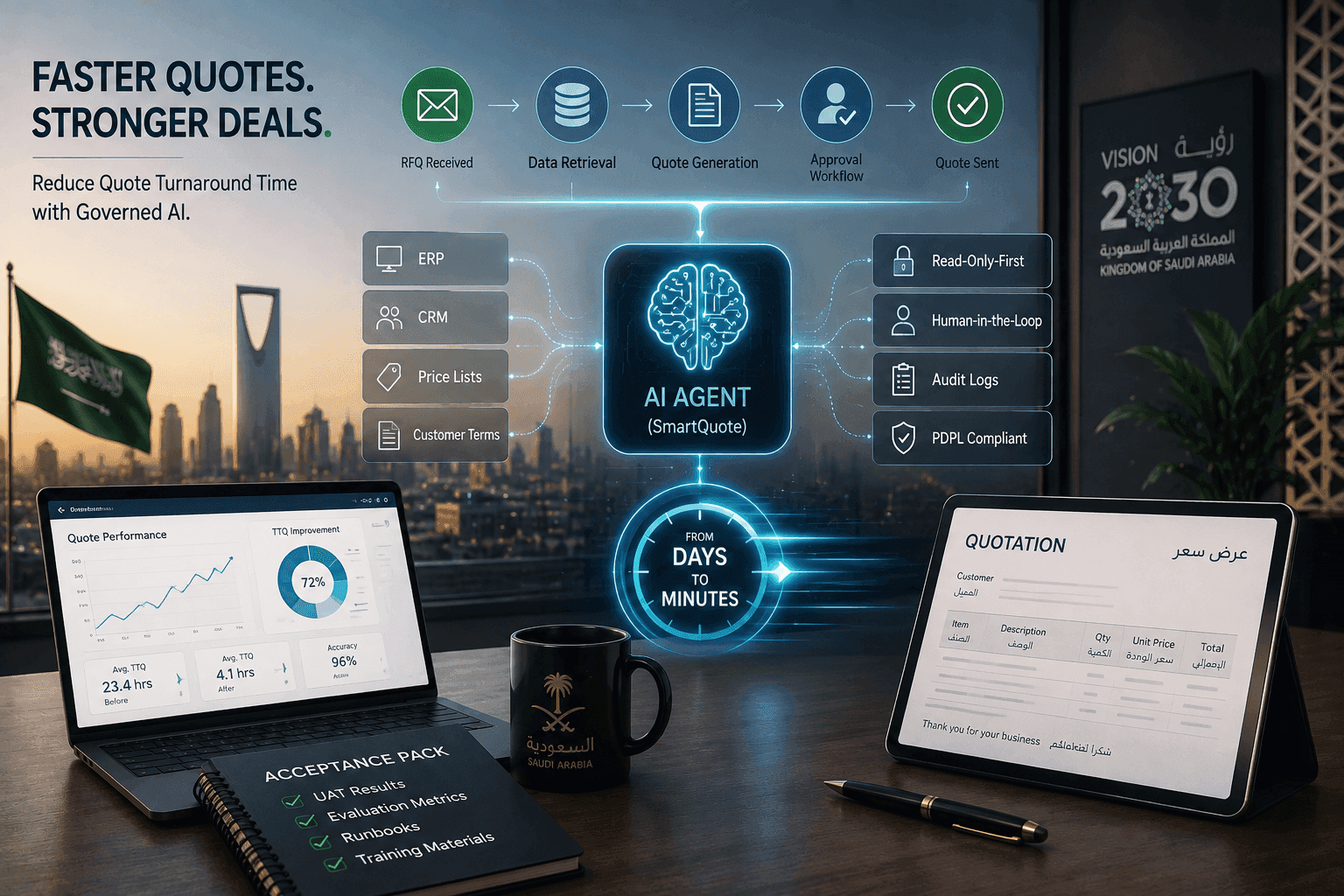
Enterprise AI agents are advanced systems designed to automate and optimize various business functions within an organization. These agents, such as LeenAI's SmartQuote and OpsRAG, are built to handle complex tasks while maintaining compliance with regulatory frameworks. They operate by analyzing large datasets to provide actionable insights, making them invaluable for decision-makers like CIOs and COOs.
Unlike traditional AI systems, enterprise AI agents are governed, meaning they include mechanisms for oversight and control, such as human-in-the-loop processes and audit logs. This governance ensures that the AI operates within safe and ethical boundaries, crucial for sectors that handle sensitive data.
How Do AI Agents Align with Vision 2030?
Saudi Arabia's Vision 2030 aims to diversify the economy and enhance public sector efficiency. AI agents play a pivotal role in this transformation by enabling faster, more accurate decision-making processes. By adopting AI agents, enterprises can streamline operations, reduce costs, and improve customer interactions, aligning with the Vision's goals of modernization and economic growth.
AI agents also contribute to developing a knowledge-based economy, a core objective of Vision 2030, by fostering innovation and improving workforce skills through AI integration.
Ensuring PDPL Compliance with AI Agents
Compliance with the Saudi Personal Data Protection Law (PDPL) is a critical consideration when deploying AI agents. These systems must prioritize data privacy and security, ensuring that personal data is processed ethically and legally.
LeenAI's AI agents are designed with PDPL compliance in mind. They incorporate features like data minimization, read-only-first access, and robust audit trails, ensuring that all data handling is transparent and accountable. This compliance not only protects organizations from legal risks but also builds trust with stakeholders.
What Does a 6-Week Pilot Deliver?
A 6-week pilot with LeenAI delivers a fully functional AI agent tailored to meet specific business objectives. The pilot includes an Acceptance Pack, which comprises user acceptance testing, evaluation frameworks, and comprehensive training sessions.
This structured approach ensures that the AI agent meets predefined KPIs, such as time-to-quote (TTQ) and first-call resolution (FCR), providing measurable ROI. The pilot phase allows organizations to assess the agent's performance and make informed decisions about full-scale deployment.
Integrating AI Agents into Existing Workflows
Integrating AI agents into existing business workflows requires careful planning and execution. The process begins with identifying areas where AI can add the most value, such as procurement, customer service, or operations.
LeenAI's AI agents are designed to seamlessly integrate with existing systems, minimizing disruption while maximizing efficiency. By providing bilingual support and human-in-the-loop mechanisms, these agents ensure that the transition is smooth and that the organization's unique needs are met.
How to Measure the Success of AI Agent Implementation?
Measuring the success of AI agent implementation involves evaluating both quantitative and qualitative metrics. Key performance indicators (KPIs) like TTQ, FCR, and average handling time (AHT) are crucial for assessing the agent's impact on operational efficiency.
Qualitative measures, such as user satisfaction and process improvement feedback, provide insights into how well the AI agent is received by staff and its effectiveness in real-world scenarios. Regular audits and reviews ensure that the AI continues to operate within governed parameters and delivers ongoing value.