
Why does warehouse safety camera AI matter in Saudi Arabia now?
Saudi warehouses are under pressure that did not exist a decade ago. E-commerce volumes, Vision 2030 logistics corridors, and the growth of last-mile hubs have turned many facilities from storage rooms into high-throughput operational sites. In that environment, safety is no longer a poster on the wall. It is a measurable operating condition, and the data that proves it usually sits unused on camera recorders.
Manual safety rounds catch a fraction of what happens on a shift. A supervisor cannot watch every aisle, every forklift turn, and every loading bay at once. Incidents and near-misses are often reported late, if at all, and the resulting reports are hard to compare month to month. This is where computer vision earns its place: not as a replacement for safety officers, but as a tireless observer that surfaces patterns and gives the safety team evidence to act on.
The risk, however, is that camera AI gets bought as a gadget and deployed without governance. In a Saudi context, that means ignoring PDPL obligations, storing identifiable footage indefinitely, and giving alerts to people who cannot act on them. The guide below is written for decision-makers who want the operational benefit without those failures.
What should a warehouse safety camera AI system actually detect?
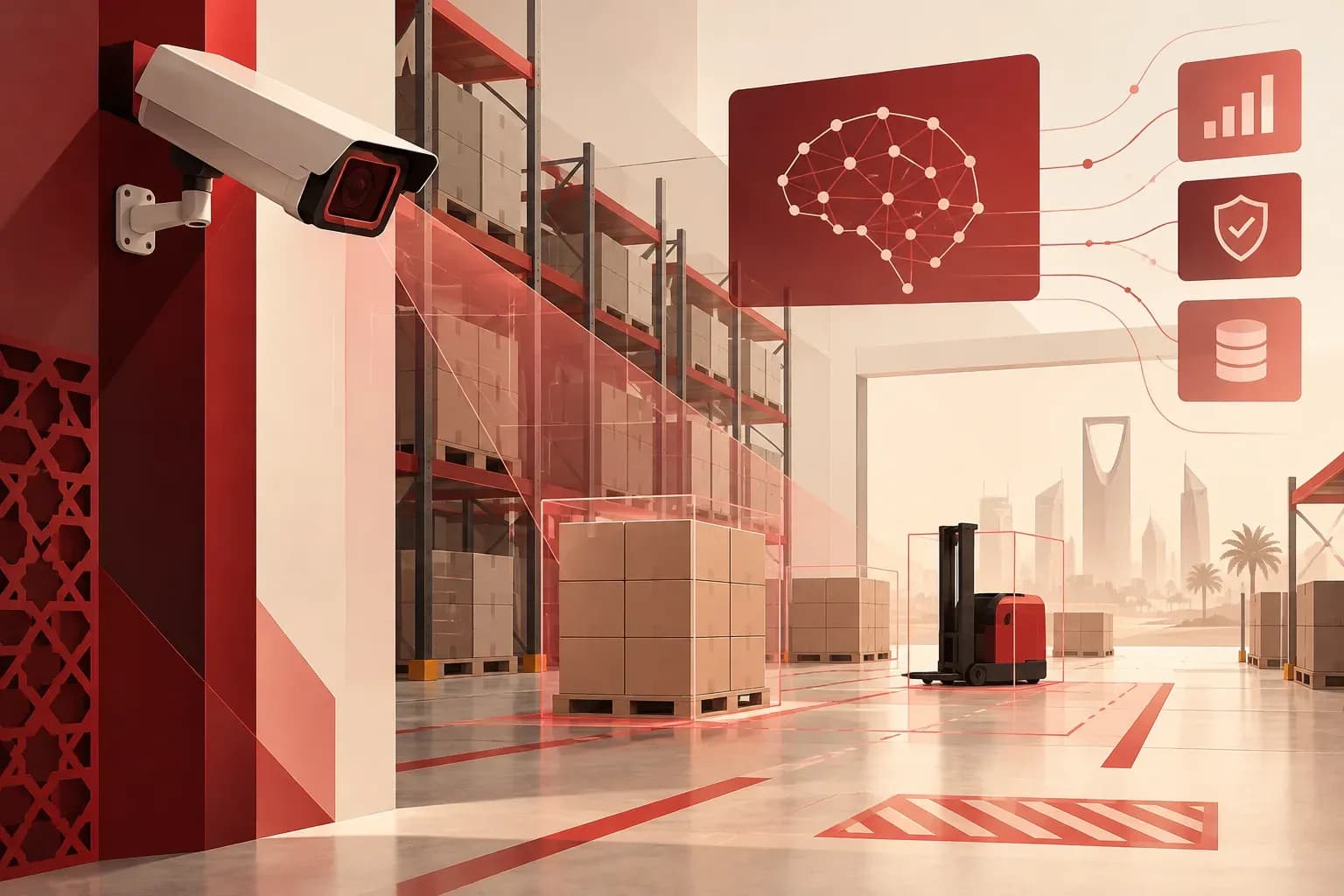
Start with the smallest useful detection set. A strong first scope usually covers three families: near-miss events (a forklift and a pedestrian coming within an unsafe distance, a load shifting, a person entering a marked zone), congestion (aisles or loading bays where flow stalls and people improvise unsafe paths), and specific safety conditions you already care about, such as missing protective equipment in designated areas or blocked emergency routes.
Each detection must be tied to a decision someone will actually make. If a near-miss alert does not trigger a coaching conversation, a layout change, or a shift-plan adjustment, it is noise. Before deployment, write down for every alert type: who receives it, what they are expected to do, and how quickly. That single exercise removes most of the over-scoping that makes camera AI projects fail.
It also helps to distinguish counting from judging. Counting people in a zone, counting forklift passes, or measuring dwell time in an aisle are objective and easy to validate. Judging whether a behavior is unsafe is harder and needs human confirmation. Design the system so counts are automated and judgments are reviewed.
How do you deploy warehouse safety camera AI without violating PDPL?
The first principle is data minimization. You do not need to identify individuals to detect congestion or near-misses. Configure the system to work on zones, distances, and object classes rather than faces. Where identity is genuinely required for an investigation, that should be a separate, logged, and approved process, not the default mode of the platform.
Second, start read-only. In the initial phase the system observes, detects, and records events, but it does not control doors, machinery, or access. This gives your team time to validate accuracy and build trust before any action is automated. Read-only first is also the safest posture for legal review, because the system is not making consequential decisions about people.
Third, put the controls in writing before code. Role-based access ensures that only the safety team and approved managers see event footage. Masking removes irrelevant areas and personal details from the frame. Audit logs record who viewed what and when. Retention rules define how long clips are kept and how they are deleted. LeenAI is PDPL-aware by design and applies these controls, while clients conduct their own legal review, which is the correct division of responsibility.
What does a governed pilot for Vision Safety Watch look like?
Vision Safety Watch is LeenAI's computer vision module for warehouses and safety. It includes detection models, a calibration plan, a compliance KPI dashboard, and operational runbooks. The delivery is governed and acceptance-first: the pilot is judged against criteria agreed before work starts, not against a demo.
The operational workflow is deliberately plain. First, calibrate cameras and areas so the system understands your aisles, bays, and zones. Second, run detection and alerts in read-only mode. Third, review the dashboard and runbook with the safety team, adjust thresholds, and confirm that each alert has an owner. Only then does the conversation turn to expanding scope.
Because the work is scoped as an AI Pilot Project, the boundaries are clear from day one. LeenAI recommends starting with the workflow closest to revenue or risk, and warehouse safety usually qualifies on the risk side. If you want to see how a pilot is structured, see how we scope pilots or talk to us about your facility.
Which KPIs make warehouse safety camera AI measurable?
A dashboard that only shows alert counts is not a safety dashboard. Useful KPIs are tied to outcomes the business already tracks: near-miss frequency per shift, time-to-acknowledge for high-priority alerts, repeat events in the same zone, congestion minutes in critical aisles, and closure rate for corrective actions. Each one should have a baseline captured before the pilot begins, otherwise improvement claims are unfalsifiable.
Final KPI wording is scoped with the client, and LeenAI uses stated review points to keep delivery measurable. That means agreeing on the review cadence up front, usually weekly during a pilot, and being honest when a metric is not moving. A safety system that reports flat results is still valuable if it tells you where to look next.
It also helps to separate leading from lagging indicators. Incident rates are lagging and slow to move. Near-miss detection, zone congestion, and alert response time are leading indicators that change within weeks. A pilot should be judged on leading indicators, with lagging outcomes tracked over a longer horizon.
Where do camera alerts fit into your operating decisions?
Camera AI is one input into a decision system, not a standalone product. The value appears when alerts connect to runbooks, shift handovers, and corrective-action tracking. A near-miss in aisle four should create a task, not just a notification. A congestion pattern at bay two should inform layout or scheduling decisions, and those decisions should be recorded so the next review has context.
This is the same discipline LeenAI applies across its work: operating decisions rather than disconnected AI demos. The same governance pattern used for Vision Safety Watch also supports OpsRAG, LeenAI's AI Document Processing and Company Knowledge Search, where employees ask questions and get cited answers from approved documents. In both cases the system informs a human who remains accountable.
If your team is still deciding where to start, an AI diagnostic can help rank workflows by risk and readiness. The point is not to buy the most technology. It is to pick one workflow, define acceptance, and prove it.
What should be in the acceptance pack before go-live?
An acceptance pack for a safety camera deployment should include the detection scope, the calibration record, accuracy results on a held-out period, the KPI baseline and targets, the alert routing map, the access and retention configuration, and the runbooks the safety team will actually use. It should also state what the system does not do, because honest boundaries prevent misuse.
The go/no-go gate is the moment to be strict. If accuracy on near-miss detection is below the agreed threshold, or if the safety team cannot act on alerts within the defined time, the right decision may be to extend the pilot rather than expand scope. LeenAI's acceptance-first approach exists precisely to make that decision easy and evidence-based.
When you are ready, LeenAI offers to provide a practical scope, measurement expectations, and the appropriate delivery path. Tell us one workflow, and within 24 hours we reply with scope, timeline, and SAR cost. The customer owns the system and all artifacts, and we work in Arabic or English, whichever you prefer.