Why is Reducing Quote Turnaround Time Crucial for Saudi Enterprises?
In the competitive landscape of Saudi Arabia's business environment, the speed at which enterprises can respond to requests for quotes (RFQs) can significantly impact their success. Rapid quote turnaround times not only enhance customer satisfaction but also improve the chances of winning contracts. As Saudi businesses align with Vision 2030, the need for efficiency and agility becomes even more pronounced. Enterprises are increasingly looking towards innovative solutions, such as AI agents, to streamline their processes and reduce operational bottlenecks.
How Can AI Agents Streamline the RFQ-to-Quote Process?
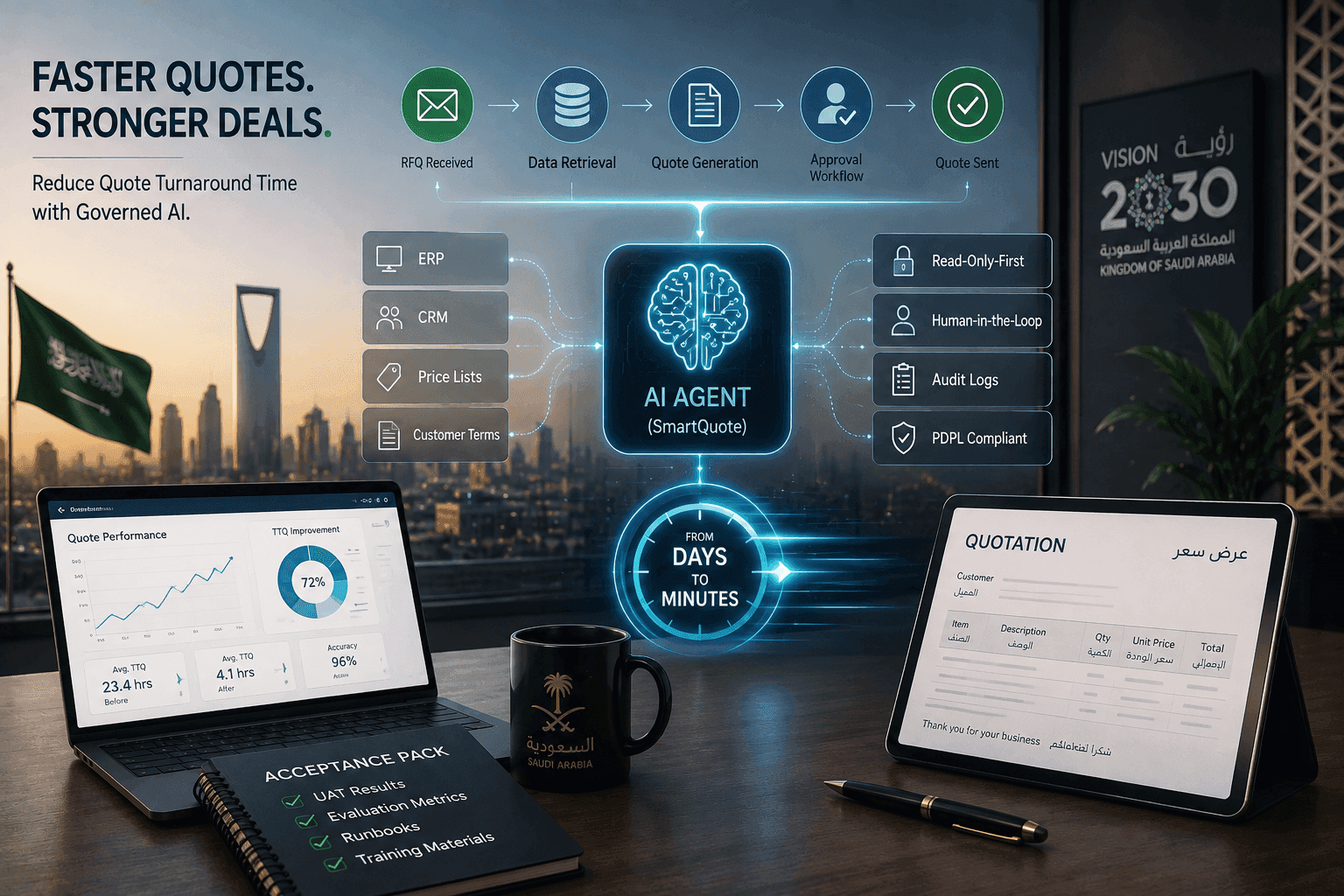
AI agents, like LeenAI's SmartQuote, are designed to optimize the RFQ-to-quote process by automating repetitive tasks and ensuring data accuracy. These agents work by first reading and analyzing RFQs to extract key information, minimizing the need for manual data entry. By employing a read-only-first approach, they maintain compliance with Saudi Arabia's PDPL, ensuring that personal data is handled responsibly. Furthermore, AI agents provide decision-makers with real-time insights, enabling faster and more informed decision-making.
What Role Does Governance Play in AI Adoption?
Governance is a critical component when adopting AI solutions in any enterprise. For Saudi companies, adhering to the Personal Data Protection Law (PDPL) is non-negotiable. AI agents must be designed with governance at their core, incorporating features such as audit logs, human-in-the-loop capabilities, and data residency controls. This ensures that all AI-driven processes are transparent and accountable. By choosing governed AI systems, enterprises can mitigate risks and foster trust among stakeholders.
How to Measure ROI from AI-Driven Quote Processes?
Measuring the return on investment (ROI) from AI-driven processes involves evaluating both qualitative and quantitative benefits. Key performance indicators (KPIs) such as time-to-quote (TTQ), first contact resolution (FCR), and average handling time (AHT) are essential metrics to consider. By implementing AI agents, enterprises can achieve a significant reduction in TTQ, which directly correlates to increased customer satisfaction and higher conversion rates. Additionally, the reduction in manual errors and enhanced data accuracy contribute to cost savings and improved operational efficiency.
What Does a 6-Week Pilot with AI Agents Deliver?
A 6-week pilot program with AI agents provides enterprises with a tangible proof of concept. This period allows businesses to evaluate the effectiveness of AI solutions like LeenAI's OpsRAG in a controlled environment. The pilot includes comprehensive user acceptance testing (UAT), evaluations, and the provision of runbooks and training materials. By the end of the pilot, enterprises can make data-driven decisions about full-scale implementation, ensuring that the AI agents meet their specific needs and KPIs.
How to Ensure Compliance with PDPL Using AI?
Ensuring compliance with PDPL while using AI agents requires a robust governance framework. AI solutions should be designed to be PDPL-aware from the onset, incorporating features such as read-only-first data handling and audit-logged processes. By keeping humans in the loop, these systems ensure that critical decisions are overseen by knowledgeable personnel, maintaining accountability and minimizing risks. Enterprises should also focus on continuous training and updates to stay aligned with evolving regulatory requirements.
The Future of AI in Saudi Enterprises
As Saudi Arabia continues its journey towards digital transformation, AI will play an increasingly vital role in enterprise operations. Governed AI agents are not only facilitating faster quote turnaround times but are also paving the way for more efficient and compliant business processes. By embracing these technologies, Saudi enterprises can enhance their competitiveness and align with Vision 2030's objectives of innovation and sustainability.