Why Saudi Enterprises Are Moving to AI Quotation Systems
For procurement and operations leaders in Saudi Arabia, the RFQ-to-quote cycle is where margins are won or lost. Every day a quote is delayed, a competitor gets the meeting. Yet most distributors and manufacturers still rely on manual review of PDFs, spreadsheets, and email threads—a process that is slow, error-prone, and hard to scale as the Kingdom's Vision 2030 pushes for faster, more diversified trade.
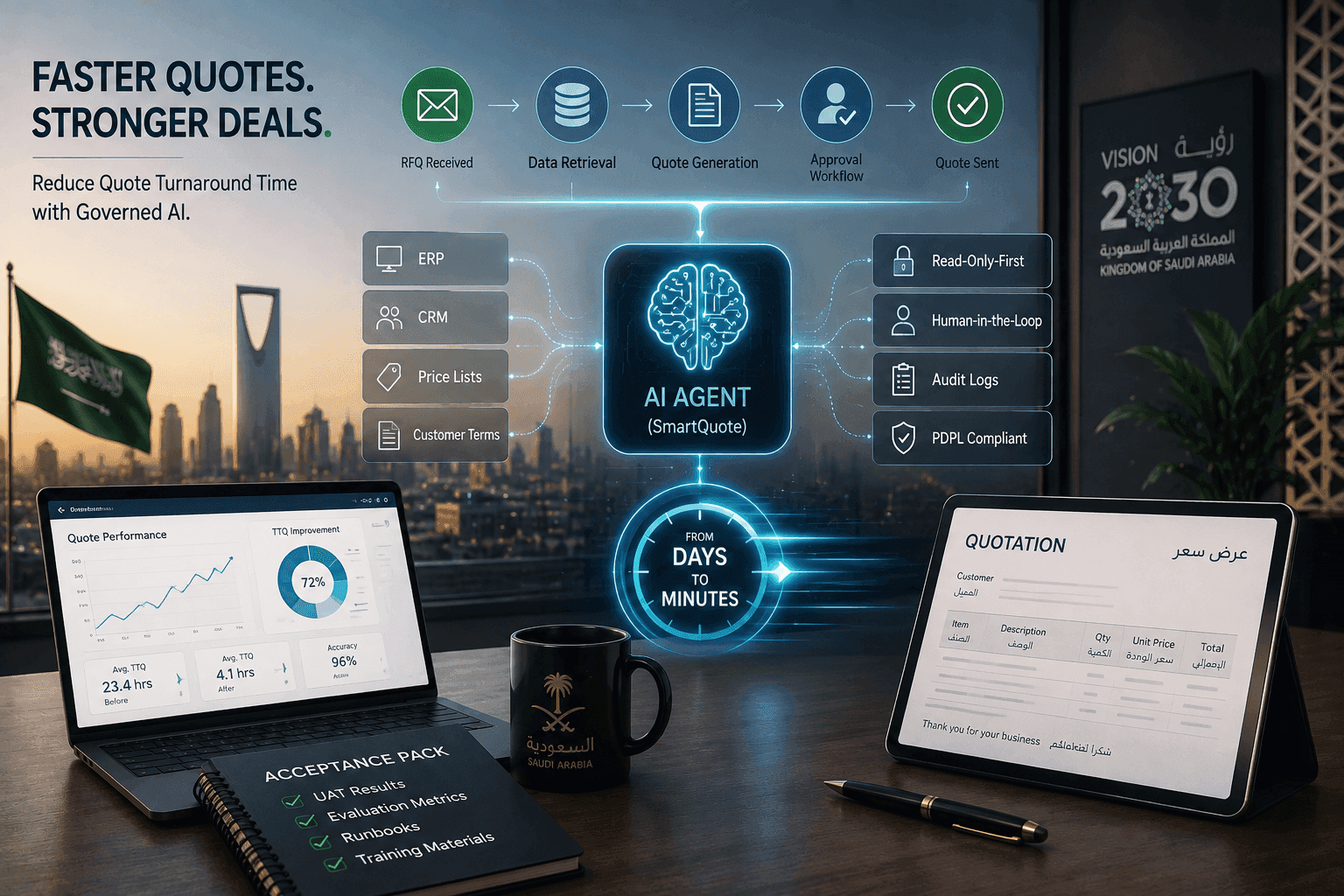
An AI quotation system changes this by using AI agents that can read incoming RFQs, extract key requirements, match them against your product catalog and pricing rules, and draft a quote for human approval. The result is not just speed—it's consistency. Every quote follows the same logic, references the same data, and is auditable from start to finish.
How Does an AI Quotation System Work Under the Hood?
At its core, an AI quotation system is a combination of retrieval-augmented generation (RAG) and workflow automation. When an RFQ arrives—whether by email, portal, or WhatsApp—an agent classifies it, extracts structured data like item numbers, quantities, and delivery dates, and then retrieves relevant information from your internal documents: price lists, contracts, technical specs, and historical quotes.
Crucially, the system is read-only-first. It does not modify your source data; it only reads what it needs and generates a draft quote. That draft goes to a human reviewer who can adjust pricing, terms, or notes before it is sent. Every action—what the agent read, what it suggested, and what the human changed—is logged in an audit trail. This is not just good practice; it is essential for compliance with Saudi Arabia's Personal Data Protection Law (PDPL).
What Are the Governance and PDPL Considerations?
PDPL compliance is non-negotiable for Saudi enterprises. An AI quotation system must be designed with data minimization in mind: it should only access the data necessary to complete the quote, and it should never store or process personal data beyond what is required. For example, if an RFQ contains contact details of a customer's employee, the system should use that information only for the purpose of the quote and not retain it longer than needed.
Governance also means human-in-the-loop. Even the best AI can misread a complex specification or miss a nuance in a long-term contract. By keeping a human reviewer in the loop, you get the best of both worlds: the speed of automation and the judgment of an experienced professional. This is especially important for high-value or strategic quotes where relationships matter.
What Does a 6-Week Pilot Deliver?
A well-scoped pilot of an AI quotation system can be delivered in 6–8 weeks, and it should focus on a specific, measurable outcome. For example, you might choose one product line or one customer segment and aim to reduce quote turnaround time (TTQ) by 30% or improve first-contact resolution (FCR) for quote-related inquiries. The pilot includes user acceptance testing (UAT), evaluation against agreed KPIs, runbooks for your team, and training—so that when the pilot ends, you have a clear go/no-go decision.
LeenAI's Acceptance Pack is built exactly for this: it ensures that every pilot is tested against real-world scenarios, that your team knows how to operate the system, and that you have the evidence to justify scaling. No slide decks, no vague promises—just proof.
How to Choose the Right AI Quotation System for Your Business
When evaluating vendors, ask tough questions. Does the system support Arabic and English? For Saudi enterprises, Arabic RAG is a real edge—many RFQs and internal documents are in Arabic, and a system that cannot handle Arabic accurately will fail. Does it integrate with your existing CRM or ERP? You don't want a siloed tool that requires manual data entry.
Also, ask about the governance model. Can you see exactly what the AI did and why? Can you override its suggestions? Is the audit log tamper-proof? These are not optional features; they are the foundation of trust. Finally, ask about the pilot process. A serious vendor will offer a fixed-scope pilot with clear KPIs, not an open-ended engagement.
The Business Case: Speed, Accuracy, and Scalability
The business case for an AI quotation system is straightforward. Faster quotes mean more deals closed. Fewer errors mean fewer disputes and rework. And because the system learns from your data, it gets better over time—your team spends less time on repetitive tasks and more time on strategic relationships.
For Saudi enterprises, this is not just about efficiency; it is about competitiveness. As the Kingdom opens up to more international trade, the ability to respond quickly and accurately to RFQs from global buyers becomes a differentiator. An AI quotation system, governed and PDPL-aware, is a practical step toward that future.
If you are ready to see how this works in practice, talk to us or explore LeenAI's SmartQuote to understand how we scope pilots. We believe in proof before claims—and we are happy to demonstrate it.