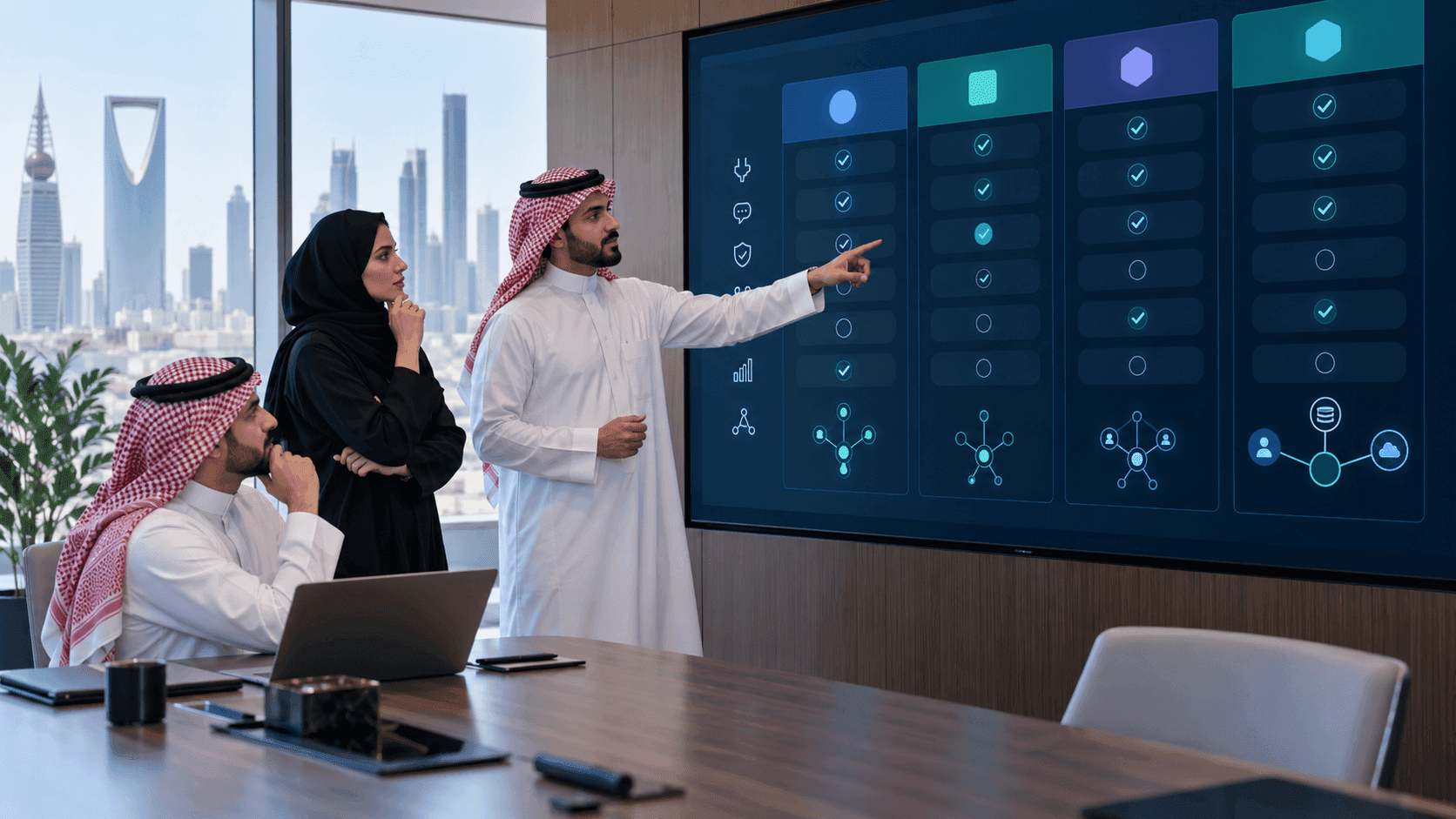

Why Saudi manufacturers are moving from dashboards to agents
Manufacturing in Saudi Arabia is at a turning point. Vision 2030 has pushed industrial leaders to digitize operations, but most have only reached the dashboard stage: data flowing in, reports generated, humans still doing the slow, repetitive work of turning that data into decisions. The next step is not another analytics tool — it's AI agents that can act. An AI agent doesn't just tell you that a quote is taking too long; it drafts the quote, flags the bottleneck, and asks for approval before sending. That shift, from insight to action, is where real efficiency gains happen.
But acting on data in a regulated environment like Saudi Arabia brings responsibility. The Personal Data Protection Law (PDPL) sets clear rules for how personal data is handled, and manufacturers handle a lot of it: customer details, supplier contacts, employee records. An AI agent that reads this data must be designed with privacy and security from day one. That's why governance isn't a compliance checkbox — it's the foundation that makes agentic AI safe to deploy in manufacturing.
What does a governed AI agent look like on the factory floor?
A governed AI agent in manufacturing is not a black box making autonomous decisions. It operates with three core principles: read-only-first, human-in-the-loop, and audit-logged by design. Read-only-first means the agent can access and analyze data, but it cannot modify or delete anything without explicit human authorization. This is critical for production systems where a wrong write could halt a line or corrupt inventory records.
Human-in-the-loop ensures that significant actions — like approving a purchase order or changing a delivery schedule — always require a person to sign off. The agent prepares the action, presents the reasoning, and waits for approval. This builds trust with operators and managers who are rightly cautious about automation. Audit logs record every action the agent takes, who approved it, and when. In a PDPL environment, this traceability is non-negotiable. It's how you prove compliance if a regulator asks.
How does Arabic RAG stay PDPL-compliant?
Many AI systems struggle with Arabic because of its morphology and dialectal variations. A retrieval-augmented generation (RAG) system that works in Arabic must be built on a solid understanding of the language, not just a translation layer. LeenAI's OpsRAG is designed for Arabic and English from day one, so it can pull from Arabic maintenance manuals, supplier contracts, and quality reports with the same accuracy as English sources.
PDPL compliance in RAG means controlling what the agent retrieves and how it uses it. The system must respect data residency — keeping data within Saudi borders — and minimize what it processes to only what's needed for the task. For example, if an agent is answering a question about a machine's maintenance history, it should not pull in the technician's personal phone number unless absolutely necessary. Data minimization is not just a legal requirement; it's good engineering that reduces risk and improves response accuracy.
What does a 6-week pilot deliver?
A common fear among manufacturers is that AI projects drag on for years with unclear results. LeenAI's approach is the opposite: a fixed-scope pilot that runs for 6–8 weeks and delivers measurable KPIs. For procurement and operations, that might be reducing quote turnaround time (TTQ) by 30% or cutting document processing errors in half. For customer service, it could be improving first-contact resolution (FCR) or reducing average handling time (AHT).
The pilot includes an Acceptance Pack: user acceptance testing (UAT), evaluation metrics, runbooks, and training. This means your team doesn't just get a demo — they get a system they can operate and a clear set of criteria to judge success. If the pilot doesn't meet the agreed KPIs, you have the evidence to stop or pivot. That's proof before claims, not a slide deck.
How to choose the right AI agent for your plant
Not every AI agent is right for every manufacturing challenge. Start by identifying the bottleneck that costs you the most time or money. If it's the RFQ-to-quote process, a specialized agent like SmartQuote can automate the drafting of quotes, pulling from your price lists and historical data, while keeping a human in the loop for final approval. If it's customer inquiries on WhatsApp, a WhatsApp CX agent can handle routine questions in Arabic and English, freeing your team for complex issues.
If your pain is knowledge retrieval — engineers spending hours searching for the right manual or spec — OpsRAG can index your documents and answer questions instantly. And if you need to automate a specific operational decision, MAE (Manufacturing Automation Engine) can be tailored to your workflow. The key is to pick a focused problem, not boil the ocean.
Why governance is your competitive advantage
In a global market, Saudi manufacturers can't compete on cost alone. They need to differentiate on speed, quality, and compliance. A governed AI agent that acts safely and transparently is a competitive advantage because it lets you move faster without risking regulatory penalties or reputational damage. Customers and partners increasingly ask about your AI governance — being able to say "our AI is PDPL-compliant, audit-logged, and human-oversight-driven" is a strong selling point.
Moreover, governance builds internal trust. When your operators see that the AI respects their expertise and requires their approval, they're more likely to adopt it. That's how you get real ROI — not from the technology itself, but from the people using it effectively.
Getting started with a governed AI pilot
If you're ready to explore AI for your manufacturing operations, start small. Define a specific KPI you want to improve, choose a process that's data-rich but slow, and run a pilot with clear acceptance criteria. LeenAI's pilots are designed to fit your timeline and budget, with the Acceptance Pack ensuring you know exactly what you're getting. Talk to us to discuss your challenges, or see how we scope pilots to understand what to expect. If you want to see a specific agent in action, explore SmartQuote or OpsRAG. The future of manufacturing in Saudi Arabia is agentic — make sure it's governed.