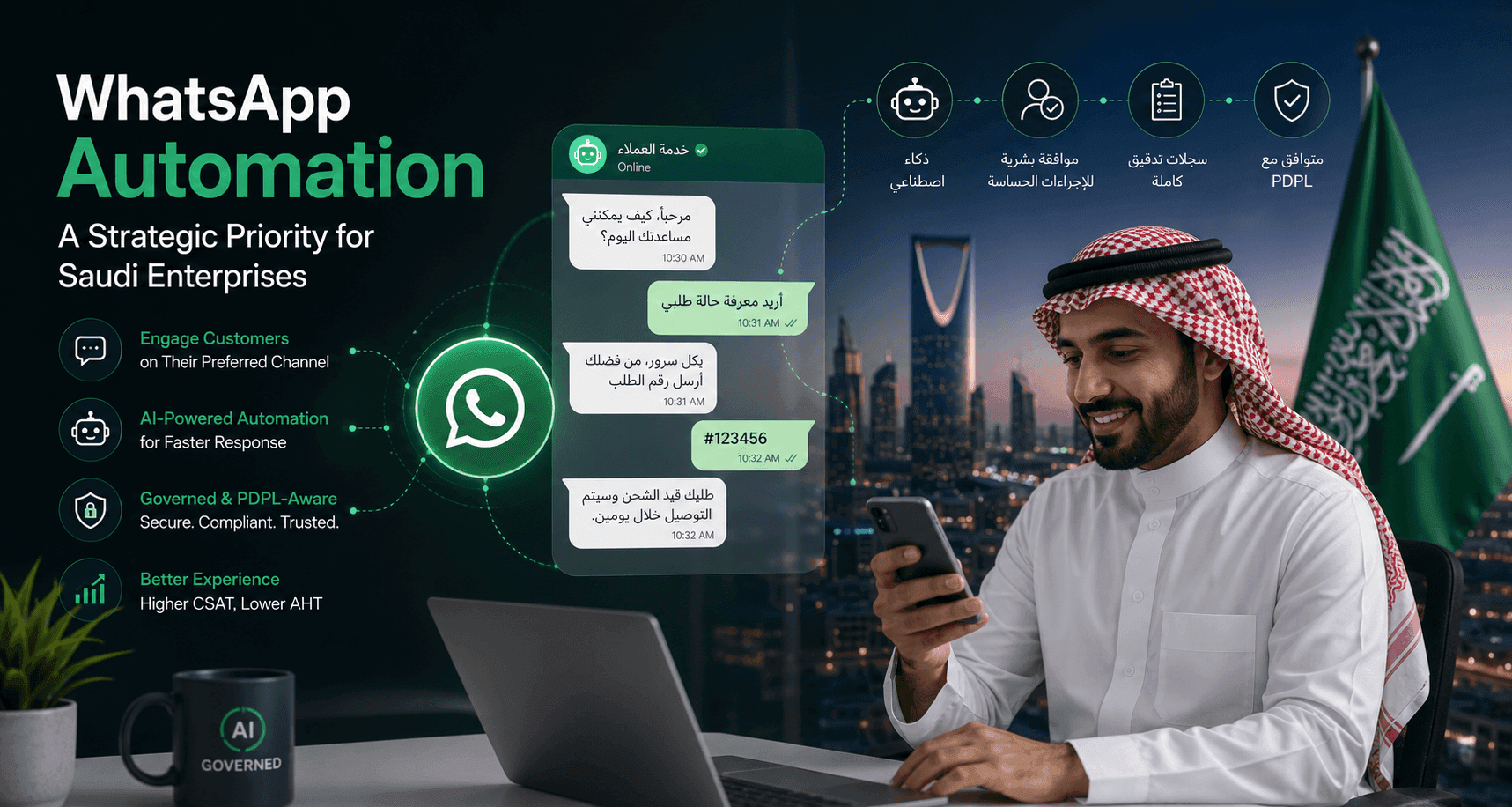
WhatsApp has become an important communication channel for customers and businesses across Saudi Arabia. For enterprises, this creates a significant opportunity: instead of handling every customer message manually, organizations can use WhatsApp automation to respond faster, manage high message volumes, and give employees more time to focus on complex requests.
But enterprise WhatsApp automation requires more than a chatbot.
When conversations involve customer names, phone numbers, orders, account information, or other personal data, organizations need to consider privacy, security, access control, and applicable requirements under Saudi Arabia's Personal Data Protection Law (PDPL).
This is where governed WhatsApp automation becomes particularly valuable. A governed AI agent can retrieve approved information, draft responses, and support customer-service workflows while operating within predefined permissions and escalation rules.
For Saudi enterprises, the goal is not simply to automate more conversations. It is to automate them securely, responsibly, and measurably.
What Is WhatsApp Automation for Saudi Enterprises?
WhatsApp automation uses software, workflows, chatbots, or AI agents to manage customer interactions through WhatsApp without requiring a human employee to handle every message manually.
Depending on the use case, automation can help with:
- Frequently asked questions.
- Order and delivery updates.
- Product and service information.
- Customer-service triage.
- Lead qualification.
- Appointment or service requests.
- Internal business communications.
- Escalation of complex customer issues.
Traditional automation generally follows predefined rules and workflows. AI-powered WhatsApp automation can go further by understanding natural-language questions, retrieving information from approved enterprise systems, and generating context-aware responses.
For Saudi organizations, bilingual capability is also important because customer interactions may take place in both Arabic and English.
Why Is WhatsApp Automation a Strategic Priority in Saudi Arabia?
The business case for WhatsApp automation goes beyond reducing the number of messages handled by customer-service teams.
Customers increasingly expect organizations to provide fast responses through convenient digital channels. Delays in answering routine questions can lead to repeated messages, longer queues, and unnecessary workload for customer-service teams.
With a properly designed AI-powered WhatsApp solution, enterprises can automate repetitive interactions while allowing employees to concentrate on requests that require judgment.
The potential benefits include:
- Faster customer response times.
- Lower Average Handling Time (AHT).
- Improved First Contact Resolution (FCR).
- More consistent customer responses.
- Better lead response speed.
- Reduced repetitive workload.
- 24/7 availability for routine requests.
- Improved access to company information.
The strategic advantage comes from combining automation with governance, rather than treating WhatsApp as an unrestricted AI channel.
How Does PDPL Apply to WhatsApp Automation?
WhatsApp customer interactions can involve personal data. Depending on the business and use case, this may include names, phone numbers, customer records, order information, or conversation history.
Organizations therefore need to consider how personal data is collected, processed, accessed, retained, and protected when implementing WhatsApp automation.
A governed architecture can support these requirements through several controls.
Read-Only-First Access
An AI agent can be given access to the information it needs to answer customer questions without automatically receiving permission to modify business records.
For example, the agent may be allowed to retrieve an order status but require additional authorization before changing an order or initiating a refund.
Human-in-the-Loop Approval
Sensitive or high-impact actions can be routed to an authorized employee.
The AI agent can prepare a response or action, while a human reviews and approves it before execution.
Access Controls
The system should restrict the information available to the AI agent based on the use case and applicable permissions.
This helps prevent the unnecessary exposure of customer or business information.
Audit Logs
Relevant interactions and actions can be logged to provide visibility into what the system did, what information it accessed, and when an action occurred.
Data Protection by Design
Privacy and security requirements should be considered when designing the workflow, integrations, data architecture, and retention policies rather than being added after deployment.
Importantly, PDPL compliance is not achieved simply by selecting a WhatsApp automation product. Organizations should evaluate their specific data-processing activities, architecture, contractual arrangements, and applicable regulatory obligations.
What Are the Best WhatsApp Automation Use Cases for Saudi B2B Enterprises?
WhatsApp automation can support both B2C and B2B organizations. For Saudi B2B enterprises, several use cases can deliver measurable value.
1. Customer-Service Triage
An AI agent can classify incoming WhatsApp messages and route them to the appropriate department.
For example, a logistics company could distinguish between:
- Delivery questions.
- Shipment delays.
- New orders.
- Complaints.
- Pricing requests.
Routine questions can potentially be answered automatically, while urgent or complex cases can be escalated.
2. Lead Qualification
Sales teams can use WhatsApp automation to engage potential customers, answer initial questions, collect qualifying information, and route qualified leads to sales representatives.
This can reduce the time between receiving an inquiry and contacting a potential customer.
3. Order Status Updates
Businesses can automate notifications related to:
- Order confirmation.
- Order processing.
- Shipment.
- Delivery.
- Service completion.
Providing proactive updates can reduce the number of customers contacting support simply to ask about order status.
4. Product and Service Questions
An AI agent connected to an approved knowledge base can answer questions about product specifications, services, policies, availability, or documentation.
This is particularly useful when customer-service teams repeatedly receive the same questions.
5. Escalation to Human Agents
Automation should not mean that customers lose access to human support.
When a request requires judgment, contains sensitive information, or falls outside the agent's approved capabilities, the conversation can be transferred to a human representative.
What Makes Governed WhatsApp Automation Different?
The biggest difference between basic WhatsApp automation and governed AI automation is control.
A governed AI agent operates within predefined boundaries.
These may include:
- What data the agent can access.
- What systems it can connect to.
- Which actions it can perform.
- Which actions require approval.
- When conversations must be escalated.
- What interactions should be logged.
- Which employees can review or approve actions.
This approach allows enterprises to benefit from AI automation without giving an AI system unrestricted control over business processes.
For regulated or data-sensitive environments, this distinction is critical.
How Important Is Arabic Support for WhatsApp AI?
For Saudi enterprises, Arabic support should be evaluated beyond simple translation.
Customers may use Modern Standard Arabic, regional expressions, abbreviations, spelling variations, or a combination of Arabic and English within the same conversation.
A capable Arabic AI customer service system should be evaluated using real customer questions and language patterns.
Important capabilities include:
- Arabic natural-language understanding.
- Arabic and English conversations.
- Contextual understanding.
- Recognition of common language variations.
- Accurate retrieval from Arabic knowledge bases.
- Consistent terminology.
- Appropriate escalation when the system is uncertain.
This is especially important for enterprises whose customer-service documentation, policies, product information, and communications exist in both Arabic and English.
How Do You Choose a WhatsApp Automation Solution?
Not every WhatsApp automation platform is suitable for enterprise use.
Before selecting a solution, evaluate the following areas.
1. Governance
Look for controls such as read-only access, approval workflows, escalation rules, and audit logging.
2. Arabic and English Support
Test the system with real Arabic customer questions rather than relying only on a vendor's language claims.
3. Enterprise Integrations
Determine whether the solution can connect to the CRM, ERP, knowledge base, order management system, or other approved data sources required for the use case.
4. Data Protection
Understand how customer data is processed, stored, accessed, retained, and protected.
5. Human Escalation
Customers should have a clear path to human support when automation cannot safely or accurately resolve their request.
6. Measurement
The solution should support measurable KPIs so the business can determine whether automation is actually improving customer service.
What Does a Six-Week WhatsApp Automation Pilot Look Like?
A fixed-scope pilot can be a practical way to evaluate AI-powered WhatsApp automation before committing to a broader deployment.
Instead of trying to automate every customer interaction, the organization selects one high-value workflow.
A typical pilot can include:
Week 1: Discovery
Define the use case, target users, existing workflow, KPIs, and governance requirements.
Week 2: Solution Design
Map the required data sources, permissions, escalation paths, and integration requirements.
Week 3: Development and Integration
Connect the AI agent to the relevant WhatsApp environment, CRM, knowledge base, or other approved systems.
Week 4: Testing
Run user acceptance testing (UAT) using realistic customer scenarios, including Arabic and English interactions where relevant.
Week 5: Controlled Deployment
Deploy the agent to a limited workflow or user group while monitoring performance and escalation behavior.
Week 6: Evaluation
Compare the results against the agreed KPIs and determine whether the use case is ready to scale.
This pilot-first approach gives enterprises evidence about language quality, integration performance, governance, and ROI before making a larger commitment.
What KPIs Should You Track for WhatsApp Automation?
Automation should be measured using business outcomes rather than the number of conversations handled alone.
Important WhatsApp automation KPIs include:
First Contact Resolution (FCR)
Measures the percentage of customer issues resolved during the first interaction without additional follow-up.
Average Handling Time (AHT)
Measures the average time required to handle and resolve a customer interaction.
Response Time
Measures how quickly customers receive an initial response.
Customer Satisfaction (CSAT)
Measures customer satisfaction after an interaction.
Escalation Rate
Shows how frequently conversations need to be transferred to human representatives.
Automation Rate
Measures the percentage of eligible conversations successfully handled without human intervention.
Resolution Accuracy
Measures whether the AI agent provides correct and relevant answers.
Before launching an automation project, establish a baseline for these metrics. The objective is to demonstrate measurable improvement without sacrificing customer experience or governance.
How LeenAI Approaches Governed WhatsApp Automation
LeenAI's WhatsApp CX is designed around governed AI customer-service workflows.
The approach combines bilingual conversations with controlled access to enterprise information, human escalation, and auditability.
Rather than giving an AI agent unrestricted authority, organizations can define what the agent is allowed to access and which actions require human involvement.
This makes WhatsApp automation suitable for a broader range of enterprise workflows where speed, control, and accountability all matter.
Why Governed WhatsApp Automation Is the Future of Enterprise Customer Service
WhatsApp automation can help Saudi enterprises respond faster, reduce repetitive workloads, and create more convenient customer experiences.
But successful enterprise automation requires more than connecting an AI model to WhatsApp.
Organizations need to consider:
- Arabic language quality.
- Enterprise system integration.
- Data protection.
- Access controls.
- Human oversight.
- Auditability.
- Customer experience.
- Measurable KPIs.
The strongest approach is therefore governed WhatsApp automation: automate routine work while keeping sensitive decisions and high-impact actions within clearly defined controls.
Frequently Asked Questions About WhatsApp Automation
What is WhatsApp automation?
WhatsApp automation uses software, workflows, chatbots, or AI agents to automatically manage customer interactions through WhatsApp, such as answering common questions, providing order updates, qualifying leads, or routing conversations.
Can WhatsApp automation support Arabic?
Yes. WhatsApp automation can support Arabic, but the quality depends on the underlying AI technology. Enterprise solutions should be tested with real Arabic customer queries, language variations, and Arabic-English conversations.
Is WhatsApp automation suitable for B2B companies?
Yes. B2B organizations can use WhatsApp automation for lead qualification, customer support, order updates, product questions, service requests, and internal routing.
Is WhatsApp automation compliant with PDPL?
WhatsApp automation itself is not automatically "PDPL compliant." Compliance depends on how personal data is collected, processed, accessed, stored, transferred, and protected within the specific implementation.
How can AI agents make WhatsApp automation safer?
AI agents can operate within defined permissions and governance controls. These can include read-only-first access, human approval for sensitive actions, restricted system access, escalation workflows, and audit logs.
Can a WhatsApp AI agent connect to a CRM?
Yes. Depending on the solution and integration architecture, an AI agent can connect to a CRM or other approved enterprise systems to retrieve the information required to answer customer questions.
Can WhatsApp AI transfer customers to human agents?
Yes. Human escalation is an important component of enterprise AI customer service. Conversations can be transferred when a request is complex, sensitive, outside the agent's permissions, or requires human judgment.
How do you measure the ROI of WhatsApp automation?
ROI can be evaluated through metrics such as response time, FCR, AHT, CSAT, automation rate, escalation rate, and conversion rate. The most useful approach is to compare these metrics against a baseline established before deployment.
How long does a WhatsApp automation pilot take?
The timeline depends on the use case, integrations, data readiness, and governance requirements. A fixed-scope pilot can provide a practical way to test one workflow, measure KPIs, and identify issues before scaling.
Start Your Governed WhatsApp Automation Journey
WhatsApp automation is becoming an important strategic opportunity for Saudi enterprises, but automation should not come at the expense of control, privacy, or customer experience.
The right approach is to start with a focused use case, define measurable KPIs, establish governance requirements, and test the AI agent with real customer interactions.
LeenAI can help organizations evaluate governed AI agents for WhatsApp customer service through a focused pilot and measurable acceptance criteria.
Explore LeenAI's pricing and pilot options or talk to our team to discuss how governed WhatsApp automation can support your organization.