Why Arabic RAG Is a Game-Changer for Saudi Enterprises
Arabic is the language of your contracts, RFQs, supplier catalogs, and customer conversations. Yet most enterprise AI tools are built for English. Arabic RAG (Retrieval-Augmented Generation) changes that: it lets an AI agent retrieve the right Arabic content from your documents and generate answers in Arabic — without retraining a model.
For a Saudi distributor, that means a procurement officer can ask, "What are the payment terms in the last contract with supplier X?" and get a precise, cited answer in seconds. For a CX leader, it means a WhatsApp bot can handle Arabic customer queries about order status or returns, pulling from your policy documents and knowledge base.
The catch? Arabic is morphologically rich, and off-the-shelf RAG systems often stumble on diacritics, synonyms, and right-to-left formatting. That's why a governed Arabic RAG approach — one that combines robust retrieval with strict access controls — is essential for enterprise use.
How Does Arabic RAG Work Under the Hood?
Arabic RAG works in three steps. First, your documents — PDFs, Word files, emails — are ingested and split into chunks. Second, an embedding model converts each chunk into a vector representation. When a user asks a question, the system retrieves the most relevant chunks by comparing vector distances. Finally, a large language model (LLM) generates a response grounded in those chunks, with citations.
For Arabic, the embedding model must understand the language's nuances. A good model handles different dialects, synonyms like "سيارة" and "مركبة", and even Arabic script variations. It also needs to respect right-to-left layout and avoid breaking words at line ends.
But retrieval is only half the story. The other half is governance: who can access which documents, what gets logged, and how do you ensure the agent doesn't "hallucinate"? That's where governed Arabic RAG comes in.
What Does "Governed" Mean for Arabic RAG?
Governed Arabic RAG means the AI agent operates within guardrails that align with Saudi regulations and enterprise risk policies. Key principles include:
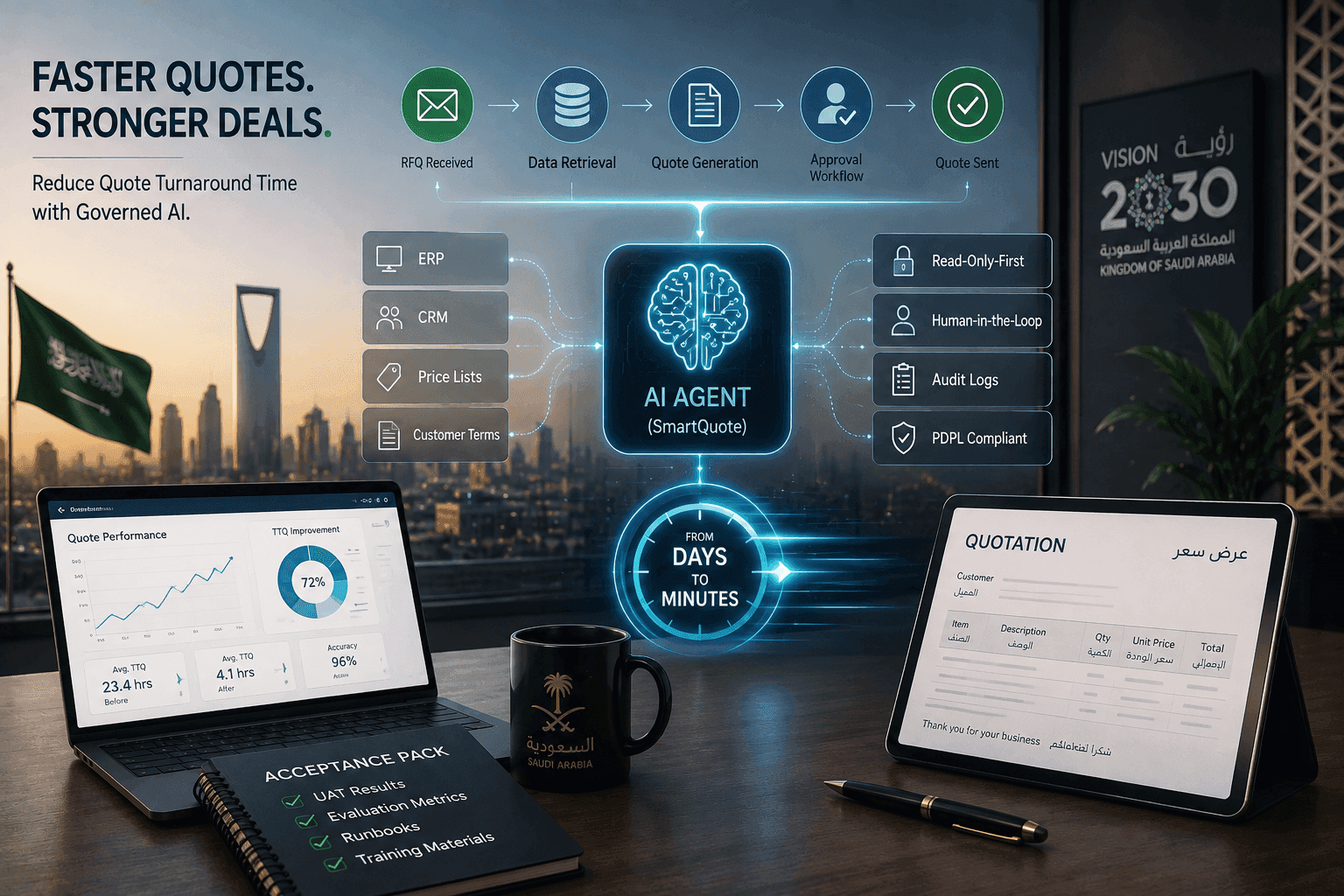
- Read-only-first: The agent can read and retrieve, but it cannot modify or delete data. This prevents accidental corruption.
- Human-in-the-loop: For high-stakes decisions, the agent proposes an answer, but a human approves before it's sent. For example, a contract clause interpretation might require a legal review.
- PDPL-aware: The Saudi Personal Data Protection Law requires data minimization and purpose limitation. Governed RAG ensures the agent only accesses data necessary for the task, and logs all access for audit.
- Audit logs: Every query and response is logged, so you can trace what the agent did and why.
These guardrails are not optional. They build trust with stakeholders and regulators, and they make the difference between a toy demo and a production-ready system.
How Does Arabic RAG Stay PDPL-Compliant?
PDPL compliance is a top concern for Saudi CIOs. Arabic RAG can be PDPL-compliant if designed carefully. First, data residency: all processing should happen within Saudi Arabia or in approved regions. Second, data minimization: the agent should only retrieve the minimum necessary data to answer a query. For example, if an employee asks about a customer's order, the agent should not pull up their full profile unless needed.
Third, purpose limitation: the RAG system should be scoped to specific use cases, like procurement or customer service, and not allow open-ended queries that could expose unrelated data. Fourth, access controls: integrate with your identity provider to ensure only authorized users can query certain document sets.
Finally, audit logging: record every query, the documents retrieved, and the response. This gives you a trail to demonstrate compliance if audited. LeenAI's agents are built with these principles in mind, so you can deploy Arabic RAG without compromising on PDPL.
What Does a 6-Week Arabic RAG Pilot Deliver?
A fixed-scope pilot is the fastest way to prove value. In six weeks, you can deploy a governed Arabic RAG agent for a specific workflow, such as RFQ-to-quote or knowledge lookup. The pilot includes:
- UAT (User Acceptance Testing): Your team tests the agent on real queries and validates the answers.
- Evals: We measure retrieval accuracy and answer quality against a golden set of questions.
- Runbooks: Documentation on how to operate and maintain the agent.
- Training: Your staff learns how to use and supervise the agent.
At the end of the pilot, you have measurable KPIs — like time-to-quote (TTQ) or first-contact resolution (FCR) — and a clear go/no-go decision. This is what we call the Acceptance Pack: proof before claims.
How to Choose an Arabic RAG Solution for Your Enterprise
When evaluating Arabic RAG solutions, ask these questions:
- Does it support Modern Standard Arabic and common dialects?
- Can it handle PDFs, scanned documents, and Arabic handwriting?
- How does it handle access control and audit logging?
- Is it deployable on-premises or in a Saudi cloud for data residency?
- How does it integrate with your existing systems like ERP or CRM?
Also, ask for a proof-of-concept with your own data. A vendor that claims "99% accuracy" without testing on your documents is not credible. Instead, look for a partner that offers a structured pilot with clear acceptance criteria. That's the approach we take at LeenAI: we scope a fixed pilot, define KPIs, and deliver within weeks.
If you're ready to explore Arabic RAG for your enterprise, talk to us or see how we scope pilots. You can also learn about LeenAI's OpsRAG, our governed knowledge-ops agent that handles Arabic and English documents.
The Future of Arabic RAG in Saudi Arabia's Digital Transformation
As Vision 2030 accelerates digital transformation, Arabic RAG will become a cornerstone of enterprise AI. It enables organizations to leverage their Arabic-language data assets — contracts, policies, customer interactions — to make faster, better decisions. With governance built in, Saudi enterprises can adopt AI confidently, knowing they are compliant and in control.
The key is to start small, prove value, and scale. A governed Arabic RAG pilot is the first step toward an agentic future where AI agents act safely and effectively on your behalf.