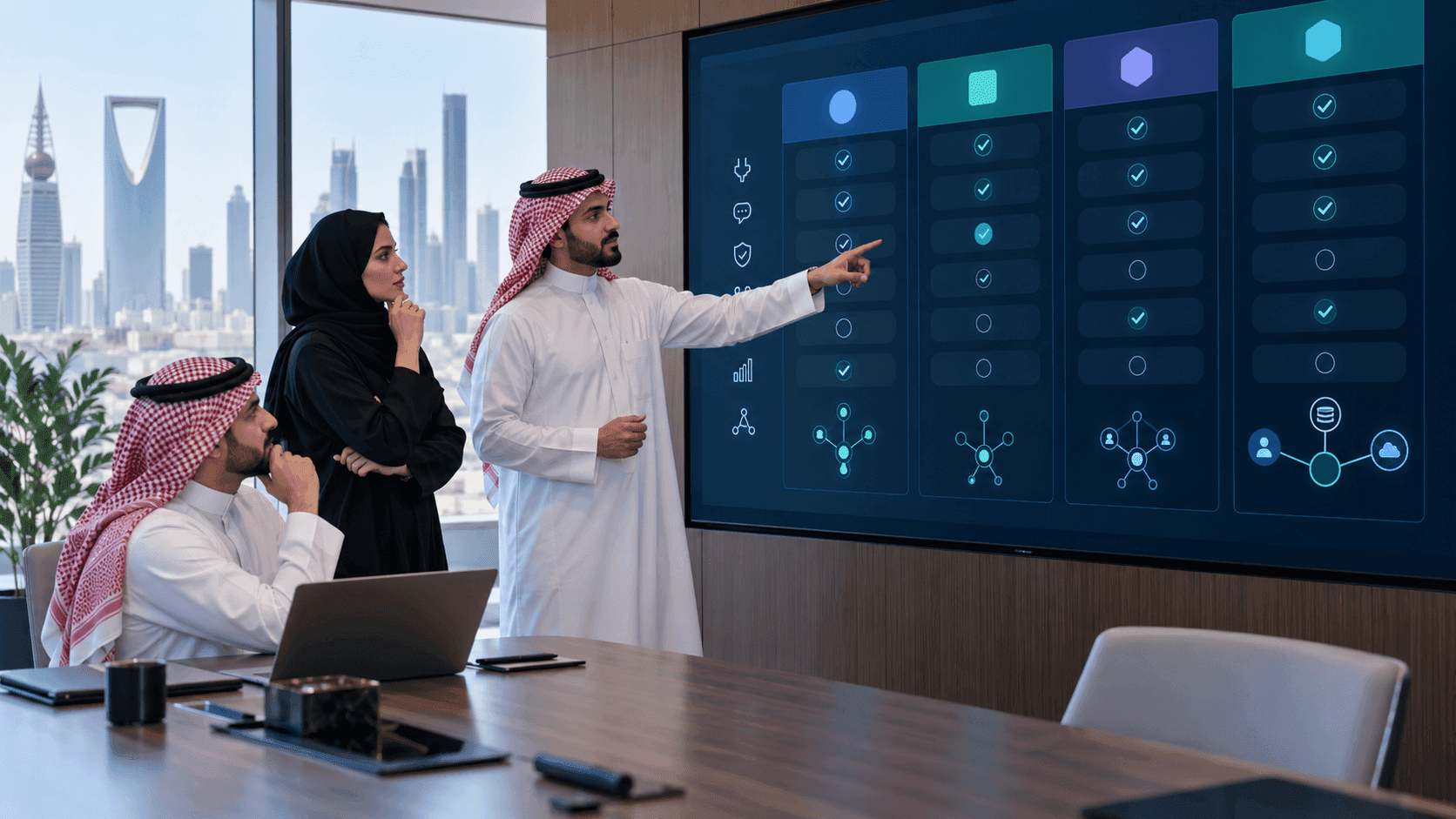

Why Saudi Enterprises Need an Arabic Knowledge Base AI Assistant What is an Arabic knowledge base AI assistant?
An Arabic knowledge base AI assistant helps employees find clear, cited answers across approved Arabic and English company documents without manually searching through PDFs, presentations, shared folders, and business systems.
Unlike a generic chatbot, an enterprise knowledge assistant uses selected organizational information. A governance-first assistant should respect access permissions, show the sources supporting its answers, decline questions when reliable evidence is unavailable, and record relevant activity for monitoring.
For Saudi enterprises, this can reduce time spent searching for information, improve answer consistency, and make operational knowledge easier to use across Arabic and English teams.
Why is enterprise knowledge difficult to access?
Saudi organizations accumulate policies, product manuals, procurement guidelines, standard operating procedures, HR policies, technical specifications, and customer service scripts.
This knowledge is often scattered across SharePoint, emails, PDFs, spreadsheets, presentations, and internal systems. Employees may not know which document is current or where the approved version is stored.
The result is:
Slow responses to routine questions. Inconsistent information between departments. Repeated interruptions for senior employees. Dependence on a few subject-matter experts. Longer onboarding for new employees. Greater risk of using outdated documents.
An AI knowledge base does not replace knowledge ownership. It provides a faster way to retrieve approved information while preserving access to the original source.
How does an Arabic AI knowledge assistant work?
An Arabic knowledge assistant commonly uses Retrieval-Augmented Generation, or RAG.
When an employee submits a question, the assistant searches selected enterprise sources, retrieves relevant passages, and uses them to prepare an answer.
A typical process includes:
Selecting approved knowledge sources. extracting, organizing, and indexing their content. Receiving a question in Arabic or English. Retrieving relevant passages from authorized sources. Producing an answer with citations or source links.
For example, a procurement employee could ask:
ما متطلبات تأهيل الموردين الجدد؟
The assistant searches the approved procurement policies and provides an Arabic answer supported by the relevant document.
An employee could also ask a question in English while the supporting information is stored in Arabic. A bilingual assistant can retrieve the Arabic source and generate an English response, provided this capability has been properly tested.
How is it different from enterprise search or a chatbot?
Enterprise search identifies potentially relevant documents, but the employee must still open them and find the required information.
An enterprise AI assistant retrieves the relevant passages and prepares a concise answer based on them.
A generic chatbot may rely on general training or public information. It may not understand the organization’s products, policies, terminology, or access restrictions.
A governed enterprise assistant should:
Use selected company sources. Provide citations. Respect configured permissions. Avoid unsupported assumptions. Indicate when evidence is insufficient. Record relevant queries and retrieval events. Be evaluated using real organizational questions.
These controls make it more suitable for enterprise use than an open-ended public chatbot.
Why does Arabic RAG need dedicated testing?
Supporting Arabic requires more than translating an English interface. An Arabic RAG system may need to search Arabic and English documents, recognize Saudi business terminology, and maintain meaning across languages.
Testing should cover:
Modern Standard Arabic. Relevant Saudi terminology. Arabic and English documents in the same knowledge base. Mixed-language requests where commonly used. Spelling and transliteration variations. Arabic names, dates, currencies, and units. Right-to-left display. Arabic tables and forms. Scanned PDFs requiring OCR. Different terms used for the same product or process.
Performance should be measured separately in Arabic and English. A system may work well in one language while producing incomplete results in another.
Therefore, claims such as “Arabic-first” or “seamless bilingual understanding” should be supported by evaluations based on the organization’s documents and user questions.
Why are citations important?
A fluent answer is not necessarily a reliable answer.
An AI assistant with citations allows employees to verify the information before using it. This is especially important for procurement rules, safety procedures, HR policies, technical specifications, and customer commitments.
A useful answer may include:
The supporting document. A relevant source passage. A link to the original file. The document version or effective date. A warning when no reliable answer is available.
Citations also help teams investigate incorrect responses. They can determine whether the problem came from an outdated document, poor retrieval, or the generated answer.
LeenAI’s OpsRAG is designed as a knowledge agent that provides grounded answers over selected enterprise documents and data sources, supported by citations.
What happens when documents are outdated or conflicting?
RAG cannot automatically correct poorly managed knowledge.
If the knowledge base contains different versions of the same policy, the assistant may retrieve the wrong one unless proper document controls are applied.
Organizations should define:
The owner of each knowledge area. Which sources are authoritative. Document versions and effective dates. Review and approval procedures. Metadata requirements. Archiving rules for outdated documents. How conflicting information should be handled.
When reliable evidence is unavailable, the assistant should acknowledge the limitation, ask for clarification, or escalate the question. Producing a confident answer without evidence should be treated as a failed result.
How should restricted knowledge be protected?
Connecting more documents does not automatically create a better system. It may increase the risk of exposing confidential information.
A secure enterprise RAG implementation should determine:
Which repositories are connected. Which users can access each source. Whether permissions differ by department or role. Which information must never be retrieved. How access is removed when an employee changes roles. Who can update the knowledge index. Which activities are recorded and monitored.
Role-based access is particularly important when the knowledge base contains commercial terms, customer information, employee records, or internal financial data.
The permission model depends on the source and integration. During the pilot, the organization should verify that users cannot retrieve documents they are not authorized to view.
How can the assistant support PDPL-aware governance?
An Arabic knowledge base AI assistant is not automatically PDPL-compliant because it uses read-only access or is hosted in Saudi Arabia.
Compliance also depends on the processing purpose, legal basis, data minimization, transparency, retention periods, security controls, processor arrangements, data-subject rights, and applicable cross-border transfers.
A governance-first implementation can support these obligations by:
Limiting the assistant to approved sources. Minimizing personal data in the knowledge index. Applying role-based access. Protecting data during transfer and storage. Recording relevant retrieval and response events. Establishing retention and deletion procedures. Reviewing subprocessors and processing locations. Testing for unauthorized disclosure.
Deployment and data-processing locations should be agreed during project scoping. Depending on the organization’s requirements, potential options may include SaaS, a Saudi-based VPC, or an on-premise environment.
These options should be assessed for each organization rather than presented as a general compliance guarantee.
What sources can be connected?
OpsRAG can be scoped to work with selected enterprise sources, including:
PDF documents. Word files. PowerPoint presentations. Spreadsheets. Policies and procedures. Product manuals. Technical specifications. Selected ERP information. Approved document repositories.
OCR may be used for scanned files. However, its accuracy should be evaluated separately, particularly for Arabic text, tables, product codes, and low-quality scans.
Connections to SharePoint, ERP, CRM, document stores, or internal APIs depend on the available interfaces, security requirements, and agreed project scope.
Where can Saudi enterprises use an Arabic knowledge assistant? Procurement
Teams can retrieve supplier requirements, purchasing policies, commercial terms, and approved procedures without searching across multiple folders.
Manufacturing and Industrial Operations
Employees can find technical specifications, maintenance instructions, quality standards, and operational procedures across sites and shifts.
Logistics
Operations teams can retrieve shipment procedures, exception-handling rules, route information, and proof-of-delivery requirements.
Customer Service
Agents can find approved answers about products, policies, warranties, lead times, and service procedures with links to the source.
Hospitality and Multi-Branch Operations
Employees can access SOPs, service standards, recipes, HR policies, and branch procedures without escalating every routine question to a manager.
Employee Onboarding
New employees can understand internal policies and procedures faster while retaining access to the original documents.
How should an Arabic knowledge base assistant be evaluated?
A pilot should measure more than response speed. Recommended evaluation metrics include:
Retrieval precision. Retrieval recall. Answer faithfulness. Citation accuracy. Unsupported-answer rate. Appropriate refusal rate. Response time. Human correction rate. Resolution without escalation. Performance by language. Performance by document type. User satisfaction.
Targets should be agreed for each use case. An assistant answering technical safety questions may need stricter thresholds than one helping employees find general administrative information.
What should a 6–8-week OpsRAG pilot include?
A fixed-scope pilot should begin with one valuable knowledge problem instead of indexing every company document.
The pilot can include:
A defined use case and user group. Selected, approved knowledge sources. Arabic and English evaluation questions. Access and security requirements. A working knowledge assistant. Citations and source links. Relevant logs and performance metrics. User Acceptance Testing. AI evaluation results. Known limitations and unresolved risks. Operational instructions and training. A documented acceptance decision.
Exact deliverables should be defined in the Statement of Work. Evaluation plans, UAT materials, runbooks, training, and acceptance documentation may be separate deliverables.
At the end of the pilot, the organization should have enough evidence to decide whether to improve, restrict, scale, or stop the use case.
How do you choose the right enterprise AI assistant?
When evaluating an enterprise AI assistant in Saudi Arabia, ask:
Can it retrieve from Arabic and English sources? Has its Arabic performance been tested using our documents? Does it cite the source behind important answers? What happens when an answer cannot be verified? Can access be restricted by user or department? Where is the data stored and processed? Is customer data used to train external models? How are outdated documents removed? Can we inspect logs and evaluation results? Which metrics determine pilot acceptance?
The strongest provider is not necessarily the one promising the most features. It is the one willing to define the scope, test its claims, document limitations, and demonstrate measurable results.
Frequently Asked Questions What is an Arabic knowledge base AI assistant?
It is an enterprise system that retrieves information from approved Arabic and English sources and provides concise answers supported by citations.
What is Arabic RAG?
Arabic RAG combines enterprise information retrieval with a language model to answer questions using Arabic or bilingual source material.
Can it search Arabic PDF documents?
Yes. Supported PDFs can be indexed and searched. Scanned files may require OCR, and the accuracy of Arabic extraction should be tested.
Can it answer in English using an Arabic source?
A bilingual system can be configured to retrieve an Arabic source and answer in English. The capability should be tested to ensure that facts, numbers, and terminology remain consistent.
How does RAG reduce hallucinations?
RAG grounds responses in approved sources and can require citations or decline unsupported questions. It reduces the risk of hallucination but cannot eliminate errors completely.
Is an Arabic AI assistant automatically PDPL-compliant?
No. The assistant can support PDPL-aware controls, but compliance depends on the entire processing activity and the organization’s implementation.
How long does an OpsRAG pilot take?
LeenAI typically scopes enterprise AI pilots for approximately six to eight weeks. The schedule depends on source readiness, integrations, security reviews, and evaluation requirements.
Turn Enterprise Knowledge Into Verifiable Answers
Saudi enterprises do not need another chatbot that produces confident answers without evidence. They need a governed knowledge assistant that works across Arabic and English sources, respects access boundaries, cites supporting information, and admits when an answer cannot be verified.
LeenAI’s OpsRAG is designed to help teams access selected policies, procedures, product information, and operational knowledge through grounded answers with citations.
Talk to LeenAI to identify a high-value knowledge use case and define a measurable OpsRAG