
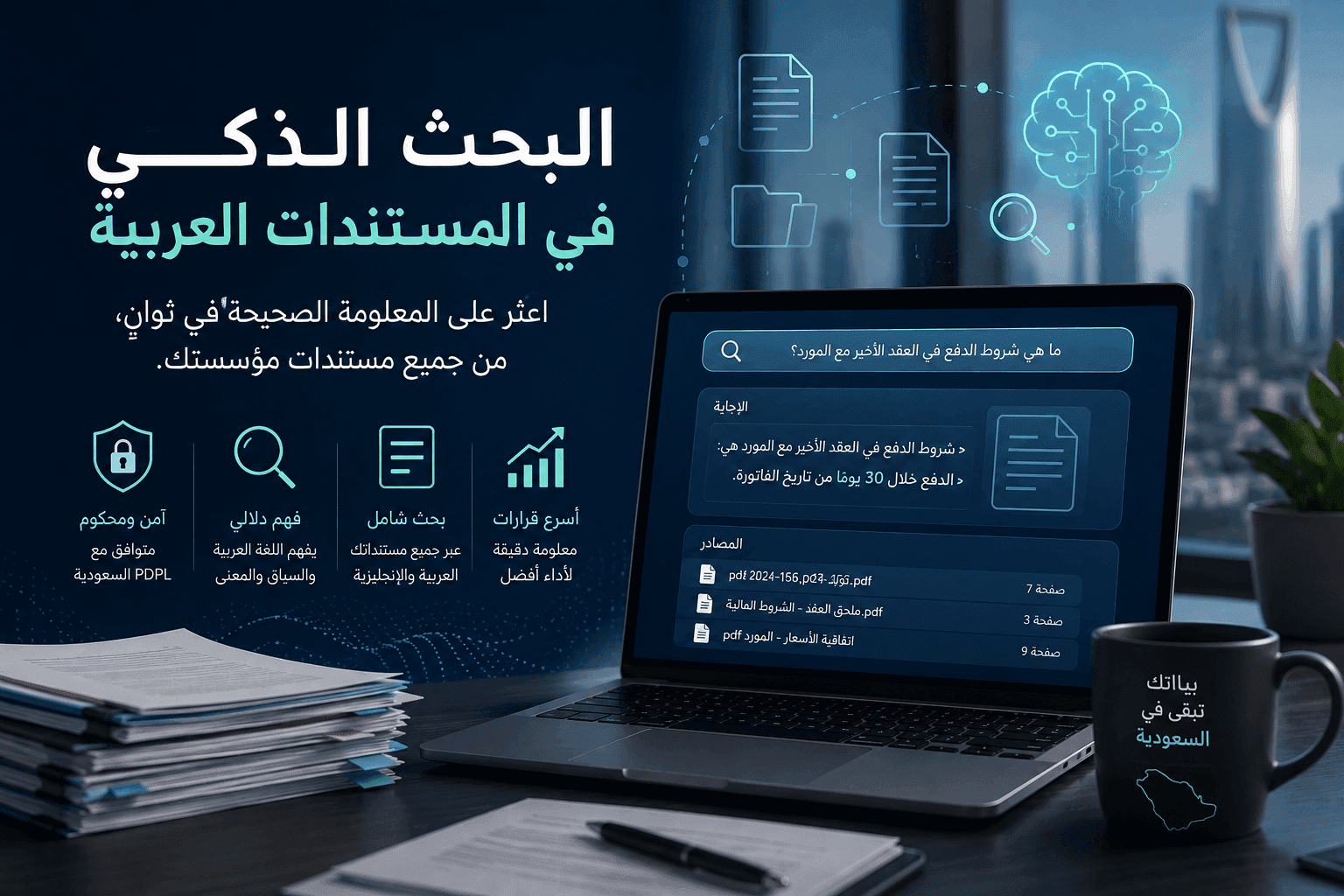
Arabic documents are at the heart of many Saudi enterprises. Contracts, RFQs, board minutes, policies, invoices, technical specifications, and operational reports contain information teams need every day.
Yet finding that information can still be surprisingly difficult.
Many organizations rely on shared drives, email threads, folders, and legacy document-management systems. Employees may spend hours searching for a specific clause, policy requirement, supplier detail, or historical decision.
The result is more than wasted time. Slow document retrieval can contribute to delayed decisions, missed contractual requirements, inconsistent customer responses, and increased compliance risk.
The problem becomes even more complex when organizations try to apply generic search tools to Arabic content.
Why Do Traditional Search Tools Struggle With Arabic Documents?
Traditional document search often relies heavily on keyword matching. This approach can work reasonably well when users search for an exact word, but it becomes less effective when Arabic words appear in different forms.
Arabic has a rich morphological structure, and the same concept can appear through different word forms. For example, a search for "عقد" may not produce the same results as searches involving "العقود", "تعاقد", or "التعاقدات" unless the search system understands the linguistic relationship between these terms.
Other challenges can include:
- Right-to-left text processing.
- Arabic spelling variations.
- Diacritics and normalization.
- Morphological variations.
- Mixed Arabic and English documents.
- Scanned documents requiring OCR.
- Tables and complex document layouts.
- Poorly structured metadata.
- Queries that require information from multiple documents.
This is why simply adding a conventional search box to an enterprise document repository may not provide the experience users expect from modern AI search.
What Is Arabic Document AI Search?
Arabic document AI search uses artificial intelligence to understand what a user is asking and retrieve relevant information from enterprise documents.
Instead of requiring the employee to identify the exact keyword used in a document, an AI-powered search system can interpret the meaning of the question and retrieve relevant passages.
For example, an employee could ask:
"ما هي شروط الدفع المتفق عليها مع هذا المورد؟"
The system can search relevant contracts and supporting documents, identify the sections discussing payment terms, and provide an answer based on the retrieved sources.
This approach can be particularly valuable when employees need to search large collections of contracts, policies, RFQs, reports, and other business documents.
How Does Arabic RAG Improve Enterprise Document Search?
Retrieval-Augmented Generation (RAG) combines information retrieval with generative AI.
Rather than relying only on what a language model learned during training, an enterprise RAG system retrieves relevant information from an organization's approved knowledge sources and uses that information to generate an answer.
For Arabic document search, this can provide several advantages.
1. Search by Meaning
Users can ask questions naturally instead of guessing the exact terminology used in a document.
2. Better Arabic Understanding
The system can be evaluated for Arabic language patterns, terminology, spelling variations, and the specific vocabulary used by the organization.
3. Source-Grounded Answers
The answer can be based on retrieved passages from the organization's documents rather than generated without reference to the source material.
4. Multi-Document Retrieval
Some questions cannot be answered from one document.
For example, a procurement employee may need to compare the original contract with later amendments and supplier documentation. An effective RAG workflow can retrieve information across multiple relevant sources.
How Does PDPL Affect Arabic AI Document Search?
Enterprise document repositories can contain personal and confidential information. This makes data protection an important consideration when implementing AI-powered document search.
Organizations should assess their specific processing activities against the Saudi Personal Data Protection Law (PDPL) and applicable requirements.
A governed AI document-search architecture can support privacy and security through controls such as:
- Role-based access.
- Permission-aware retrieval.
- Data minimization.
- Controlled data sources.
- Audit logging.
- Human approval for sensitive actions.
- Appropriate data retention policies.
- Secure processing and storage.
For example, an employee searching for supplier performance should only receive information they are authorized to access. The AI system should not bypass the organization's existing document permissions simply because a user asks a question.
This principle is critical: AI search should respect enterprise access controls rather than create a new path around them.
PDPL compliance depends on the organization's data, processing activities, technical architecture, contracts, and applicable legal requirements. Therefore, compliance should be assessed as part of the overall implementation rather than treated as a feature that automatically comes with an AI search product.
What Does a Governed Arabic Document Search System Look Like?
Enterprise AI search should not operate as an unrestricted system with access to every document.
A governed Arabic document search system applies controls around what the AI can access and how it can use retrieved information.
A practical architecture can include:
Read-Only-First Access
The AI agent retrieves information without automatically changing or deleting source documents.
Permission-Aware Retrieval
The system respects user roles and document permissions when determining which content can be retrieved.
Human-in-the-Loop Controls
Sensitive actions, such as exporting, sharing, or updating records, can require human approval.
Audit Trails
Important queries, retrievals, and actions can be recorded to support monitoring, troubleshooting, and internal reviews.
These controls help organizations use AI search while maintaining accountability and visibility.
What Does an Arabic Document Search Pilot Deliver?
A fixed-scope pilot is often a practical way to test AI document search before expanding it across the organization.
Instead of indexing every document from day one, an enterprise can begin with a high-value document collection such as:
- Contract repositories.
- RFQ archives.
- Procurement documents.
- Company policies.
- Technical documentation.
- Product specifications.
- Customer-service knowledge bases.
The pilot can then be evaluated against clearly defined KPIs.
Useful Pilot KPIs
Time-to-Find (TTF): How long does it take an employee to locate the required information?
Answer Accuracy: Does the system provide the correct answer based on the available documents?
Retrieval Relevance: Are the retrieved passages actually relevant to the user's question?
Groundedness: Can the generated answer be supported by the retrieved source material?
User Satisfaction: Do employees find the new search experience easier and more useful than the existing process?
A pilot should use real questions from employees rather than artificial demonstration queries.
How Do You Evaluate Arabic Document Search Quality?
Arabic AI search should be tested with the language employees actually use.
A strong evaluation dataset can include:
- Modern Standard Arabic.
- Common spelling variations.
- Arabic-English mixed queries.
- Industry-specific terminology.
- Abbreviations.
- Typos.
- Questions requiring multiple documents.
- Questions about contracts and amendments.
- Questions requiring contextual understanding.
For example, a user might search for:
"شروط الدفع للمورد"
while another might ask:
"متى يتم سداد مستحقات المورد؟"
A strong search system should understand that these questions can relate to the same underlying information.
Evaluation should combine automated metrics with human review.
Automated evaluation can assess retrieval relevance and answer grounding, while human reviewers can determine whether the answer is accurate, complete, understandable, and appropriate for the business context.
What Role Does Arabic OCR Play in Document Search?
Not every enterprise document is digitally searchable.
Organizations often have scanned contracts, PDFs, archived reports, and other image-based documents. These files require Optical Character Recognition (OCR) before their content can be indexed and searched.
Arabic OCR can introduce additional challenges, including:
- Incorrect character recognition.
- Problems with diacritics.
- Complex layouts.
- Tables.
- Mixed Arabic and English text.
- Low-quality scans.
For this reason, document ingestion should include quality checks.
Critical documents should be validated when OCR quality is uncertain, particularly when a search result could influence a legal, financial, procurement, or compliance decision.
What Are the Most Common Mistakes in Arabic AI Document Search?
Mistake 1: Treating Arabic Like English
A solution that performs well in English does not automatically provide the same quality in Arabic.
Test the system using real Arabic documents and real employee queries.
Mistake 2: Ignoring Access Control
AI search should never become a shortcut around existing permissions.
Make sure retrieval respects user roles and document-level access requirements.
Mistake 3: Assuming OCR Is Perfect
Poor OCR can create poor search results. Include document-quality validation in the ingestion process.
Mistake 4: Measuring Only Demo Quality
A system may perform well during a demonstration but struggle with real enterprise queries.
Evaluate it against a representative dataset before scaling.
Mistake 5: Allowing Unrestricted AI Actions
Document search should generally begin with controlled, read-only access. Any action that modifies, exports, or shares information should follow appropriate authorization and approval workflows.
How Can Saudi Enterprises Get Started With Arabic AI Document Search?
The best starting point is usually a focused, high-value document collection.
Choose documents that employees search frequently and where faster information retrieval could produce measurable value.
For example, a procurement team could start with its Arabic contract repository.
The organization can then:
- Identify the most common search questions.
- Select and classify the relevant documents.
- Map access permissions.
- Prepare and validate document ingestion.
- Configure Arabic retrieval and RAG.
- Establish evaluation criteria.
- Test with real users.
- Measure the results.
- Refine the system.
- Decide whether to scale.
This approach reduces implementation risk and creates measurable evidence before a wider rollout.
How OpsRAG Supports Arabic Enterprise Document Search
LeenAI's OpsRAG is designed around enterprise knowledge retrieval using a governed AI approach.
It can support Arabic and English document search, allowing employees to interact with organizational knowledge using natural-language questions.
The focus is not simply on finding documents. The goal is to retrieve relevant information from approved enterprise sources and provide useful answers while maintaining appropriate governance controls.
For organizations with large Arabic and bilingual document repositories, this can create a more practical alternative to manually searching folders, shared drives, and long PDF files.
Why Arabic AI Document Search Matters for Saudi Enterprises
Arabic document search is becoming increasingly important as Saudi organizations generate and manage larger volumes of Arabic and bilingual business information.
The challenge is not simply storing these documents. It is making their information accessible when employees need it.
AI-powered document search can help organizations move from:
"Which folder contains this document?"
to:
"What do our documents say about this issue?"
That shift can reduce information-search time, improve access to institutional knowledge, and help employees make decisions using the information already available inside the organization.
The most effective approach combines Arabic language understanding, RAG, enterprise search, access controls, document governance, OCR quality, and measurable evaluation.
Frequently Asked Questions About Arabic Document AI Search
What is Arabic document search?
Arabic document search is the process of finding information within Arabic-language documents such as contracts, policies, reports, and RFQs. AI-powered solutions can go beyond exact keyword matching by understanding the meaning and context of user queries.
Why does traditional search struggle with Arabic?
Traditional keyword search can struggle with Arabic because of morphological variations, spelling differences, diacritics, right-to-left text, OCR quality, and differences between the terminology used in a query and the wording used in a document.
What is Arabic RAG?
Arabic RAG, or Retrieval-Augmented Generation, combines information retrieval with generative AI to retrieve relevant information from Arabic documents and use those sources to generate an answer to the user's question.
Can AI search Arabic PDF documents?
Yes. AI document-search systems can search digitally generated Arabic PDFs and, with an appropriate OCR pipeline, scanned PDF documents. The quality depends on document structure, OCR accuracy, indexing, and the retrieval technology used.
Can Arabic AI search understand different word forms?
A properly designed Arabic search system can be evaluated for its ability to understand related word forms and linguistic variations. This can make semantic search more effective than relying only on exact keyword matching.
Is Arabic AI document search suitable for Saudi enterprises?
Yes. It can be useful for organizations that manage large collections of Arabic or bilingual contracts, policies, procurement documents, reports, and operational records.
How does AI document search protect sensitive information?
Enterprise AI search can use permission-aware retrieval, role-based access controls, data minimization, audit logs, and controlled data sources to reduce the risk of unauthorized information exposure.
Does Arabic AI document search automatically comply with PDPL?
No. Using an AI search system does not automatically make an organization compliant with PDPL. Compliance depends on the organization's specific data-processing activities, architecture, controls, contracts, and applicable requirements.
What is the difference between keyword search and semantic search?
Keyword search primarily looks for matching words or phrases. Semantic search attempts to understand the meaning behind a query and retrieve information that is conceptually relevant even when the exact words differ.
How can companies measure Arabic AI search performance?
Companies can measure performance using metrics such as Time-to-Find (TTF), retrieval relevance, answer accuracy, answer groundedness, user satisfaction, and task completion time.
How long does an Arabic AI document-search pilot take?
The timeline depends on document volume, data quality, integrations, security requirements, and the selected use case. A focused pilot can be used to test a defined document collection and measure results before scaling.
Start Your Arabic AI Document Search Pilot
If your teams are spending too much time searching through Arabic contracts, policies, RFQs, and reports, a focused AI document-search pilot can help you determine whether semantic retrieval and Arabic RAG can deliver measurable value.
Start with a small, high-value document collection, define your KPIs, test the system with real employee queries, and evaluate the results before expanding.
LeenAI can help organizations explore governed AI-powered document search through OpsRAG and a fixed-scope pilot approach.
See how LeenAI scopes AI pilots or talk to the team to discuss your Arabic document-search requirements.