
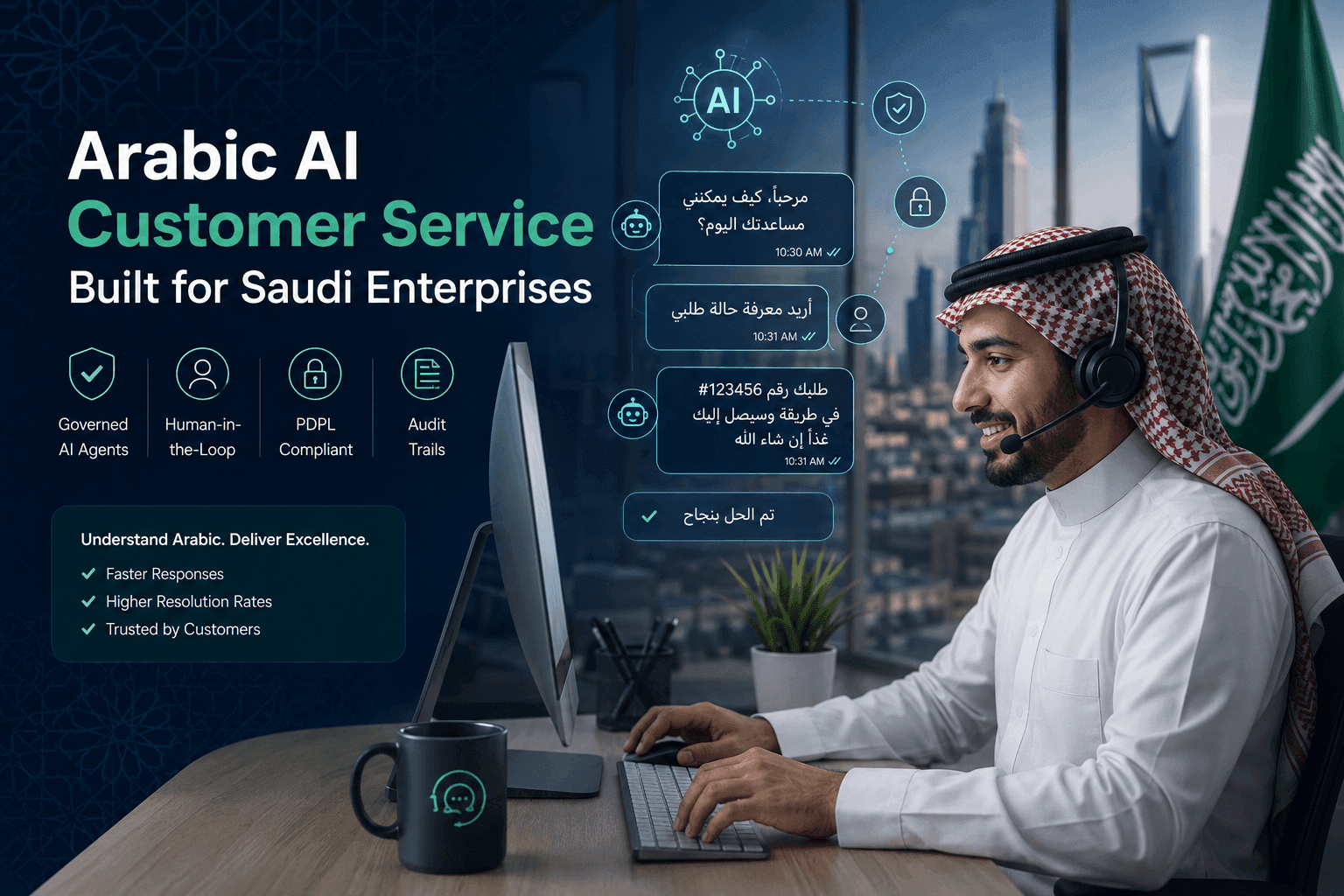
For Saudi enterprises, customer service in Arabic is more than a language preference. It is an important part of delivering a localized customer experience in a market where digital expectations continue to rise.
As organizations across Saudi Arabia accelerate digital transformation, customers increasingly expect fast, accurate, and convenient support across the channels they already use. WhatsApp, websites, mobile applications, and other digital channels are becoming essential touchpoints.
However, deploying Arabic AI customer service is not simply a matter of adding a chatbot. Arabic presents unique challenges, including dialect variations, context, terminology, and bilingual business environments. Enterprises also need to consider data protection, access controls, human oversight, and regulatory requirements such as the Saudi Personal Data Protection Law (PDPL).
This is where governed AI agents become valuable. Instead of operating without boundaries, a governed AI agent can retrieve information, respond to routine customer requests, and support service teams while operating within predefined permissions and escalation rules.
The result can be faster responses, improved resolution rates, lower handling times, and a customer experience that feels genuinely local.
What Makes Arabic AI Customer Service Different?
Arabic customer service requires more than translating an existing English chatbot.
Customers may use Modern Standard Arabic, regional expressions, abbreviations, spelling variations, or a mixture of Arabic and English in the same conversation. A customer might also describe the same product, service, or issue using different terms.
For an AI customer service system to be useful, it should be able to understand these variations and connect the customer's question with the correct information in the organization's knowledge base.
For example, a customer asking:
"وين طلبي؟"
may be looking for the same information as someone asking:
"ما حالة طلب الشراء الخاص بي؟"
A capable Arabic AI agent should understand the intent behind both requests and retrieve the appropriate order information.
This makes Arabic natural language processing, knowledge retrieval, and contextual understanding important components of enterprise customer service.
Why a Generic Chatbot Is Not Enough for Saudi Enterprises
Traditional chatbots generally depend on predefined rules, keywords, and conversation flows. They can be effective for simple scenarios but often struggle when customers ask questions outside those predefined paths.
An AI agent can provide a more flexible approach.
Instead of simply matching a question to a scripted response, an enterprise AI agent can:
- Understand natural-language customer questions.
- Retrieve information from approved company sources.
- Use context from the conversation.
- Respond in Arabic or English.
- Escalate complex requests to human representatives.
- Operate within defined permissions.
- Maintain records of relevant actions and interactions.
This does not mean giving the AI unrestricted access to enterprise systems. In a regulated environment, the opposite is usually more appropriate: give the agent only the access it needs to perform its task.
What Does a Governed AI Agent Mean?
Governance is one of the most important differences between an enterprise AI agent and a basic chatbot.
A governed AI agent is designed to operate within clearly defined controls covering access, actions, approvals, and monitoring.
Three principles are particularly important.
Read-Only-First Access
The agent can retrieve information from approved systems without automatically modifying or deleting business data.
For example, a customer service agent could retrieve:
- Order status.
- Product information.
- Warranty policies.
- Delivery information.
- Return policies.
But changing an order, issuing a refund, or modifying a customer record could require additional authorization.
Human-in-the-Loop Oversight
Not every customer request has the same level of risk.
Routine questions can potentially be handled automatically, while sensitive actions can be escalated to a human employee.
For example, an AI agent may prepare a refund request based on the company's policy, but a human representative can review and approve the final action.
This approach combines automation with human accountability.
Audit Trails
Enterprise AI systems should provide visibility into important interactions and actions.
Audit logs can help organizations understand:
- What information the agent accessed.
- What response it generated.
- Which actions it attempted.
- When an action occurred.
- When a request was escalated to a human.
This visibility is important for internal governance, troubleshooting, and compliance processes.
How Can Arabic AI Customer Service Support PDPL Requirements?
Customer service systems often process personal information, including customer names, contact details, order information, account information, and conversation history.
For this reason, privacy and data protection should be considered during the design of an AI customer service solution rather than added later.
Important considerations can include:
Access Control
The AI agent should only access information that is necessary for the task and permitted by the organization's access policies.
Data Minimization
The system should avoid exposing or processing unnecessary customer information when resolving a request.
Data Processing and Storage
Organizations should evaluate where customer data is processed and stored and whether the architecture aligns with applicable Saudi requirements and internal policies.
Auditability
Relevant access and system activities should be recorded where appropriate so organizations can review how information is being used.
Human Approval
Sensitive actions can be routed to authorized employees instead of allowing the AI agent to execute them automatically.
PDPL compliance is ultimately dependent on the organization's specific data, processing activities, architecture, and legal requirements. Therefore, AI customer service should be designed with privacy and governance principles from the beginning.
What Customer Service Tasks Can Arabic AI Agents Automate?
Arabic AI customer service can support a wide range of repetitive customer interactions.
Order and Delivery Questions
Customers can ask about order status, delivery information, or expected fulfillment dates, while the agent retrieves the relevant information from approved systems.
Product and Service Questions
The agent can retrieve information from product catalogs, service documentation, FAQs, and knowledge bases.
Return and Warranty Policies
Routine questions about returns, exchanges, and warranties can potentially be answered automatically when the relevant policies are available in the organization's knowledge base.
Frequently Asked Questions
Common questions can be handled without requiring a customer service representative to respond manually to every interaction.
Human Escalation
When a request involves a complaint, exception, refund, sensitive account information, or another high-risk scenario, the agent can route the conversation to a human representative.
The objective is not to remove humans from customer service. It is to allow human teams to spend more time on cases that require judgment and less time answering repetitive questions.
What Metrics Should You Use to Measure Arabic AI Customer Service?
AI customer service should be evaluated using measurable business outcomes rather than the number of conversations handled alone.
Three useful metrics include:
First-Contact Resolution (FCR)
FCR measures how often customer issues are resolved during the first interaction without requiring additional follow-up.
A well-designed Arabic AI agent can improve FCR by giving customers and service representatives faster access to accurate information.
Average Handling Time (AHT)
AHT measures the average amount of time spent handling a customer interaction.
AI can reduce AHT by retrieving information automatically and providing customer service teams with relevant answers faster.
Time-to-Quote (TTQ)
For businesses where customer interactions include quotations, TTQ measures how quickly a customer receives a quote or pricing response.
An AI agent connected to approved product and pricing information can help reduce the time required to prepare routine quotations.
Other useful metrics include:
- Customer Satisfaction (CSAT).
- Response time.
- Escalation rate.
- Resolution accuracy.
- Automation rate.
- Agent productivity.
The most important step is to establish a baseline before deployment and compare performance after the AI agent is introduced.
How Should You Choose an Arabic AI Customer Service Solution?
Not every AI customer service solution is suitable for an enterprise environment.
When evaluating vendors, consider the following:
Arabic Language Capability
Can the system understand Modern Standard Arabic, common variations, spelling differences, and the language patterns used by your customers?
Bilingual Support
If your organization operates in both Arabic and English, the AI agent should be able to support both languages without creating separate customer experiences.
Enterprise Integrations
The solution should be able to connect with the systems that contain the information needed to resolve customer requests, such as CRM, ERP, order management systems, and knowledge bases.
Governance
Look for controls such as:
- Read-only-first access.
- Human-in-the-loop workflows.
- Role-based permissions.
- Audit logs.
- Escalation rules.
Security and Data Protection
Evaluate how the solution handles customer information, where data is processed, and how access and retention are controlled.
Measurement and Evaluation
A strong solution should allow the organization to test performance against real customer questions and predefined acceptance criteria.
What Does a Six-Week AI Customer Service Pilot Look Like?
A fixed-scope pilot can be a practical way for an enterprise to evaluate Arabic AI customer service before committing to a large-scale deployment.
Instead of attempting to automate every customer interaction, the organization selects one specific use case.
For example:
Pilot: Automate routine WhatsApp customer inquiries.
The process can include:
- Define the use case and target KPIs.
- Connect approved knowledge sources and systems.
- Configure the Arabic AI agent and governance controls.
- Test the agent using real customer-service scenarios.
- Conduct user acceptance testing (UAT).
- Measure FCR, AHT, response quality, and escalation rates.
- Refine the system based on evaluation results.
- Decide whether to expand the deployment.
This approach provides evidence before a wider rollout and helps identify integration, language, governance, or data-quality issues early.
How LeenAI Approaches Arabic AI Customer Service
LeenAI provides governed AI agents designed for enterprise workflows, including WhatsApp CX for customer service, SmartQuote for RFQ-to-quote automation, OpsRAG for enterprise knowledge retrieval, and MAE for executive decision support.
For Arabic customer service, the focus is not simply on generating Arabic responses. The objective is to combine bilingual interaction with enterprise knowledge retrieval, controlled access, human escalation, and measurable performance.
For organizations that need Arabic and English support, this approach can help connect customer conversations with approved business information while maintaining appropriate governance controls.
Why Arabic AI Customer Service Is a Strategic Advantage
For Saudi enterprises, Arabic AI customer service can become more than an automation project.
It can help organizations deliver:
- Faster customer responses.
- More consistent answers.
- Better access to enterprise knowledge.
- Reduced workload for customer service teams.
- Improved first-contact resolution.
- Lower average handling time.
- Bilingual customer experiences.
- More controlled AI adoption.
The key is to avoid treating AI customer service as a standalone chatbot project.
Successful enterprise deployment requires the combination of Arabic language capability, reliable knowledge retrieval, system integration, governance, data protection, human oversight, and measurable KPIs.
Ready to Start With Arabic AI Customer Service?
Arabic AI customer service can give Saudi enterprises a practical way to improve customer experience while maintaining the controls required for enterprise environments.
Rather than starting with a large, open-ended AI transformation project, begin with a focused use case, define measurable acceptance criteria, and test the solution using real customer-service scenarios.
LeenAI can help organizations evaluate governed AI agents for customer service and other enterprise workflows.
Explore LeenAI's pricing and pilot options or talk to our team to discuss how an Arabic AI customer service pilot could fit your organization.