
Extract structured facts, not summaries
Per-call output is JSON with typed fields. A summary is cheap to generate; structured facts are what make scoring and trend analysis possible.
Watches the sales pipeline, listens to call recordings and email threads, and surfaces at-risk deals before the rep notices.
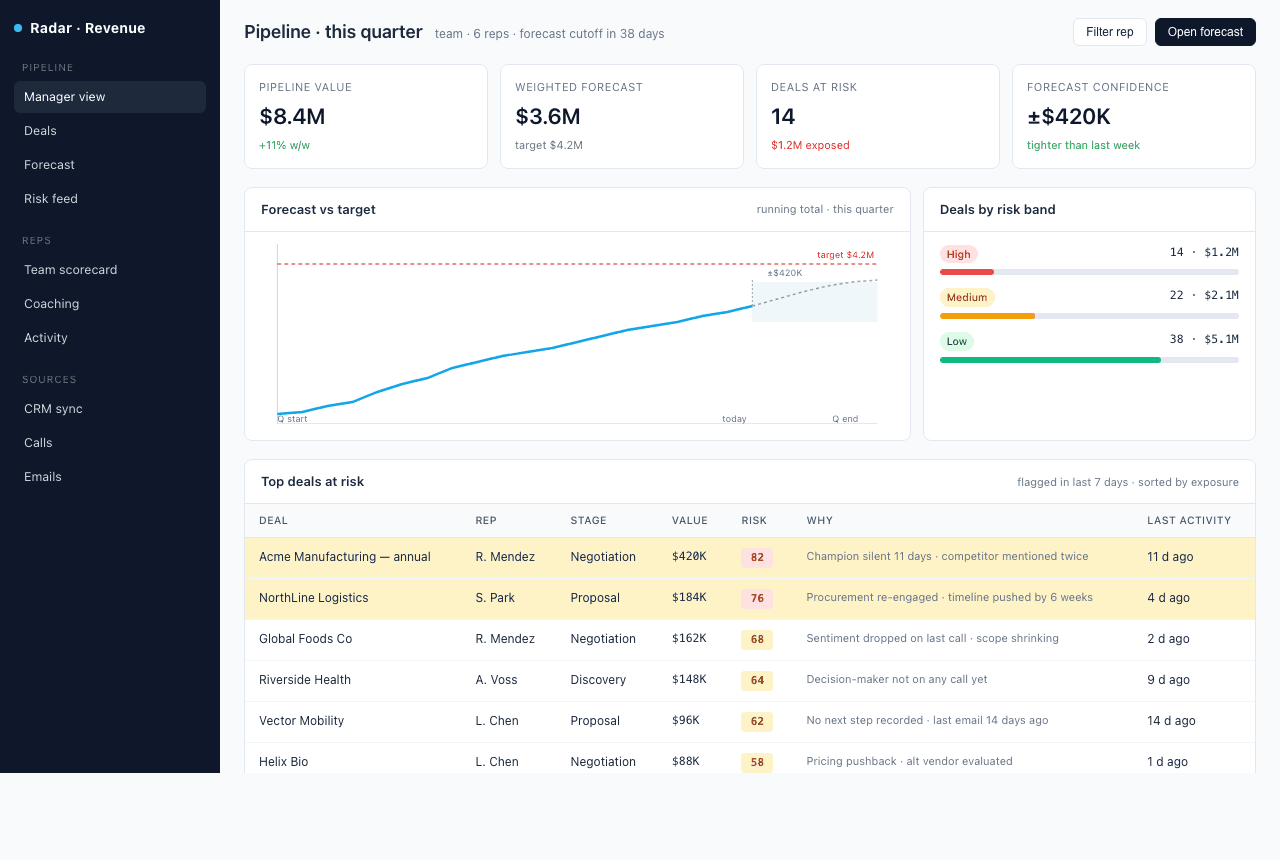
Pulls deal data from the CRM and call recordings (auto-transcribed) and email threads tied to each deal. Runs each conversation through an LLM that extracts: stated next step, sentiment shift, raised objections, decision-maker presence, mentioned competitors. Combines those signals with deal-stage history to score risk. Output: a daily "deals at risk" view per rep, per manager, per region — each flagged deal with a one-paragraph "why" and a suggested next action. Also produces a quarterly forecast number with a confidence interval.
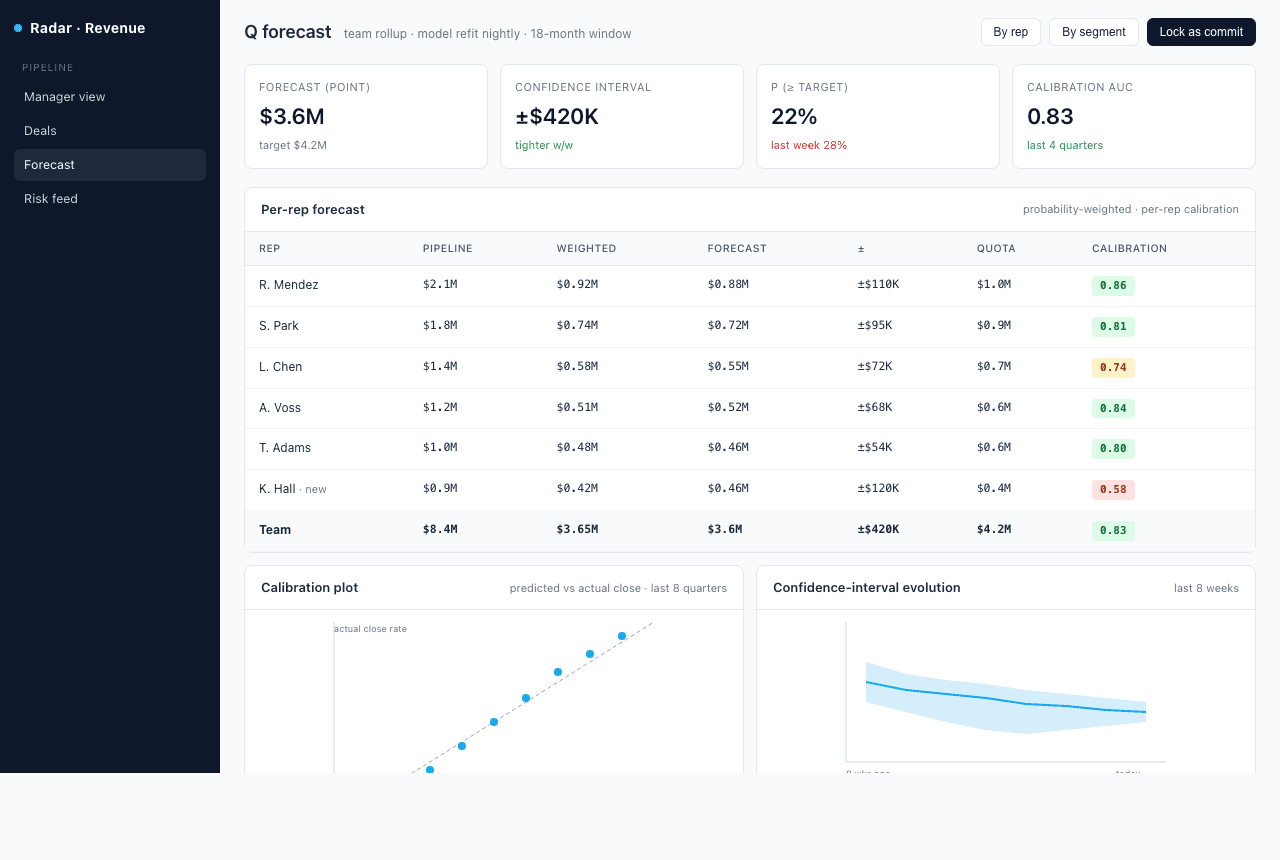
Before: pipeline reviews were rep self-reporting (reps are optimistic about their own deals). Managers found out a deal was lost when the customer stopped responding. Forecasts were vibes with no calibration. Coaching opportunities (a rep mishandling the same objection across multiple calls) were invisible. After: managers walk into reviews knowing which deals are quietly cooling, with evidence. Forecast accuracy improved measurably — the calibration plot tightened around the diagonal.
Pulls deals, contacts, activities, stage history. Upserts into the local pipeline store.
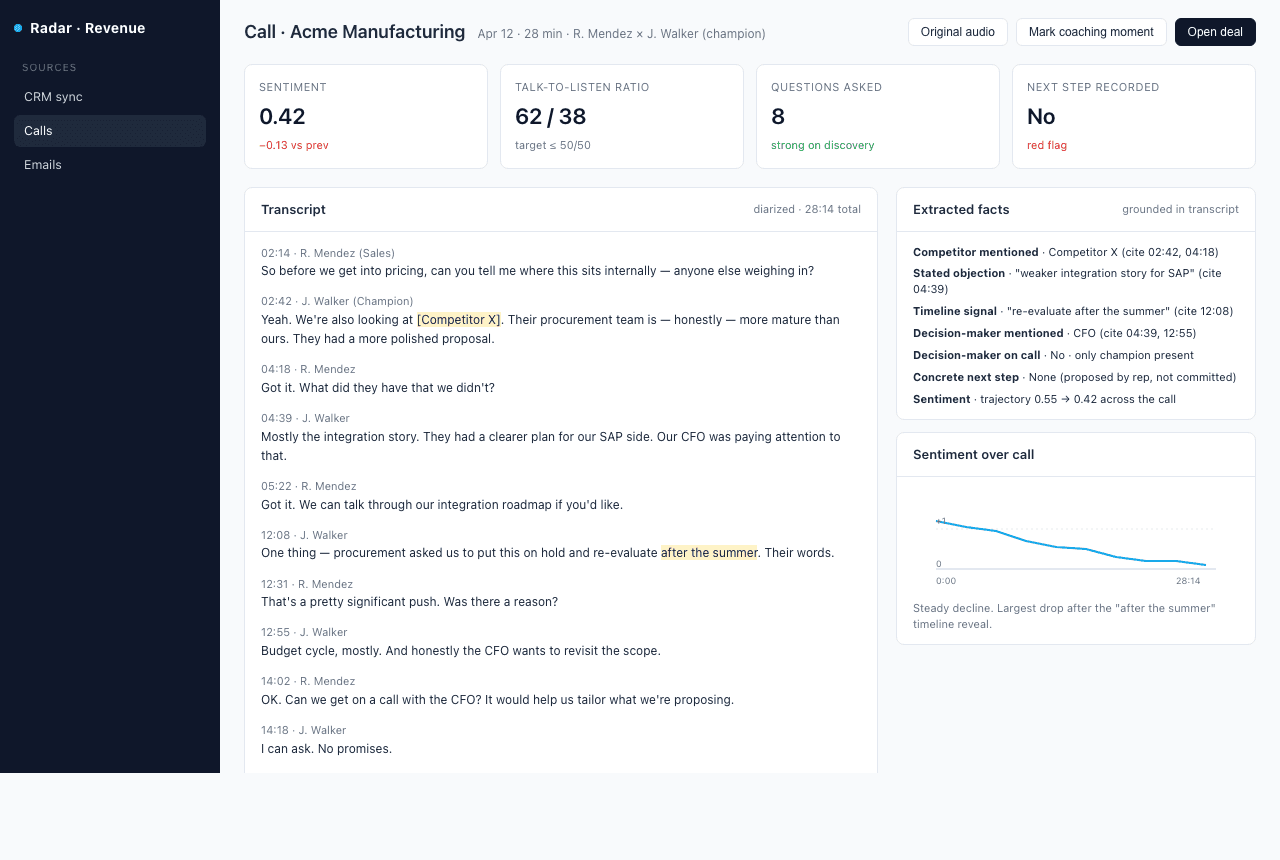
Telephony provider pushes recordings. Transcribe (Whisper-class), diarize speakers (rep vs prospect), enrich with deal context.
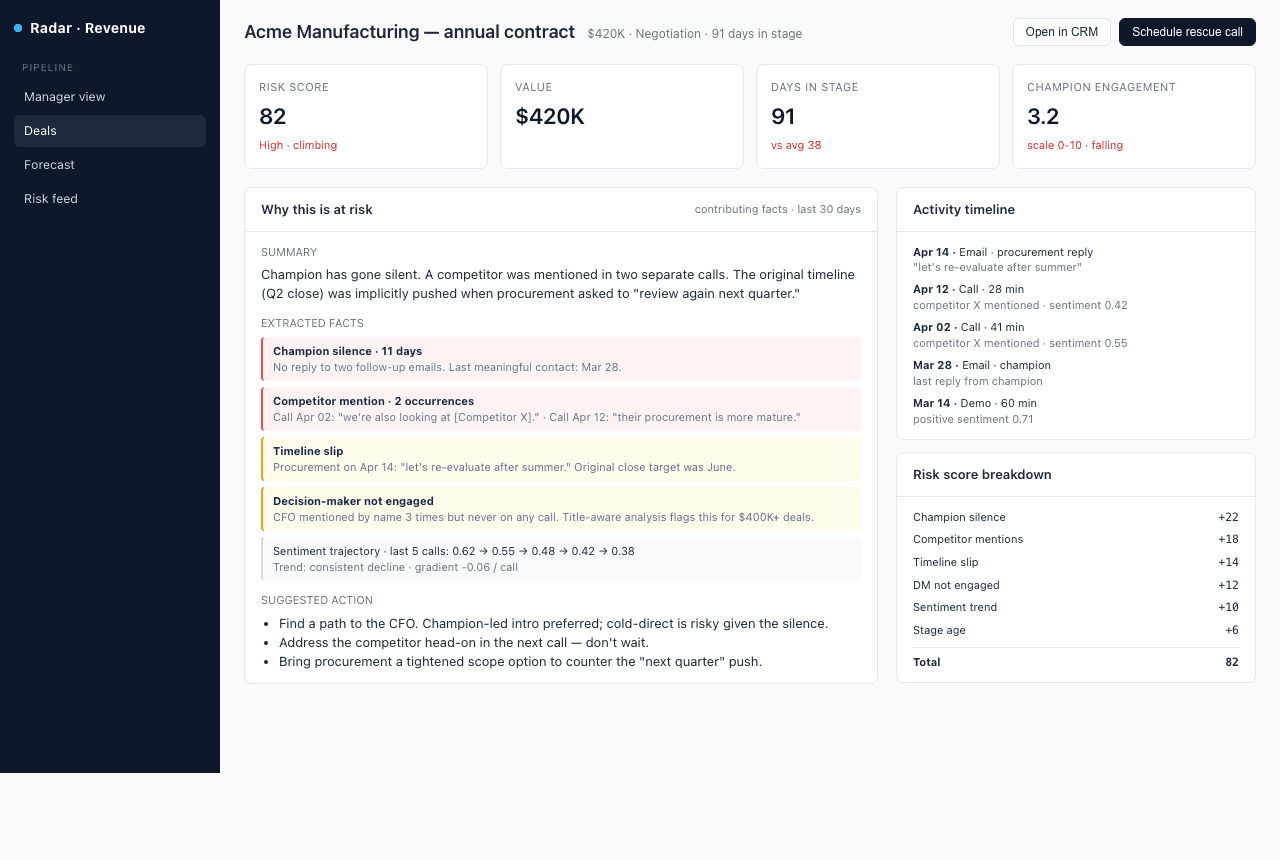
LLM extracts structured facts: stated next step, sentiment trajectory, objections, decision-makers mentioned, competitors, timeline signals, red flags (silence, deflection, scope creep).
Aggregate facts across all activities for the deal. Compare to deal-stage expectations (what signals should be present at this stage). Compute risk 0-100 with a human-readable reason.
Daily "deals at risk" per rep. Weekly coaching opportunities flagged when a rep mishandles the same objection multiple times. Quarterly forecast with confidence interval based on call coverage + historical close rates.
CRM sync interval
every 15 min
Forecast frequency
daily + quarterly
Risk score range
0-100, with reason
Signal types extracted
7 per conversation
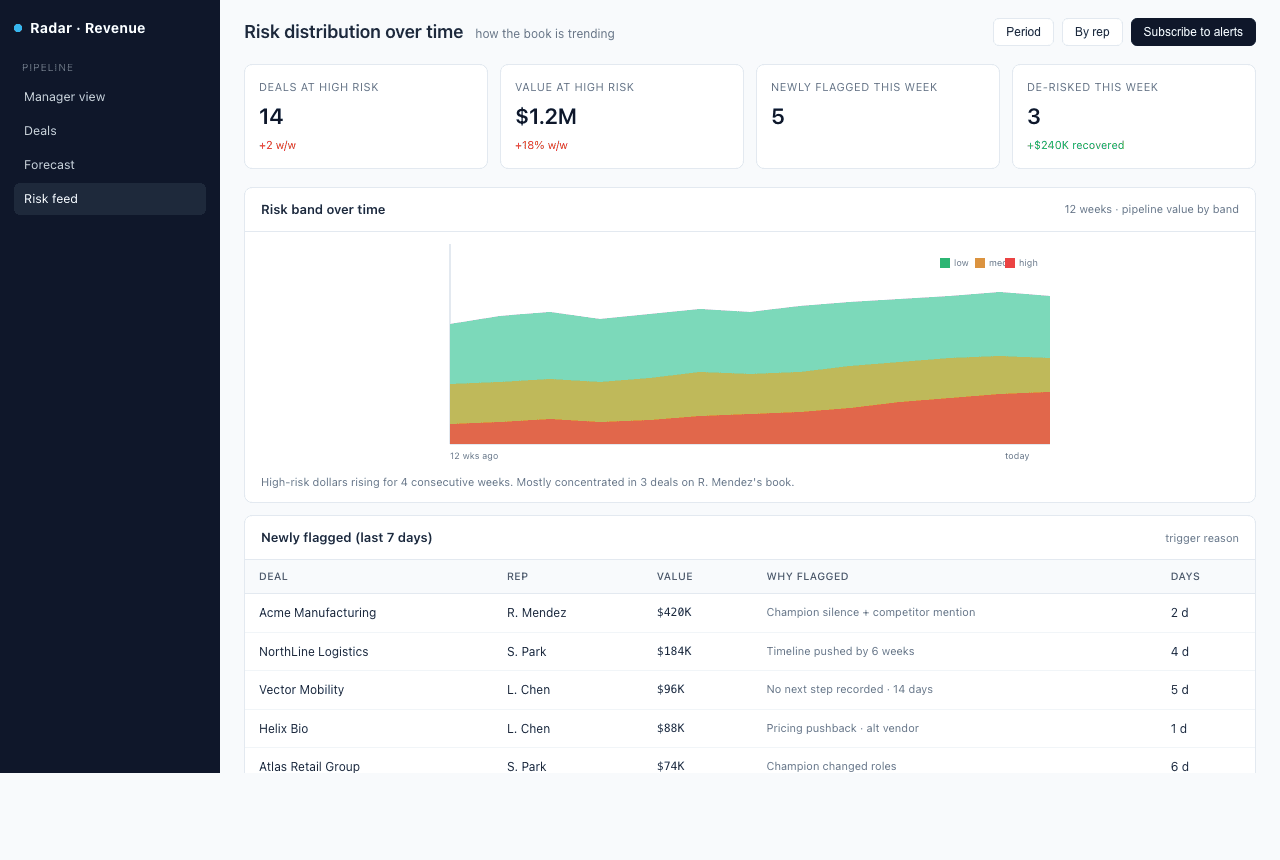
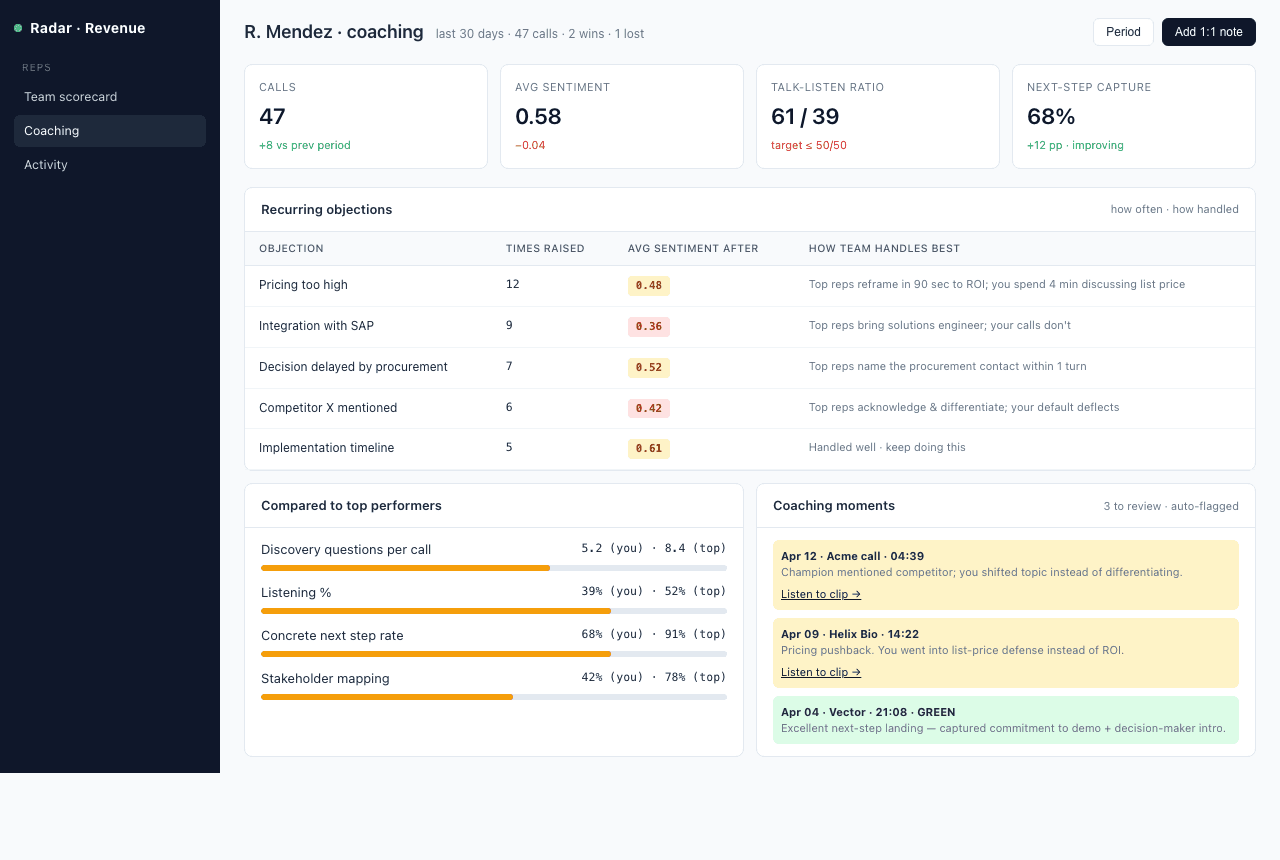
These are not mockups. Every screenshot below is from the system running in production.
For anyone evaluating the system from an engineering angle: why these choices, and what was traded off.
Per-call output is JSON with typed fields. A summary is cheap to generate; structured facts are what make scoring and trend analysis possible.
A deal in "discovery" missing a stated next step is normal. A deal in "verbal commit" missing one is a red flag. Same signal, different weight per stage.
Single-number forecasts are politics. A range + a calibration plot forces honest conversation about what we actually know.
The system surfaces risk; humans decide what to do. AI does not email customers on its own.
When the conversation analyzer keeps flagging the same objection mis-handled by the same rep, that gets surfaced to their manager. Same data, different lens.
Share the workflow and the systems you use today. Within 24 hours we reply with scope, KPIs, timeline, and a SAR estimate.
Start nowWatches the sales pipeline, listens to call recordings and email threads, and surfaces at-risk deals before the rep notices.
Pulls deal data from the CRM and call recordings (auto-transcribed) and email threads tied to each deal. Runs each conversation through an LLM that extracts: stated next step, sentiment shift, raised objections, decision-maker presence, mentioned competitors. Combines those signals with deal-stage history to score risk. Output: a daily "deals at risk" view per rep, per manager, per region — each flagged deal with a one-paragraph "why" and a suggested next action. Also produces a quarterly forecast number with a confidence interval.
Before: pipeline reviews were rep self-reporting (reps are optimistic about their own deals). Managers found out a deal was lost when the customer stopped responding. Forecasts were vibes with no calibration. Coaching opportunities (a rep mishandling the same objection across multiple calls) were invisible. After: managers walk into reviews knowing which deals are quietly cooling, with evidence. Forecast accuracy improved measurably — the calibration plot tightened around the diagonal.
Pulls deals, contacts, activities, stage history. Upserts into the local pipeline store.
Telephony provider pushes recordings. Transcribe (Whisper-class), diarize speakers (rep vs prospect), enrich with deal context.
LLM extracts structured facts: stated next step, sentiment trajectory, objections, decision-makers mentioned, competitors, timeline signals, red flags (silence, deflection, scope creep).
Aggregate facts across all activities for the deal. Compare to deal-stage expectations (what signals should be present at this stage). Compute risk 0-100 with a human-readable reason.
Daily "deals at risk" per rep. Weekly coaching opportunities flagged when a rep mishandles the same objection multiple times. Quarterly forecast with confidence interval based on call coverage + historical close rates.
CRM sync interval
every 15 min
Forecast frequency
daily + quarterly
Risk score range
0-100, with reason
Signal types extracted
7 per conversation
These are not mockups. Every screenshot below is from the system running in production.
For anyone evaluating the system from an engineering angle: why these choices, and what was traded off.
Per-call output is JSON with typed fields. A summary is cheap to generate; structured facts are what make scoring and trend analysis possible.
A deal in "discovery" missing a stated next step is normal. A deal in "verbal commit" missing one is a red flag. Same signal, different weight per stage.
Single-number forecasts are politics. A range + a calibration plot forces honest conversation about what we actually know.
The system surfaces risk; humans decide what to do. AI does not email customers on its own.
When the conversation analyzer keeps flagging the same objection mis-handled by the same rep, that gets surfaced to their manager. Same data, different lens.
Share the workflow and the systems you use today. Within 24 hours we reply with scope, KPIs, timeline, and a SAR estimate.
Start now