Overview
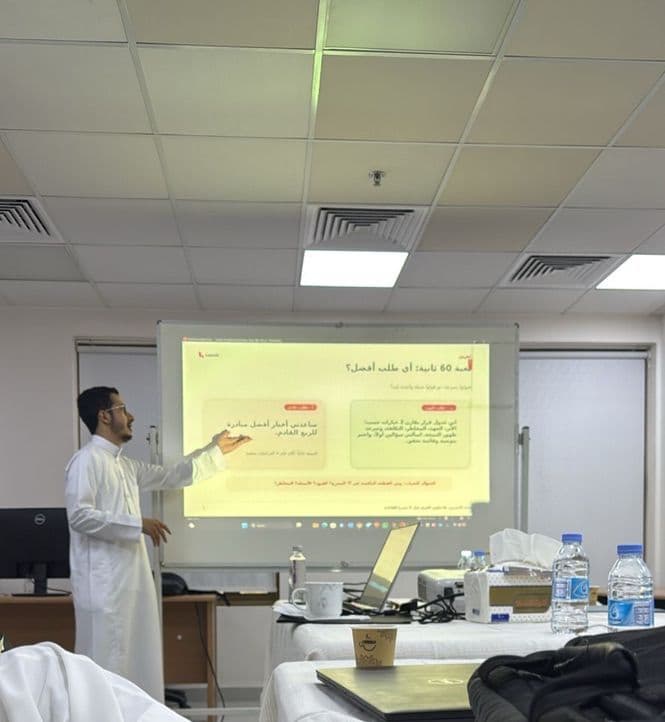
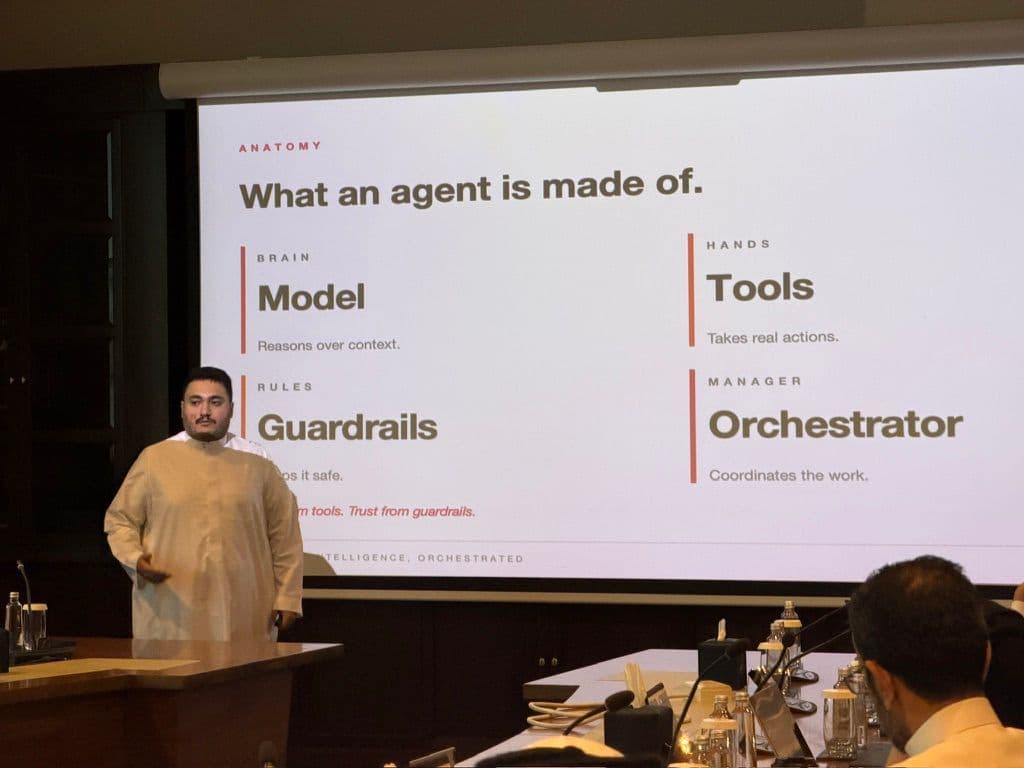
LeenAI delivered a focused session on AI agents for business to the KFUPM Executive MBA class. The session moved past the chatbot framing that most executives are already familiar with and into what agents actually do in production: read, decide, draft, hand back.
The goal was simple — give Saudi executive learners a clear mental model of how AI fits into operations without the buzzwords, and the right questions to ask before approving an AI project.
What the session covered
1. Chatbot vs agent — the real difference
Chatbots answer. Agents do work. Participants walked through concrete cases: a chatbot replies to a customer message, but an agent reads the inbox, classifies the request, opens the catalog, applies pricing rules, and hands the sales rep a finished quote draft. Same starting point, very different ending.
2. Where agents fit in real operations
We mapped the patterns we see across Saudi B2B clients:
- Quotation pipelines — RFQ email in, priced draft out.
- CX on WhatsApp — intent-mapped replies with auditable escalation.
- Document AI — read 800 pages, answer with citations.
- Sales radar — listen to calls, flag the deal that's quietly slipping.
- Recruitment — read 300 CVs, hand the recruiter a ranked shortlist with reasons.
For each, the same shape: the agent does the boring 80%, the human owns the decision.
3. The "human in the loop" rule
This was a deliberate emphasis. None of these systems take final action without a human approving. That's not a limitation — it's the design. We discussed why "agents that act autonomously" is the wrong frame for most enterprise work, and what "supervised autonomy" actually looks like.
4. Questions every executive should ask
Before approving any AI project:
- What workflow are we actually fixing? (Not "we want AI" — what does the agent replace, exactly?)
- What does success look like in numbers? (Time, error rate, throughput.)
- Where is the human approval gate?
- What does the audit trail look like?
- Who owns the failure case?
Most projects that fail in production fail because these were not answered upfront.
5. The Saudi context
We also discussed what's different about deploying agents in Saudi B2B specifically — Arabic-first communication, PDPL-aware data handling, ERP integration realities, and procurement expectations that reward predictability over hype.
Why this matters
Executives don't need to write prompts. They need to know how to evaluate a vendor pitch, how to scope an internal AI initiative, and how to tell whether something is real or theater.
That's what this session was built around.
Looking ahead
LeenAI continues to deliver tailored AI capability sessions for executive programs, leadership teams, and operational managers across Saudi Arabia and the GCC.
If your team would benefit from a similar session — adjusted for your industry and your maturity level — get in touch and we will design one with you.