Why Arabic speech-to-text agents matter for Saudi call centers
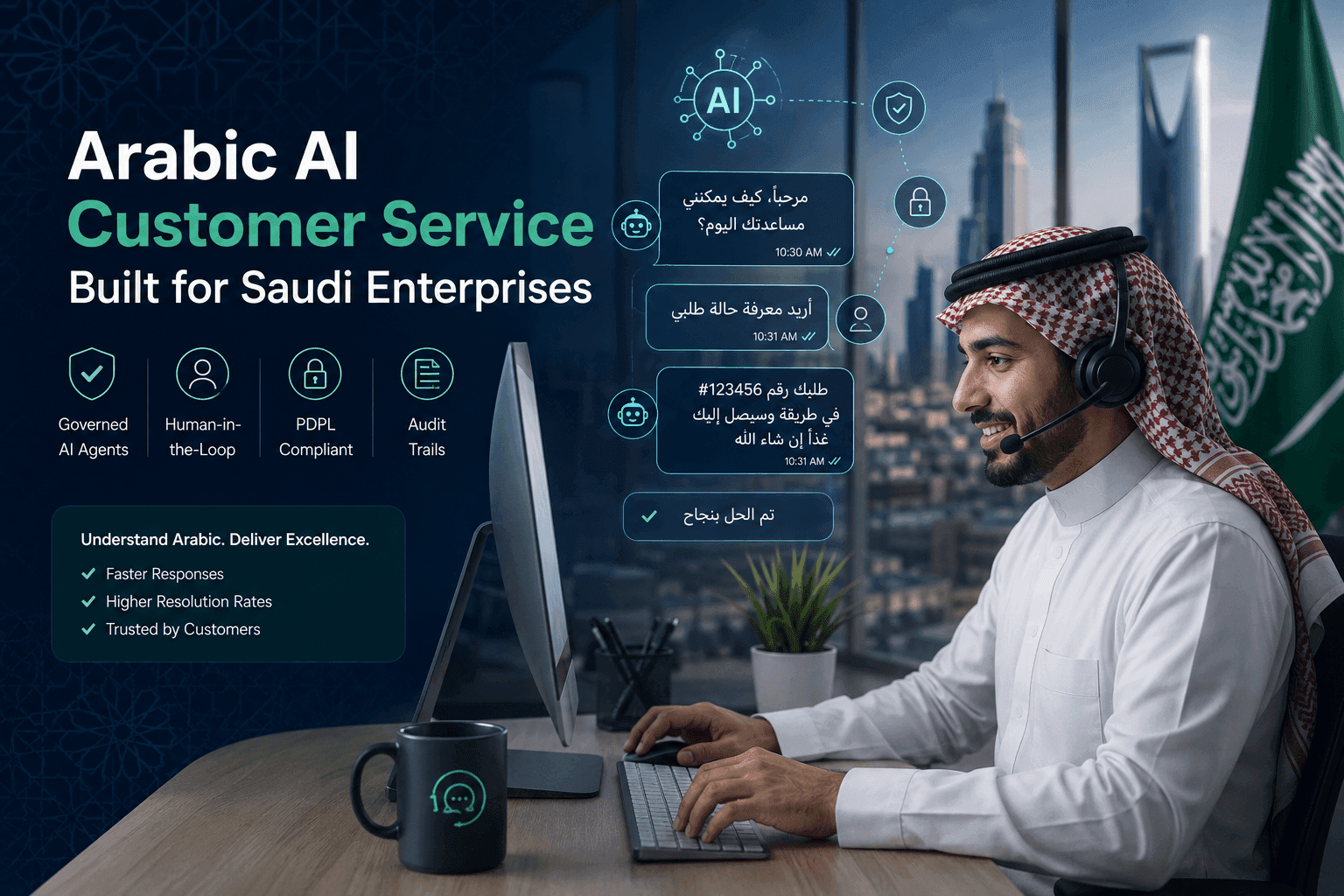
Saudi call centers handle a high volume of Arabic calls across multiple dialects—Najdi, Hijazi, and Gulf—mixed with English technical terms. Traditional speech-to-text (STT) engines often struggle with dialectal variations, code-switching, and domain-specific vocabulary, leading to poor transcription accuracy. This creates a gap in quality assurance, compliance monitoring, and agent training. Arabic speech-to-text agents are AI systems designed to handle these nuances, transcribing calls accurately and enabling downstream analytics. For Saudi enterprises, these agents are not just about automation; they are about unlocking insights from voice data while respecting privacy and governance. With Vision 2030 pushing digital transformation, call centers are under pressure to improve customer experience (CX) and operational efficiency. Arabic STT agents can help by providing real-time agent assistance, automated call scoring, and compliance checks. However, deploying them requires careful planning around data privacy, dialect coverage, and integration with existing systems. LeenAI's approach emphasizes governance-first: read-only-first access, human-in-the-loop, and PDPL-aware data handling. This guide outlines how to evaluate and deploy Arabic STT agents responsibly.
How do Arabic speech-to-text agents handle dialectal variation?
Arabic is a diglossic language with significant differences between Modern Standard Arabic (MSA) and spoken dialects. Call center conversations often mix dialects and English terms, making transcription challenging. Effective Arabic STT agents use acoustic models trained on diverse Saudi dialects and incorporate language models that adapt to code-switching. They also allow for custom vocabulary injection—such as product names or regulatory terms—to improve accuracy. For example, an agent might mishear a local idiom or a brand name; with custom vocabulary, the system can be tuned to recognize these terms. Additionally, agents can be designed to flag low-confidence transcriptions for human review, ensuring that errors are caught before they impact decisions. LeenAI's OpsRAG treats Arabic and English as first-class languages, and its speech-to-text capabilities are built with the same principle: accurate transcription in both languages, with citations and refusal to guess when uncertain. This is crucial for compliance and quality assurance, where mis-transcription could lead to incorrect scoring or missed red flags.
What governance controls are essential for Arabic STT agents?
Governance is non-negotiable when transcribing customer calls, which contain personal data. Under Saudi PDPL, organizations must minimize data collection, ensure data residency, and provide audit trails. Arabic STT agents should be deployed with read-only-first access to call recordings, meaning the system can transcribe but not modify or delete original data. Human-in-the-loop is critical: transcriptions should be reviewed by supervisors before being used for agent evaluation or compliance actions. Role-based access control (RBAC) ensures that only authorized personnel can access transcripts, and audit logs track who accessed what and when. Data minimization means transcribing only the necessary portions of calls and retaining transcripts for a defined period. LeenAI's OpsRAG enforces role-based access during retrieval, provides citations with source links, and does not send personal data to LLM providers for training. These controls are documented before code is written, ensuring that governance is baked in, not bolted on. For call centers, this means you can leverage STT insights without compromising customer trust or regulatory compliance.
How can Arabic STT agents improve call center KPIs?
Arabic STT agents can impact key performance indicators such as average handling time (AHT), first call resolution (FCR), and quality scores. By transcribing calls in real-time, agents can provide live assistance to human agents—suggesting answers or flagging compliance issues. Post-call, automated transcription enables faster quality assurance: supervisors can search transcripts for keywords, score calls against rubrics, and identify training needs. This reduces the manual effort of listening to calls and allows for 100% call coverage instead of sampling. However, it's important to set realistic targets. For instance, a pilot might target a 10% reduction in AHT through real-time assistance, or a 20% improvement in QA efficiency. These are targets, not guarantees. For text channels, the same governed approach powers WhatsApp CX, LeenAI's customer service agent for WhatsApp Business. LeenAI's AI Pilot Projects build one workflow-specific system in 2 to 8 weeks with baseline KPIs, UAT, and an Acceptance Pack. This approach ensures that improvements are measured against a baseline and that the system meets acceptance criteria before scaling. For call centers, a pilot could focus on transcribing a subset of calls and measuring transcription accuracy, QA time savings, and agent satisfaction.
What does a typical Arabic STT pilot look like?
A pilot for Arabic STT agents should start with a clear scope: one use case, such as quality assurance or agent assistance, and a defined set of calls. The pilot should include baseline metrics—current QA time, AHT, FCR—and target improvements. Data readiness is assessed: are calls recorded in good quality? Are there dialect variations? Is there consent for recording? The pilot then deploys the STT agent in read-only mode, transcribing calls and generating insights. Human reviewers validate transcriptions and provide feedback to fine-tune the model. Acceptance criteria are defined upfront: transcription accuracy threshold (e.g., word error rate below a certain percentage), integration with existing QA systems, and compliance with PDPL. LeenAI's AI Consulting helps pick the right workflow and scope the pilot, ensuring that it aligns with business goals and governance requirements. The pilot concludes with an Acceptance Pack documenting results and a go/no-go decision. This structured approach minimizes risk and ensures that the technology delivers value before full-scale deployment.
How does LeenAI support Arabic speech-to-text agents?
LeenAI builds governed AI agents for Saudi enterprises, with a focus on Arabic and English. For call centers, LeenAI's OpsRAG can be extended to include speech-to-text capabilities, providing transcription with citations and do-not-guess behavior. LeenAI's AI Pilot Projects offer a fast, 2-to-8-week path to deploy a workflow-specific STT agent with baseline KPIs and an Acceptance Pack. The customer owns the system and all artifacts, and LeenAI communicates in Arabic or English. To explore how Arabic STT agents can improve your call center, talk to us or see how we scope pilots. Within 24 hours, we reply with scope, timeline, and SAR cost. LeenAI is PDPL-aware and committed to governance-first AI adoption.